
Morocco itinerary: the complete guide for every travel style
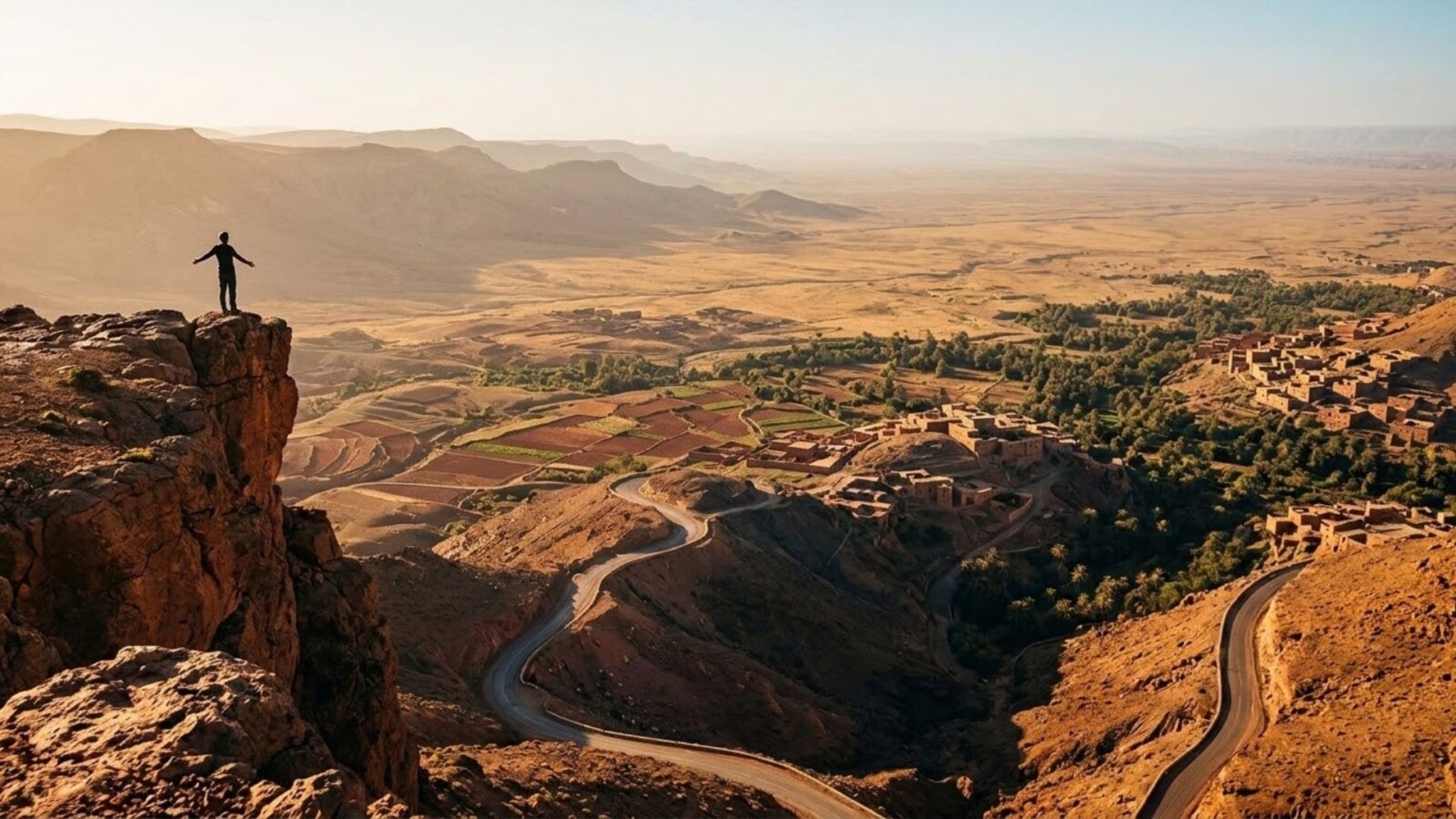
Most people spend more time planning a kitchen renovation than they spend planning Morocco, and then they wonder why the trip felt like it never quite arrived.
Morocco is not a destination that forgives careless planning. It rewards the traveler who understands the geography before they book the flights, who knows that Fes and Chefchaouen are not a quick detour from each other but a deliberate choice, who builds a route with enough breathing room to let the country actually show itself rather than rushing past it at bus-window speed. The travelers who come back from Morocco talking about it for years are almost never the ones who winged it. They are the ones who made good decisions before they left.
This guide is where those decisions start. It covers every dimension of planning a Morocco itinerary across every travel style, every trip length, and every budget level. Whether you have five days or two weeks, whether you plan to drive the Atlas passes or rely on trains and buses, whether you are traveling solo or with a family that includes a seven-year-old who needs a reliable breakfast and an eight-hour sleep, the information here gives you the framework to build a trip that fits your actual priorities rather than a generic recommendation.
Morocco is one of the most geographically and culturally diverse countries in the world relative to its size. The country runs from Mediterranean coastline in the north to Saharan desert in the southeast, from the cedar forests of the Middle Atlas to the Atlantic surf towns of the west, from the imperial grandeur of Fes and Marrakech to the blue-painted mountain medina of Chefchaouen. Getting the structure of your itinerary right is the single most important planning decision you will make, because the wrong structure wastes the experience and the right one delivers something most travelers describe as one of the best trips of their lives.
Why your Morocco itinerary structure matters more than your destination list?
The most common Morocco itinerary mistake is building a list of places you want to see and then attempting to connect them in ten days without considering what the connections actually require.
Morocco is roughly the size of California. The bus from Marrakech to Fes takes eight hours. The desert at Merzouga is 560 kilometers from Marrakech, a seven-hour drive on a good day. Chefchaouen and Casablanca are not particularly close to each other despite both appearing on the northern half of a map. These distances are not obstacles to a good Morocco trip. They are the geographic reality that your itinerary needs to work with rather than pretend does not exist.
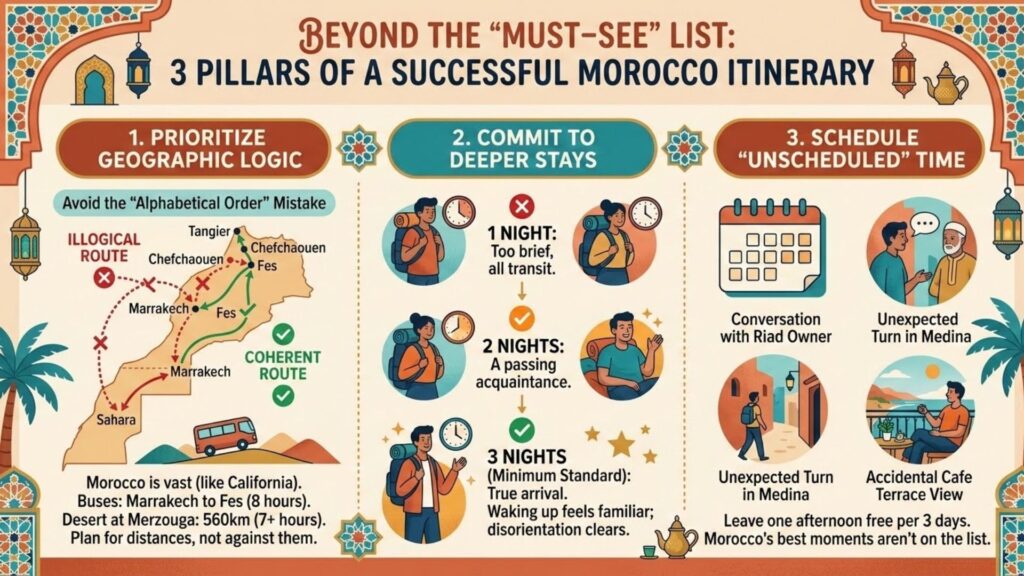
The travelers who get the structure right are the ones who identify their anchor destinations first and then build routes between them that follow geographic logic rather than alphabetical order or list popularity. A route that runs Marrakech to Fes to Chefchaouen to Tangier is geographically coherent. A route that runs Marrakech to Chefchaouen to Fes to Marrakech to the Sahara is not, and the transit days it requires eat the trip from the inside.
The second structural principle is minimum nights per destination. One night somewhere in Morocco is almost always not enough. Two nights is adequate for a passing acquaintance with a place. Three nights is where the experience shifts from transit to arrival, where you wake up in a medina on the second morning and the streets that were disorienting the first afternoon begin to make a kind of sense. Build your itinerary around the three-night standard for your most important destinations and accept that this means fewer places, not more.
The third principle, more philosophical than logistical, is to leave one afternoon per three days genuinely unscheduled. Morocco’s best moments are not on the itinerary. They are the conversation with the riad owner about his grandfather’s recipe for bastilla, the unexpected turn into a quarter of the medina where no other tourists are present, the cafe terrace you found by accident that turns out to have the best view in the city. An itinerary so full that none of these can happen is an itinerary that misses the point of Morocco.
Choosing the right Morocco itinerary length for your trip
Trip length is the variable that most travelers treat as fixed and most experienced Morocco visitors treat as the most important decision they made.
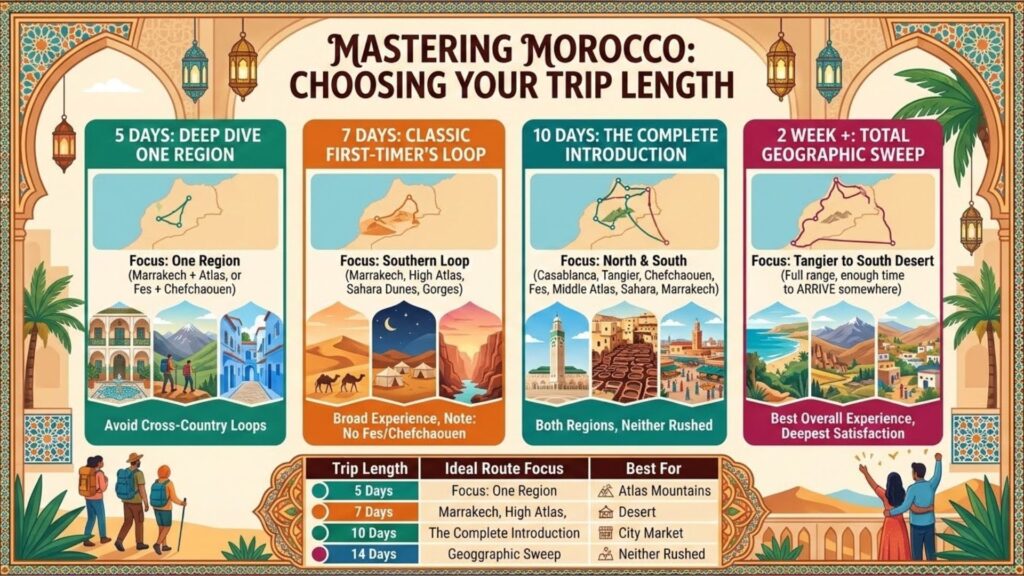
Five days in Morocco is a real trip if you respect the geography and resist the urge to include too many destinations. The key is to choose one region and go deep rather than sketching a cross-country loop that leaves you spending half your time in transit. Marrakech combined with the Atlas Mountains or Essaouira on the Atlantic coast works well in five days. Fes combined with Chefchaouen works. What does not work is a five-day itinerary that attempts Marrakech, Fes, Chefchaouen, and the Sahara and produces four days of buses and one day of actual arrival.
Seven days is the most popular first-time Morocco trip length and the one that delivers the broadest experience when structured correctly. The classic seven-day route centers on Marrakech as the entry and exit point, crosses the Atlas Mountains to the desert south, includes one to two nights at the Sahara edge, and returns through the gorge country of the southeast. It does not include Fes or Chefchaouen, a trade-off that most travelers who take it wish had been explained to them before they left.
Ten days allows the country to reveal itself properly. With ten days, the north and the south can both feature in the same trip without either feeling rushed. The counterclockwise loop from Casablanca through Tangier, Chefchaouen, Fes, the Middle Atlas, Merzouga, and back to Marrakech through the desert south is the ten-day Morocco itinerary that most experienced travelers describe as the ideal introduction to the country’s full range.
Two weeks is what the travelers who have been once wish they had taken the first time. Fourteen days accommodates the full geographic sweep of Morocco with enough time in each destination to feel like you actually arrived somewhere rather than passed through. It is the trip length that produces the specific quality of satisfaction that leads people to describe Morocco as one of the best travel decisions they have ever made.
| Trip Length | Ideal Route Focus | Best For |
|---|---|---|
| 5 days | One region: Marrakech plus Atlas or Fes plus Chefchaouen | Short breaks, first taste |
| 7 days | South loop: Marrakech, Atlas, Sahara, gorges | Most first-timers |
| 10 days | Full loop: Casablanca, north, Fes, Sahara, Marrakech | Complete introduction |
| 14 days | North to south: Tangier, Rif, Fes, desert, Marrakech | Best overall experience |
The detailed planning for each of these lengths, including day-by-day breakdowns and specific routing advice, lives in the dedicated trip length guides for each duration from five days to two weeks.
Getting around Morocco: transport options and what each one actually delivers
How you move between destinations shapes the Morocco experience as much as where you go, and the choice between driving, taking public transport, or combining both is worth making deliberately rather than by default.
Morocco’s ONCF rail network is the backbone of intercity travel between the major cities. Trains connect Casablanca, Rabat, Meknes, Fes, and Marrakech comfortably and reliably. The Al Boraq high-speed service between Casablanca and Tangier covers the route in just over two hours. For any itinerary that stays within the network’s coverage area, trains are the first choice: comfortable, affordable, and operating on schedules you can plan around with confidence.
The CTM bus network extends coverage to destinations the rail system does not reach, including Agadir, Essaouira, Ouarzazate, Chefchaouen, and the desert south. Grand taxis, the shared long-distance vehicles that operate between towns on fixed routes, fill the remaining gaps. The grand taxi is how you reach Chefchaouen from Fes, how you move between smaller towns in the Draa Valley, and how you cover the final leg of any journey into the countryside where buses do not stop. The system requires a willingness to wait for a full load and a basic facility with negotiation, but it reaches places that no other public transport serves and provides the kind of unplanned interaction with Moroccan passengers that bus journeys rarely produce.
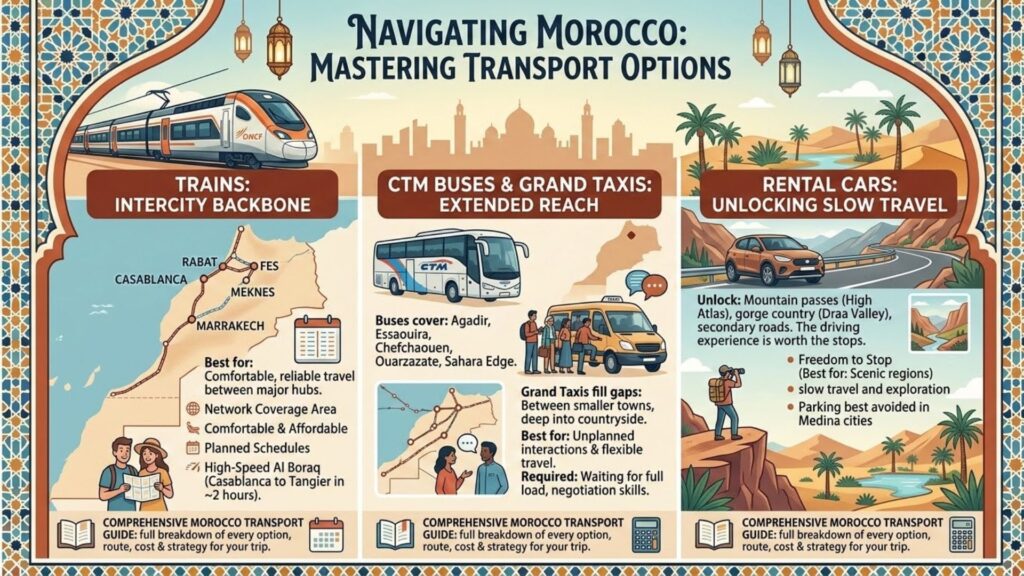
Renting a car unlocks the parts of Morocco that most reward slow travel. The mountain passes of the High Atlas, the gorge country of the southeast, the secondary roads through the Draa Valley where the landscape changes every ten kilometers: these are driving experiences in the specific sense that the freedom to stop when something earns it is what makes them worth doing. The trade-off is the driving culture on Moroccan roads, which requires adjustment, and the parking situation in medina cities, which is best described as best avoided. The practical approach for many travelers is to use public transport between cities and rent a car for two or three days specifically for the gorge and desert roads where the freedom to stop matters most.
The decision between driving Morocco and navigating it without a car is covered in full in the Morocco transport guide, which breaks down every option, route, and cost so you can build the movement layer of your trip with the same specificity as the destination layer.
Practical planning: money, timing, and the details that change your trip
The practical layer of a Morocco itinerary is where well-intentioned planning most often falls short, not because the information is hard to find but because it is scattered across sources that each give you part of the picture without assembling it into anything actionable.
Morocco operates almost entirely on cash. The Moroccan dirham is a closed currency that cannot be purchased outside the country, which means you arrive and exchange or withdraw once you land. ATMs in major cities are plentiful and reliable. ATMs in smaller destinations, including Chefchaouen, are limited in number and run out of cash with regularity during peak season. The standard advice for managing this is simple: withdraw enough cash in a major city to cover your time in smaller destinations before you head north or south into the mountains. For real daily numbers across every travel style, our guide to what a Morocco trip actually costs breaks it down.
Timing matters enormously in Morocco. The country’s best travel windows are spring and fall, with April and October representing the peak of both weather quality and crowd density. March and November offer nearly equivalent conditions with meaningfully lower prices and better accommodation availability. The summer months of July and August push temperatures above 40 degrees Celsius in Marrakech and the desert, which is manageable for coast-bound travelers and genuinely challenging for medina and Sahara itineraries. The complete month-by-month breakdown of when to visit Morocco covers every season with the specificity that broad seasonal advice cannot provide, including the cultural dimension of Ramadan and the specific conditions in each region across the calendar year.
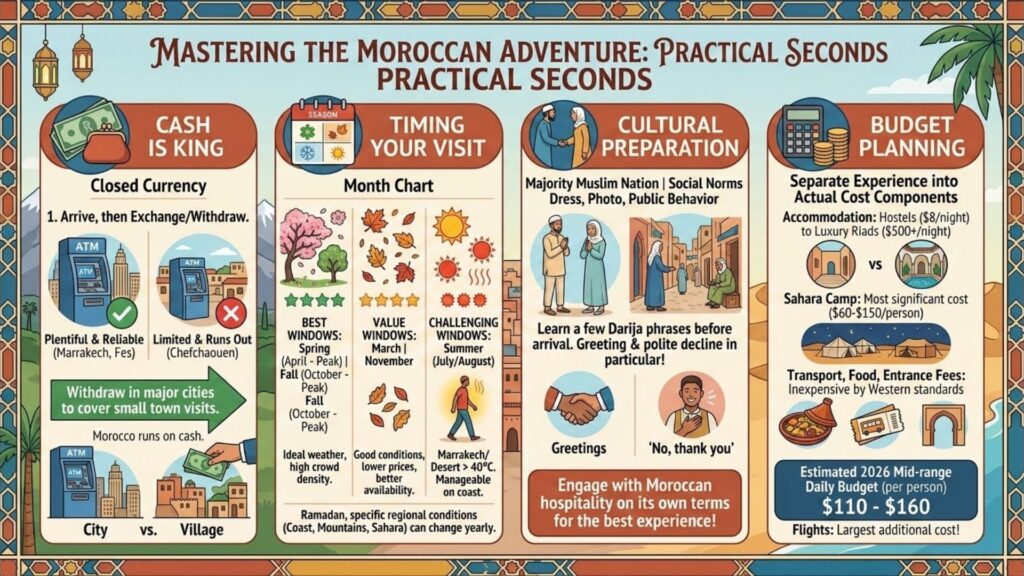
Cultural preparation is as important as logistical preparation in Morocco. The country is a majority Muslim nation with specific social norms around dress, photography, public behavior, and the pace of transactions that differ from Western defaults in ways that are easy to navigate once you understand them and mildly disorienting until you do. A handful of Darija phrases learned before departure, the greeting exchange and the polite decline in particular, changes how vendors, riad hosts, and street-level interactions feel within hours of arrival. The travelers who engage with Moroccan hospitality on its own terms rather than measuring it against different cultural standards consistently have a better experience than those who do not.
Budget planning for Morocco requires separating the experience into its actual cost components rather than relying on the country’s general reputation for affordability. Accommodation ranges from eight dollars a night in a medina hostel dormitory to five hundred dollars a night at a luxury riad. The Sahara desert camp experience, the most significant single discretionary cost in most Morocco itineraries, runs from sixty to one hundred and fifty dollars per person depending on the quality level. Transport, food, and entrance fees are genuinely inexpensive by Western standards. The overall daily budget for a mid-range Morocco trip in 2026 runs to one hundred and ten to one hundred and sixty dollars per person, with flights the largest single additional cost.
The Morocco trip that rewards you
Morocco is a country that gives back in proportion to what you bring to it.
The traveler who brings curiosity, patience, and a willingness to let the country operate on its own timeline finds something genuinely irreplaceable. The one who arrives expecting efficiency, consistency, and the kind of seamless experience that a well-resourced European city delivers will find Morocco confusing and occasionally frustrating. Both outcomes are available. The planning decisions you make before you arrive determine which one you get.
What the best Morocco itineraries share is not a particular destination list or a specific duration. They share a structure that respects the geography, a pace that leaves room for the unexpected, and a traveler who understood enough about the country before arrival to navigate it with confidence rather than manage it with anxiety.
The single most immediately useful place to start building that understanding is the Morocco travel tips guide, which covers every practical dimension of the trip from money and transport to cultural norms and connectivity in the specific, actionable terms that make planning feel real rather than theoretical.
Morocco rewards those who come prepared. It rewards them generously, specifically, and in ways that stay with them long after the dirham coins have been spent and the riad keys returned.
What kind of Morocco traveler are you, and how does your answer change where you would go first?


