Morocco travel tips: what to know before you go
The traveler who arrives in Morocco knowing how a grand taxi works, what to say when a vendor approaches, and why the ATM situation in Chefchaouen is genuinely different from Marrakech has a better first day than the one who figures all of that out on the ground. These tips work best paired with a solid plan, so build them into your route using our complete Morocco itinerary guide.
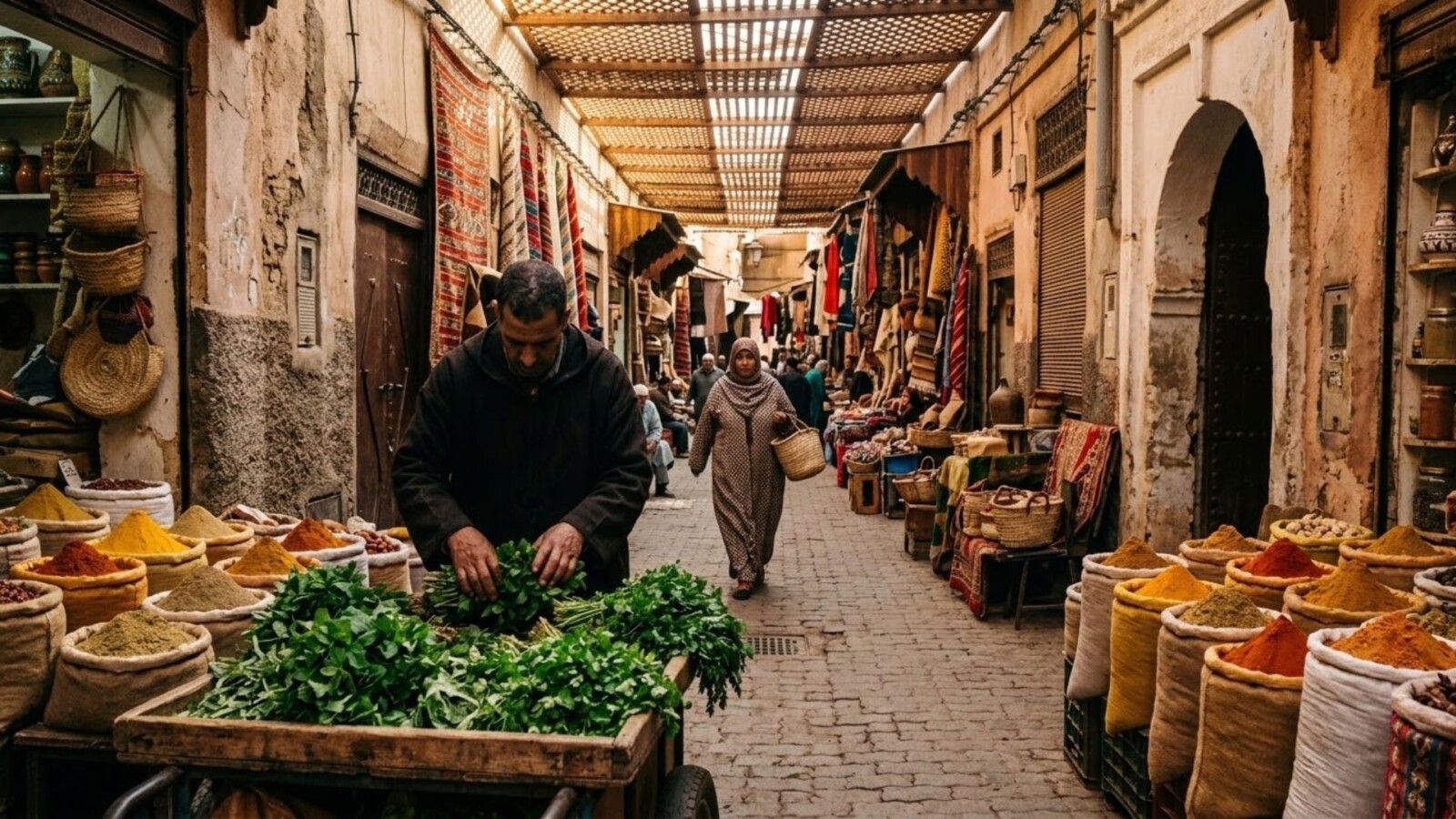
That is not a judgment. Morocco is not a difficult country to travel. It is a specific one. It operates by its own logic in ways that are entirely coherent once you understand them and mildly disorienting until you do. The medina street that appears to lead nowhere leads somewhere. The price quoted first is not the price that ends the conversation. The man who says he is not a guide and just wants to show you something genuinely interesting is sometimes telling the truth and sometimes not. Learning to read these situations before you arrive rather than while you are standing in them changes the quality of the experience substantially.
This guide covers the practical layer of a Morocco trip, the money, the movement, the cultural norms, the connectivity, the safety, and the small logistical details that travel blogs mention briefly and then move past before giving you anything actually useful. Every section is written for the traveler who wants to understand the country well enough to navigate it independently and confidently, which is the only way Morocco really gives itself to you.
Money: dirhams, ATMs, and the cash reality
Morocco operates almost entirely on cash, and understanding the currency situation before you arrive saves the kind of stress that ruins first impressions.
The Moroccan dirham is a closed currency, which means it cannot be purchased or exchanged outside Morocco. You will not find dirhams at your local bank before departure, and attempting to source them in advance is not worth the effort. Exchange your cash or use ATMs once you are inside the country.
ATMs are widely available in Casablanca, Marrakech, Rabat, and Fes. In smaller cities and mountain towns, including Chefchaouen, the ATM situation is more constrained. Chefchaouen has a handful of machines clustered near the new town rather than inside the medina, and they run out of cash with regularity during peak season. Arriving in Chefchaouen with enough dirhams to cover your stay is not paranoid planning. It is practical travel.
The reliable approach is to withdraw a meaningful amount of cash at a major city ATM before heading to smaller destinations. Five hundred to eight hundred dirhams covers two to three days of mid-range spending, accommodation excluded, and gives you the buffer that a malfunctioning ATM or a long queue cannot compromise.
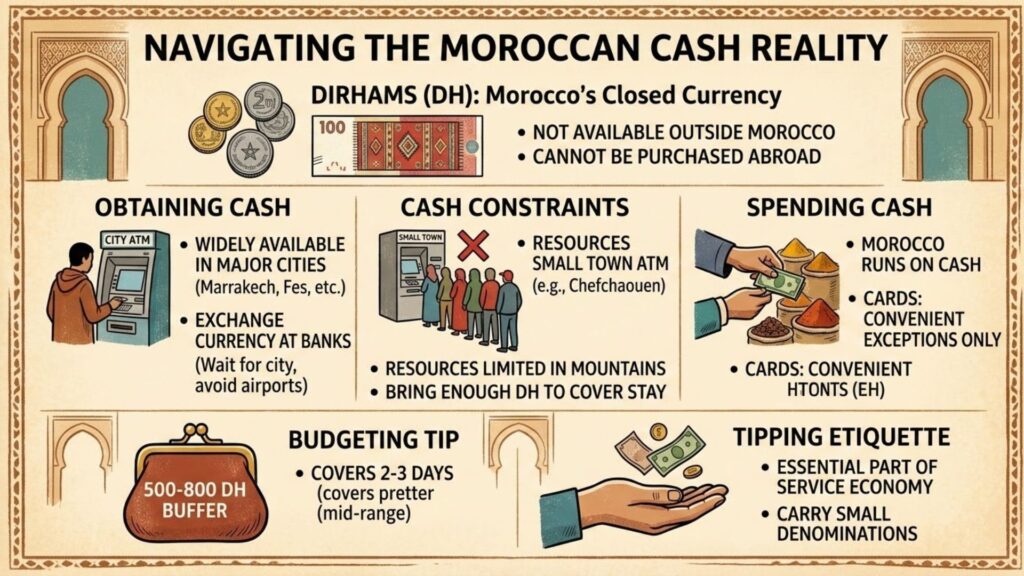
Exchange rates at airport counters are reliably worse than at city center bank branches. If you are exchanging foreign currency rather than using an ATM, wait until you reach the city. Major currencies including US dollars and euros exchange easily at banks and licensed exchange offices throughout Morocco. Keep your exchange receipts, as some establishments and hotels request them when paying in foreign currency.
Credit cards are accepted at a growing number of larger riads, upscale restaurants, and tourist-facing shops in the major cities. They cannot be relied upon as a primary payment method. Assume cash for everything and treat card acceptance as a convenient exception rather than an expectation.
Tipping is not optional in Morocco in the way that it is technically optional in some countries. It is an expected part of the service economy and the people who provide your meals, carry your bags, guide your medina walk, and drive your grand taxi depend on it as part of their income. Budget for it explicitly and carry small denomination bills to make it practical.
Getting around: the transport system explained simply
Morocco has more reliable transport options than most first-time visitors expect, and understanding the system before arrival eliminates the anxiety that comes from figuring it out in a busy bus station.
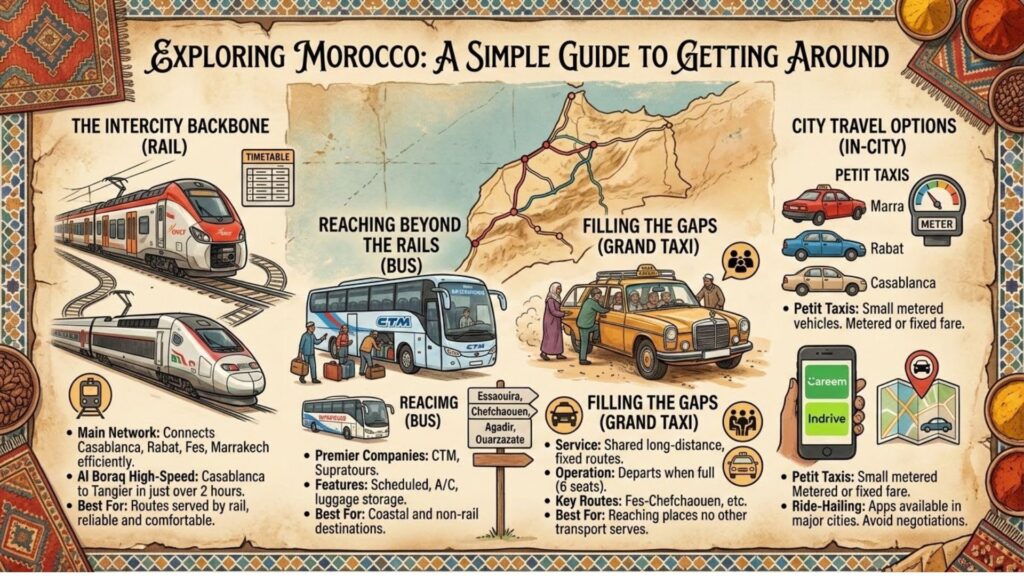
The ONCF rail network is the backbone of intercity travel between Morocco’s major cities. Trains connect Casablanca, Rabat, Meknes, Fes, and Marrakech efficiently and comfortably. The Al Boraq high-speed service between Casablanca and Tangier covers the route in just over two hours. For any itinerary that stays within the rail network’s coverage, trains are the first choice: reliable, comfortable, and reasonably priced.
CTM intercity buses serve the destinations the rail network does not reach, including Agadir, Essaouira, Ouarzazate, Chefchaouen, and the desert south. CTM is Morocco’s premier bus company, with air-conditioned coaches, scheduled departures, and undercarriage luggage storage. Supratours is a reliable alternative on many of the same routes.
Grand taxis are the shared long-distance taxis that fill every gap the trains and buses leave. These are typically older Mercedes sedans that operate on fixed routes between towns, departing when they have a full load of six passengers. You pay per seat. If you want to depart immediately without waiting, you pay for the remaining empty seats. The grand taxi is how you get from Fes to Chefchaouen, from Tangier to Tetouan, from Ouarzazate to smaller desert towns. It requires patience and a basic willingness to negotiate, but it reaches places that no other public transport serves.
Within cities, petit taxis are the standard option. These small metered vehicles are color-coded by city: red in Marrakech, blue in Rabat, beige in Casablanca. Insist on the meter or agree on a fare before you get in. Careem and inDrive operate ride-hailing services in major Moroccan cities and are worth downloading before arrival for the convenience of eliminating fare negotiation at airports and train stations.
Language: what you actually need
Morocco has four languages operating simultaneously, and understanding which one to use in which context removes a significant source of confusion.
Darija is the Moroccan Arabic dialect spoken in daily life across the country. It is distinct enough from Modern Standard Arabic that speakers of other Arabic dialects sometimes find it challenging. A handful of Darija phrases learned before arrival pays dividends that are entirely disproportionate to the effort required.
French is Morocco’s primary language of administration, business, and educated discourse and is understood by a large proportion of the urban population. If you speak French, you will find it useful in restaurants, hotels, and formal interactions throughout the country. If you do not, basic French phrases for numbers, greetings, and transactions are worth learning.
Spanish is more useful in northern Morocco than anywhere else in the country. The cities of Tangier, Chefchaouen, and Tetouan spent decades under Spanish colonial administration, and Spanish remains a living second language for many residents. If you have any Spanish, it will serve you more reliably in Chefchaouen than French.
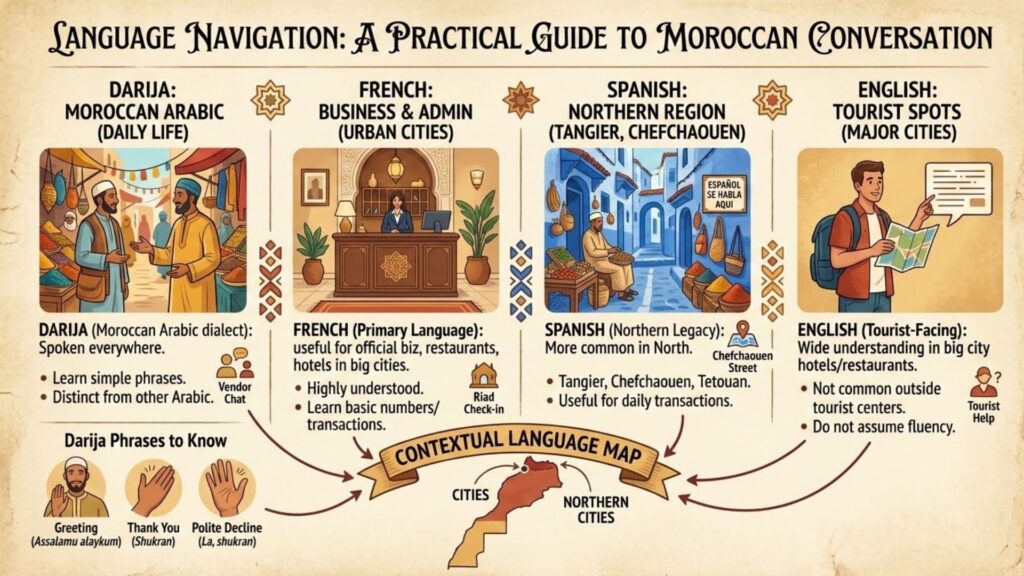
English is widely understood in tourist-facing accommodation and restaurants in the major cities. Coverage becomes patchier in smaller towns and rural areas. Do not assume English fluency outside the main tourist centers.
The Darija phrases that earn the most return on minimal investment are the greeting exchange, the thank you, and the polite decline. As-salamu alaykum as a greeting and shukran for thank you open interactions with warmth that generic English does not produce. La, shukran, delivered with a calm smile and continued forward motion, is the most effective tool for declining persistent vendor attention without creating friction on either side.
Cultural norms: the things worth knowing before you breach them
Morocco is a majority Muslim country with a specific set of social norms that are not difficult to navigate but are worth understanding before you encounter them unexpectedly.
Dress code expectations vary by context. In medinas and rural areas, covering shoulders and knees is both respectful and practical. In tourist-facing restaurants, pool areas, and beach resorts, standard Western clothing is entirely appropriate. The practical approach is to carry a light layer in your bag when exploring medinas that can be added quickly if the context requires it. This is not about strict enforcement. It is about reading the room and making an effort that Moroccan hosts notice and appreciate.
Photographing people requires permission. This is not unique to Morocco but is more important here than in some destinations. Photographing local residents, particularly women, without explicit permission is considered disrespectful and in some cases genuinely offensive. The respectful approach is to ask, using a gesture and a questioning expression if no common language exists, and to accept a refusal gracefully. Many Moroccans are happy to be photographed when asked properly. Many are not, and their preference deserves the same respect as any other boundary.
Physical affection between couples in public is uncommon in Moroccan social culture and draws attention in medina and rural contexts more than in coastal resort areas. Same-sex couples should be aware that public displays of affection carry legal risk in Morocco, where same-sex relationships are not legally recognized.
The pace of transactions in Morocco is slower than most Western travelers expect, and attempting to accelerate it through impatience produces worse outcomes than accepting the rhythm. Whether you are negotiating in a souk, waiting for a grand taxi to fill, or arranging a riad breakfast at an unusual hour, the approach that works is patience delivered with warmth rather than efficiency delivered with pressure.
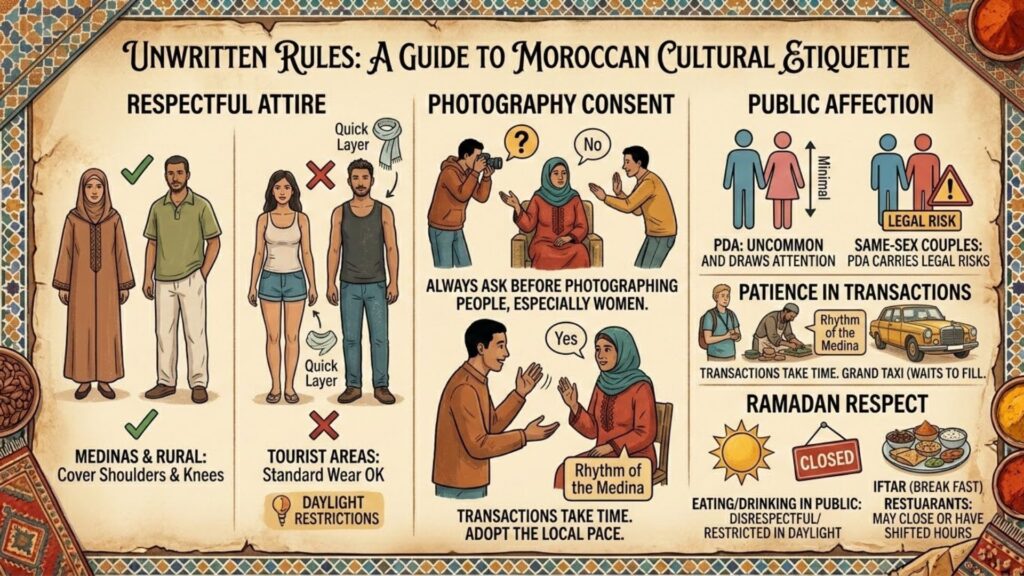
Ramadan changes the rhythm of daily life in ways that affect travelers meaningfully and reward cultural curiosity. During Ramadan, eating, drinking, and smoking in public during daylight hours is disrespectful and legally restricted in some contexts. Most restaurants catering to international travelers remain open, but hours shift and some close entirely until iftar, the sunset meal that breaks the fast. The evenings during Ramadan are alive in a way that other times of year are not, and travelers who engage with that atmosphere rather than treating it as an inconvenience consistently describe it as one of the most memorable periods to be in Morocco.
Safety: what the reputation misses
Morocco has a better safety record for international travelers than its position in North Africa and its medina complexity sometimes lead people to assume.
Violent crime against tourists is genuinely rare. The safety concerns that most travelers encounter in Morocco are of an entirely different category: persistent vendor attention in tourist areas, unofficial guides who attach themselves to lost-looking visitors, and petty theft in crowded spaces. None of these constitute danger in the meaningful sense of the word. They constitute the navigable social friction of a country with significant economic disparity between international visitors and local residents.
The most effective safety tool in Morocco is confident, purposeful movement. Travelers who walk as if they know where they are going, even when they do not, experience substantially less unsolicited attention than those who stop, look uncertain, and consult their phones at every corner. If you need to check your map, step into a shop or cafe rather than stopping in the middle of a medina alley.
Solo female travelers face more persistent attention in Morocco than solo male travelers, particularly in Marrakech. This is a real pattern that deserves honest acknowledgment. It is not a reason to avoid solo travel in Morocco. It is a reason to prepare for it with the right tools: decisive body language, the la shukran response delivered without hesitation, and a riad host whose judgment you trust for recommendations about which areas and what hours deserve more caution than others.
Registration with the Smart Traveler Enrollment Program through the US State Department before departure is worth the five minutes it requires. The US Embassy in Rabat and consulate in Casablanca provide emergency consular assistance. Keeping a photograph of your passport on your phone and storing a physical copy separately from your actual passport is the standard precaution that matters most in the unlikely event of loss or theft.
Connectivity: SIM cards, Wi-Fi, and staying in touch
Morocco’s mobile network coverage is reliable in cities and along major highways, patchy in mountain areas, and essentially absent in remote desert locations.
The most practical connectivity solution for most travelers is purchasing a local SIM card at the airport or at a phone shop in any major city. Maroc Telecom and Orange Morocco both offer prepaid SIM cards with data plans that work out to roughly ten to fifteen dollars for several gigabytes of data, which covers a week of navigation, communication, and reasonable social media use without difficulty. Bring your unlocked phone. If your phone is carrier-locked, resolve this before departure.
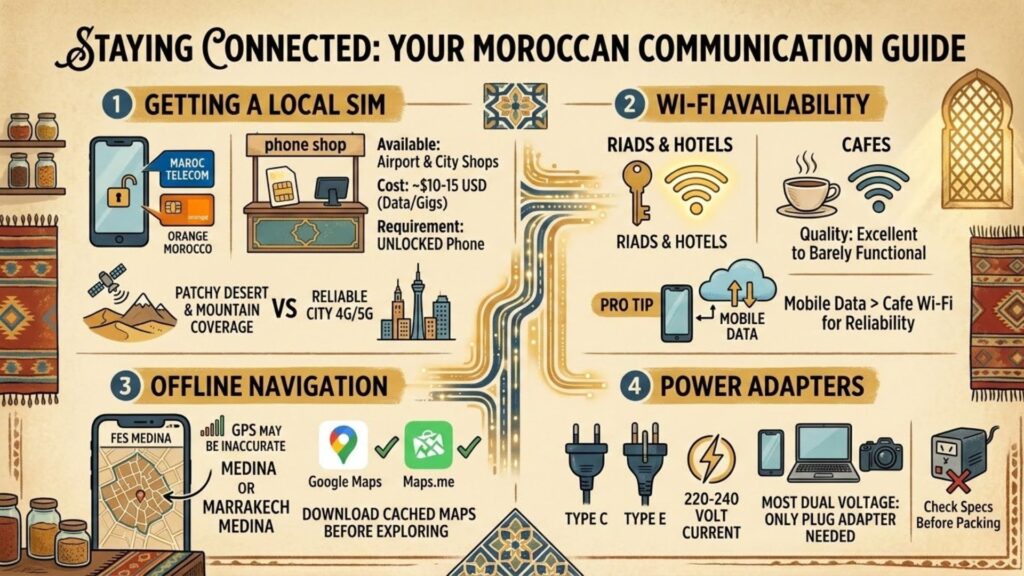
Wi-Fi is available at virtually all riads, guesthouses, and hotels and at most cafes in tourist areas. The quality varies from excellent to barely functional. For anything requiring reliable connectivity, mobile data is more dependable than cafe Wi-Fi.
Offline maps are worth downloading before you leave a city with reliable connection. The medinas of Fes and Marrakech are the specific environments where GPS loses accuracy most frequently, and having a cached offline map removes the single most common navigation frustration in Morocco’s complex historic urban centers. Maps.me and Google Maps both offer reliable offline functionality for Moroccan cities.
Power adapters: Morocco uses Type C and Type E electrical sockets with 220 to 240 volt current. US devices require both a plug adapter and, for devices not rated for dual voltage, a voltage converter. Most modern electronics including phones, laptops, and cameras are dual voltage rated, meaning only the plug adapter is necessary. Check your device specifications before packing a voltage converter you may not need.
Health and vaccinations
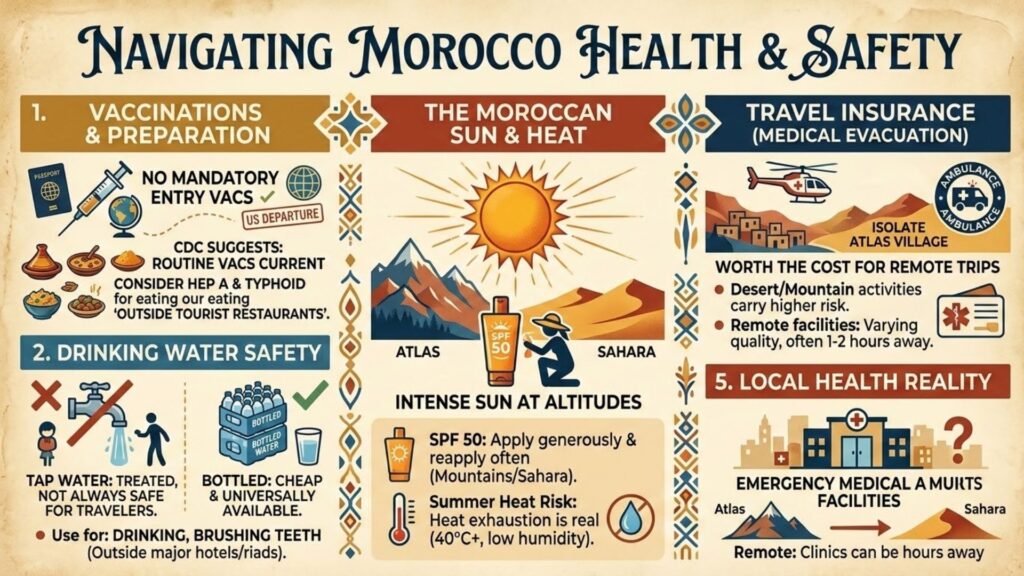
No vaccinations are required for entry to Morocco from the United States, but the Centers for Disease Control recommends that routine vaccinations are current and suggests considering hepatitis A and typhoid vaccinations for travelers who plan to eat outside established tourist restaurants, which describes most independent Morocco travelers.
Tap water in Morocco is treated but not consistently safe to drink for travelers without local immunity. Bottled water is cheap and universally available. Use it for drinking and brushing teeth outside of established hotels and riads where the water quality is more reliably controlled.
The sun at Moroccan altitudes, particularly in the Atlas Mountains and the Sahara, is more intense than travelers from northern latitudes expect. Broad-spectrum sunscreen with SPF 50, applied generously and reapplied through the day, is not optional in these environments. Heat exhaustion in the desert south during summer months is a real risk for travelers who underestimate how quickly fluid loss accumulates in forty-degree heat with low humidity.
Travel insurance that covers medical evacuation is worth the cost for any Morocco trip that includes desert or mountain activities. The nearest hospital to some desert and mountain destinations is in a city one to two hours away, and the quality of emergency medical facilities varies significantly across the country.
The detail that changes everything
After all the practical information is absorbed and the planning is done, the single detail that most consistently separates satisfying Morocco trips from frustrating ones is not logistical. It is attitudinal.
Morocco rewards travelers who approach the country as a place with its own coherent logic rather than as a place that should operate more like home. The medina that seems chaotic is not chaotic. The transaction that seems slow is not slow. The hospitality that seems excessive is not excessive. It is all operating within a framework of social and cultural values that produces one of the most genuinely distinctive travel experiences available anywhere in the world once you stop measuring it against different standards.
The complete Morocco itinerary guide covers how to put all of these practical elements together into a coherent route, and the Morocco travel cost breakdown gives you the specific budget framework that makes the planning real. The practical layer and the route layer are both necessary. Neither one works without the other.
What is the one piece of Morocco travel advice you wish someone had told you before your first trip?