Morocco without a car: trains, buses, and grand taxis explained
The rental car assumption is the single most persistent myth in Morocco travel planning, and it costs a lot of travelers money they did not need to spend.
It is understandable where the assumption comes from. Morocco is a large country with a desert in the southeast, mountain passes in the middle, and a coastline running along two different seas. Looking at a map, it seems like the kind of place that requires a vehicle to navigate properly. The reality is more nuanced and considerably more interesting. Morocco has one of the best public transport networks in North Africa, a rail system that would not embarrass Western Europe on its major routes, and a supplementary network of buses and shared taxis that reaches virtually every destination worth visiting. The travelers who figure this out tend to spend less money, have more interesting interactions, and arrive at their destinations with better stories than the ones who spent the same hours in a rental car navigating unfamiliar roads.
This guide covers every transport option available to independent travelers building a Morocco itinerary without a car, including how each one works, what it costs, where it falls short, and how to combine them into a coherent, stress-free route.
The ONCF rail network: Morocco’s backbone
The Office National des Chemins de Fer, known as ONCF, operates Morocco’s national rail network, and on the routes it serves, it is the best way to travel in the country. Full stop.
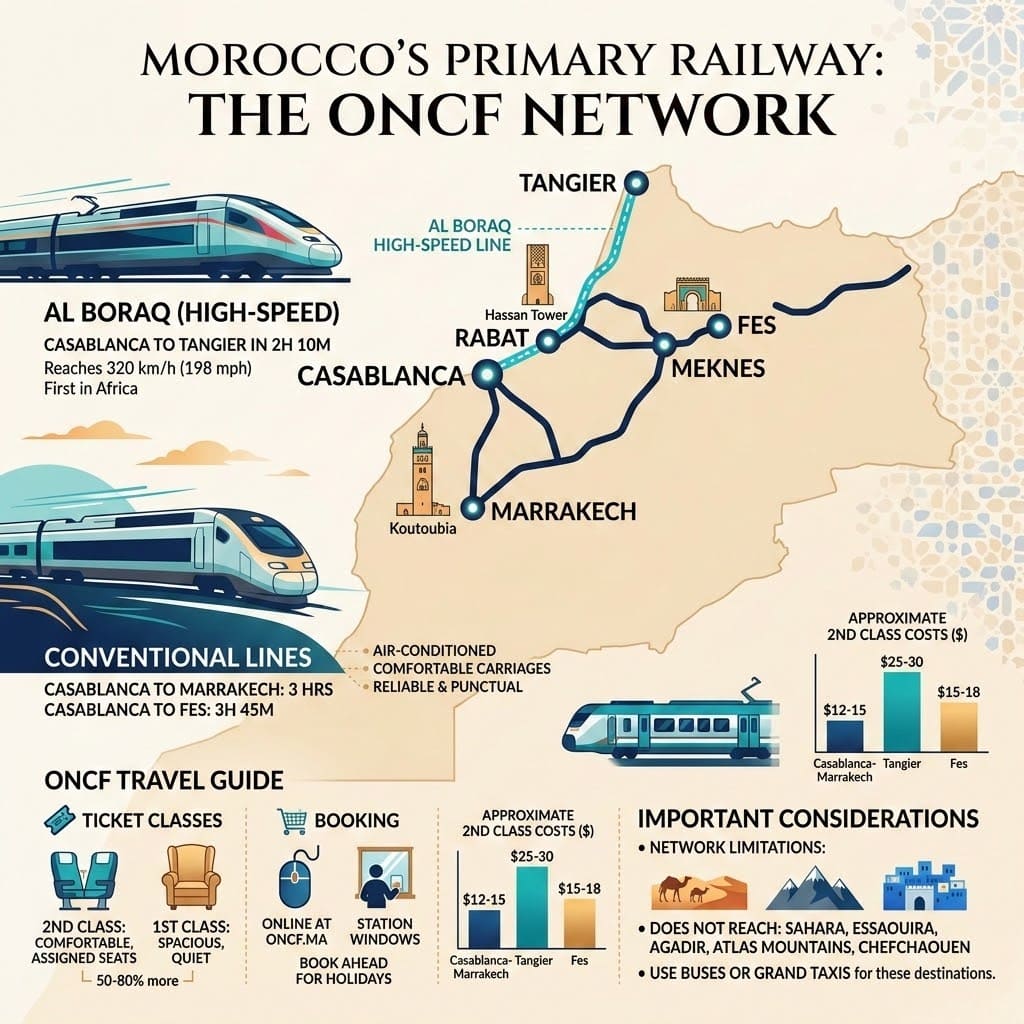
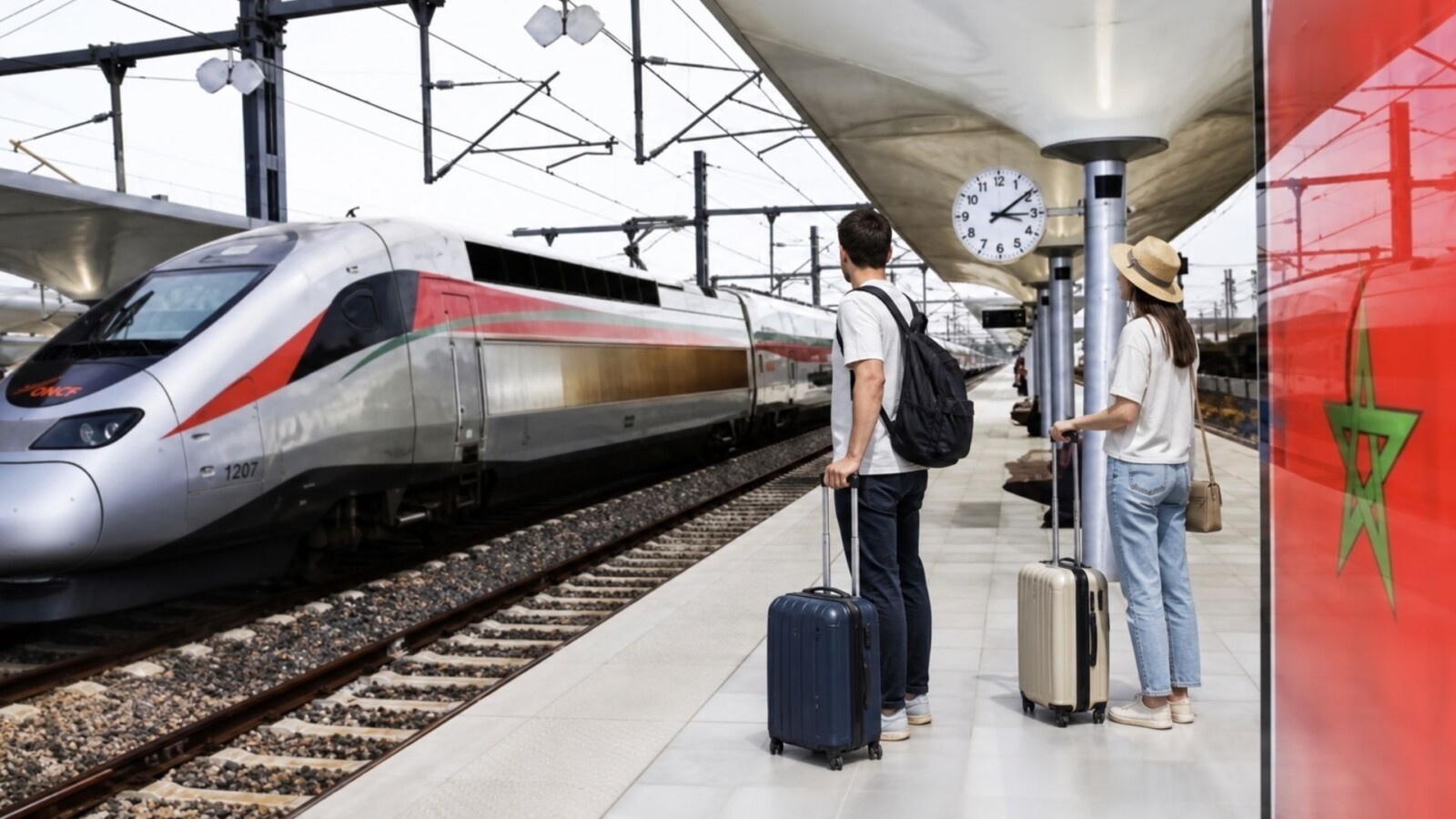
The main line connects Casablanca, Rabat, Meknes, Fes, and Marrakech in a configuration that covers the four imperial cities most visited by international travelers. The high-speed Al Boraq line, which launched in 2018 and remains the first high-speed rail service in Africa, connects Casablanca and Tangier in just over two hours, covering a route that used to take five hours by conventional train. Casablanca to Marrakech takes around three hours. Casablanca to Fes takes just under four. The trains run on schedule, the carriages are air-conditioned and comfortable, and the ticket prices are reasonable by any international standard.
First class on ONCF trains costs roughly 50 to 80 percent more than second class depending on the route. Second class is perfectly comfortable and what most independent travelers use. The seats are assigned, the compartments are clean, and the journey times are short enough that the upgrade rarely justifies the cost.
Book tickets online through the ONCF website or at station ticket windows. For travel during Eid holidays or the week between Christmas and New Year, book in advance. For most other travel periods, same-day or next-day tickets are available without difficulty.
| Key ONCF routes | Duration | Approx. Cost (2nd Class) |
| Casablanca to Marrakech | 3 hrs | $12 to $15 |
| Casablanca to Fes | 3 hrs 45 min | $15 to $18 |
| Casablanca to Tangier (Al Boraq) | 2 hrs 10 min | $25 to $30 |
| Rabat to Fes | 2 hrs 30 min | $10 to $13 |
| Marrakech to Casablanca | 3 hrs | $12 to $15 |
The rail network’s limitation is straightforward: it does not reach the Sahara, Chefchaouen, Essaouira, Agadir, the Atlas Mountains, or the gorge country of the southeast. For those destinations, you need buses or grand taxis.
CTM buses: the reliable long-distance option
Compagnie de Transports au Maroc, universally known as CTM, is Morocco’s premier intercity bus company and the most reliable way to reach destinations the rail network does not serve.
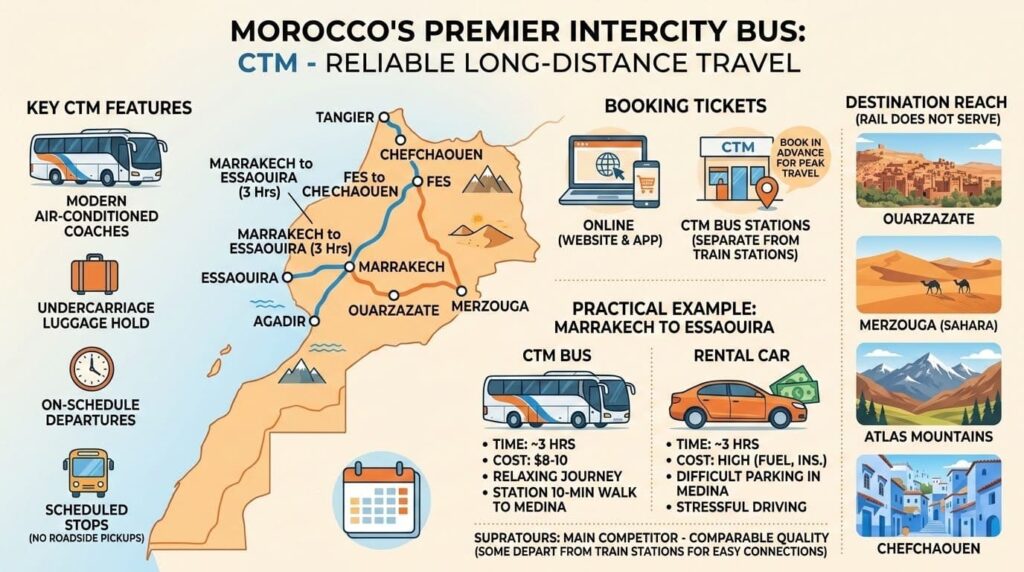
CTM operates air-conditioned coaches on routes that cover the entire country, including Marrakech to Ouarzazate, Ouarzazate to Merzouga, Marrakech to Agadir, Fes to Chefchaouen, Tangier to Chefchaouen, Marrakech to Essaouira, and dozens of others. The buses depart on schedule, carry luggage in an undercarriage hold, and make scheduled stops rather than picking up passengers along the road. Journey times are longer than driving yourself on the same route, typically by 20 to 40 percent, but the difference is usually smaller than travelers expect and the experience is considerably more relaxing than navigating mountain passes in an unfamiliar vehicle.
CTM tickets are available at the company’s bus stations, which are located separately from ONCF train stations in most cities but are usually within walking distance or a short taxi ride. Online booking is available through the CTM website for most routes, which is worth using during peak travel periods when popular morning departures sell out.
Supratours is CTM’s main competitor and operates many of the same routes with comparable quality. In some cities, Supratours departures operate directly from the ONCF train station, which simplifies connections between rail and bus.
A practical example: the route from Marrakech to Essaouira by CTM bus takes about three hours and costs around eight to ten dollars. The same route by rental car takes the same amount of time and costs significantly more once you factor in fuel, insurance, and the difficulty of parking in Essaouira’s medina. The bus drops you at a station a ten-minute walk from the medina walls.
Grand taxis: the system that fills every gap
The grand taxi is the transport option that most first-time Morocco visitors find confusing and most experienced Morocco travelers consider indispensable.
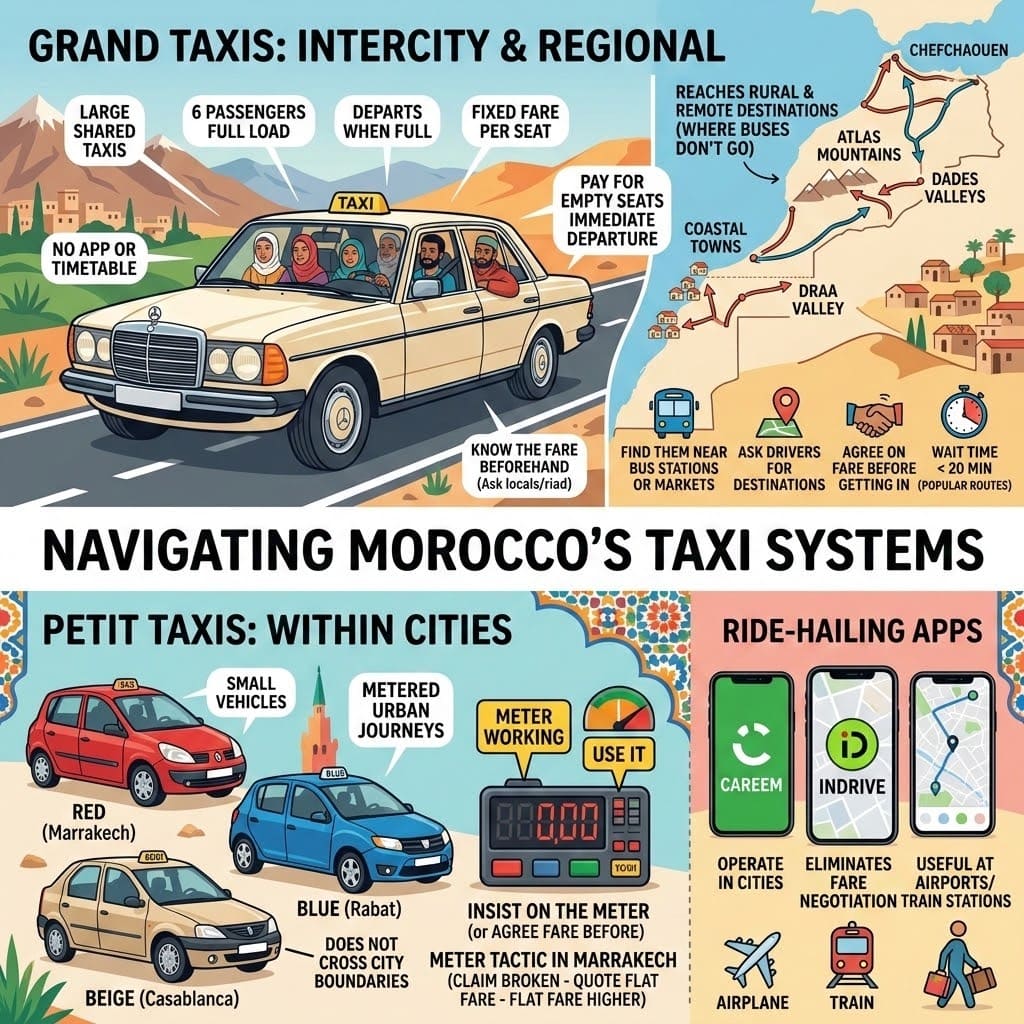
Grand taxis are large shared taxis, typically older Mercedes sedans or similar vehicles, that operate on fixed routes between towns and cities across Morocco. The system works on a shared basis: the taxi departs when it has a full load of passengers, which for a standard grand taxi means six people including the front seat passenger. You pay a fixed fare per seat. If you want the taxi to depart immediately without waiting for other passengers, you pay for the empty seats yourself.
The grand taxi station in any Moroccan city is usually near the local bus station or the main market. There is no central booking system, no app, and no published timetable. You arrive at the taxi station, identify the taxis going to your destination by asking drivers or other passengers, agree on the fare before getting in, and wait for the vehicle to fill. In busy cities on popular routes, this wait is usually under twenty minutes. On quieter routes or at off-peak times, it can be longer.
Grand taxis reach destinations that CTM buses do not serve, including Chefchaouen from Fes or Tetouan, smaller towns in the Draa and Dades valleys, mountain villages in the Atlas, and coastal towns along routes without regular bus service. For the final leg of any journey into the countryside, the grand taxi is often the only public option.
The fares are fixed and generally known to locals. Asking a fellow passenger or your riad host what the correct fare should be before you travel eliminates the possibility of being quoted an inflated tourist price. The difference between the correct fare and the inflated one is usually a few dollars, which is not financially significant but matters as a matter of principle and self-respect.
Petit taxis: getting around inside cities
Within any Moroccan city, the petit taxi is the standard option for short urban journeys. These small vehicles, color-coded by city (red in Marrakech, blue in Rabat, beige in Casablanca), operate on metered fares within city limits and do not cross city boundaries.
The meters work. Use them. In Marrakech, a common tactic is for drivers to claim the meter is broken and quote a flat fare instead. The flat fare is almost always higher than what the meter would register. Insisting on the meter or agreeing on a specific fare before departure is standard practice and not considered rude.
Ride-hailing apps including Careem and inDrive operate in most Moroccan cities and are worth downloading before arrival. They eliminate fare negotiation entirely and are particularly useful at airports and train stations where taxi touts can be persistent.
Building a car-free Morocco itinerary
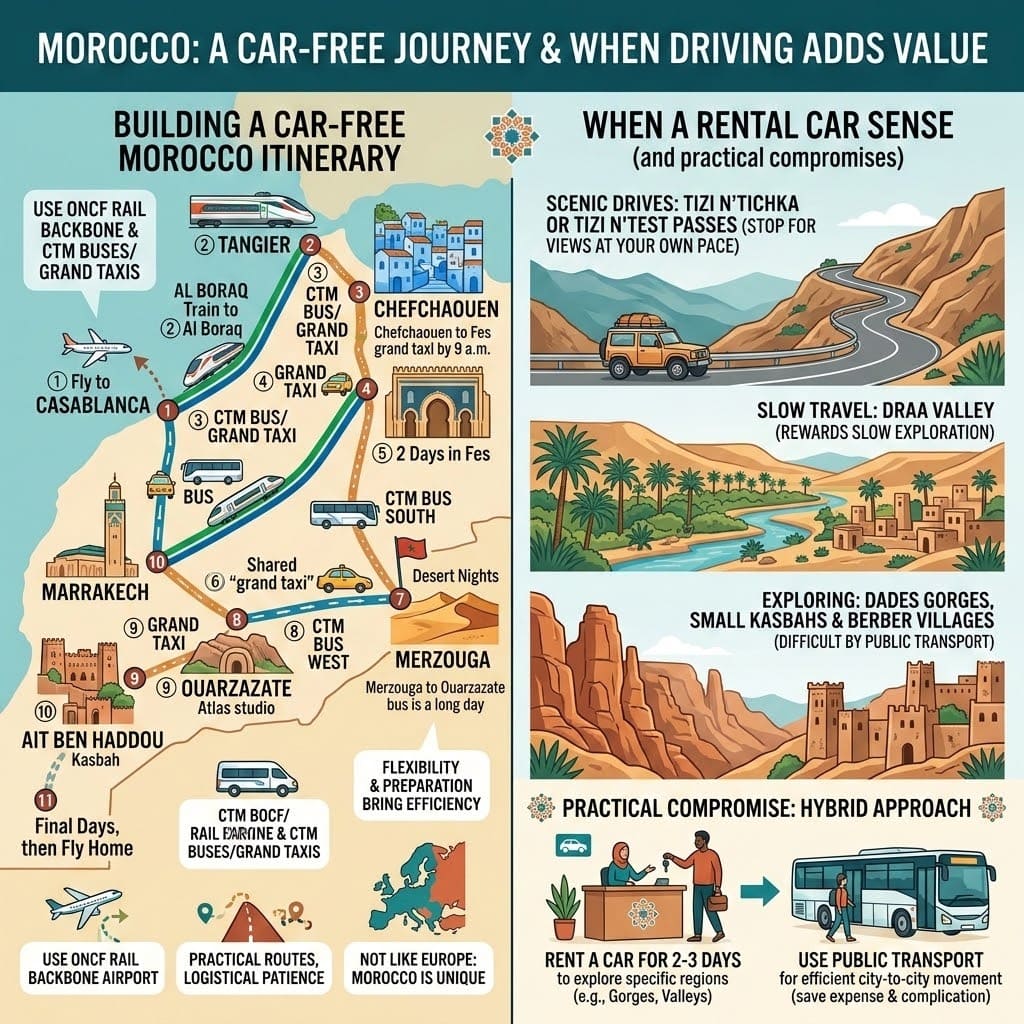
The most logical car-free Morocco itinerary uses the ONCF rail network as its backbone. CTM buses cover the south. Grand taxis fill in the connections in between.
A ten-day car-free route might run as follows. Fly into Casablanca and take the Al Boraq train to Tangier. From there, a CTM bus or grand taxi brings you to Chefchaouen. Continue by grand taxi to Fes and spend two days exploring the medina.
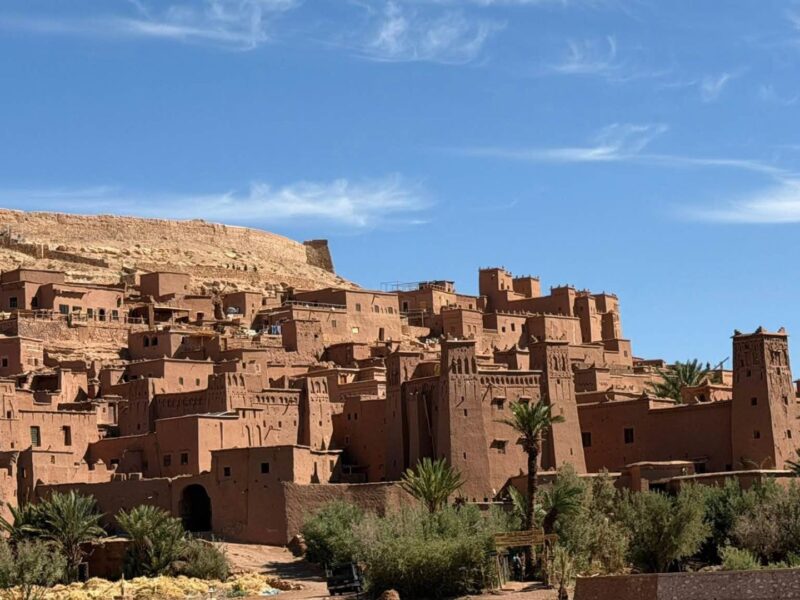
Next, take a CTM bus south to Merzouga via Errachidia and spend two nights in the desert. Head west by CTM bus to Ouarzazate. Visit Ait Ben Haddou by grand taxi, then continue to Marrakech. Spend your final days in the city before flying home.
Every leg of that itinerary is achievable by public transport. Some legs require more patience than others. The Merzouga to Ouarzazate bus, for example, is a long day. The Chefchaouen to Fes grand taxi requires arriving at the taxi station before 9 a.m. for a same-morning departure. These are not hardships. They are logistics.
The car-free traveler who approaches Moroccan public transport with flexibility and basic preparation moves through the country efficiently and cheaply. The one who expects it to behave like European transport will find Morocco frustrating in ways that have nothing to do with Morocco and everything to do with expectations.
When a car actually makes sense
Intellectual honesty requires acknowledging the situations where a rental car genuinely improves the Morocco experience.
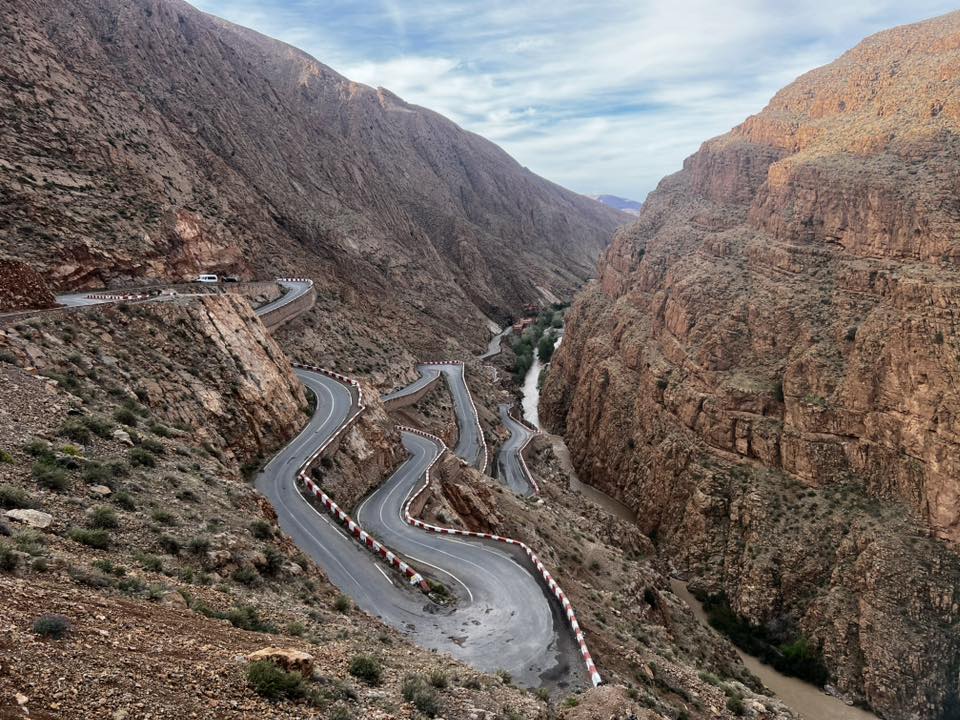
Driving the Tizi n’Tichka or Tizi n’Test passes in your own vehicle, stopping when a view earns it rather than when a bus schedule allows it, is a meaningfully better experience than the same route by bus. The Draa Valley between Ouarzazate and Merzouga rewards slow travel in a way that a direct bus does not facilitate. The gorge country of the southeast, particularly the secondary roads through the Dades and the access routes to smaller kasbahs and Berber villages, is genuinely difficult to explore thoroughly without your own transport.
Many experienced Morocco travelers use a hybrid approach. They take public transport for city-to-city movement. Then they rent a car for two or three days to explore a specific region at their own pace. Once done, they return the car and continue by bus or train.
This captures the freedom of driving where it matters most. It also avoids the expense and complication of keeping a rental for the entire trip.
What car-free travel actually feels like
There is a particular quality to arriving somewhere by grand taxi that a rental car does not replicate. You share the journey with people who are going where you are going for their own reasons, not yours. The conversation that happens in a shared taxi between Fes and Chefchaouen, conducted in a mixture of Arabic and French and sign language and the universal vocabulary of pointing at things out the window, is the kind of interaction that does not happen behind the wheel of a car you are concentrating on not crashing.
Morocco’s public transport system is not perfect. It is also not the obstacle that most pre-trip planning assumes it to be. Getting around without a car here is a genuine option, not a compromise, and for the travelers who approach it with the right expectations, it is frequently the better choice.
Still building your route? The complete Morocco itinerary guide covers how to structure your destinations first. It helps you decide how to move between them before committing to anything.
If you are leaning toward driving, the Morocco road trip itinerary lays out the full alternative. It is worth reading before you decide whether a car is the right call.
What part of Morocco would you most want to explore by car versus public transport?