Morocco Travel Cost: What a Trip Actually Costs in 2026
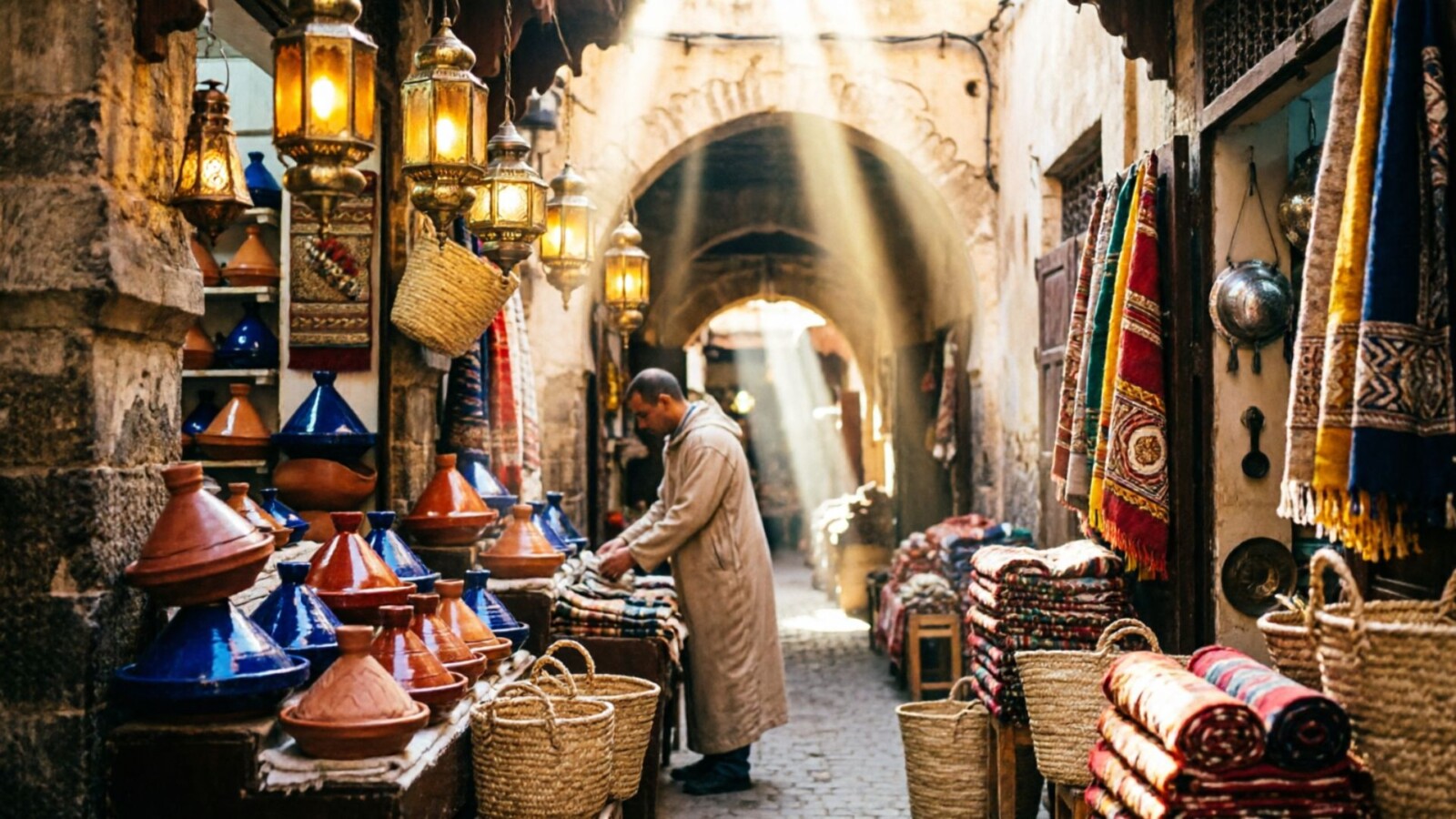
The number one planning mistake travelers make with Morocco is budgeting for the country they imagined rather than the country that actually exists.
Morocco has a reputation as a cheap destination, and that reputation is partially deserved and partially misleading. It is cheap relative to Western Europe in the ways that matter most: accommodation, food, and local transport cost a fraction of what equivalent experiences would run in France or Spain. It is not cheap in the ways that sometimes catch travelers off guard: the desert camp that was supposed to be affordable turns out to cost more than two nights in a decent riad, the private guided day in Fes adds up faster than expected, and the mid-range riad in Marrakech during April peak season costs as much as a solid hotel in Lisbon.
The honest version of Morocco travel costs requires separating the experience into its actual components and being specific about what each one costs in 2026, not in a general sense but in the practical, per-day terms that make a trip budget real. That is what this guide does.
The Three Morocco Traveler Budgets
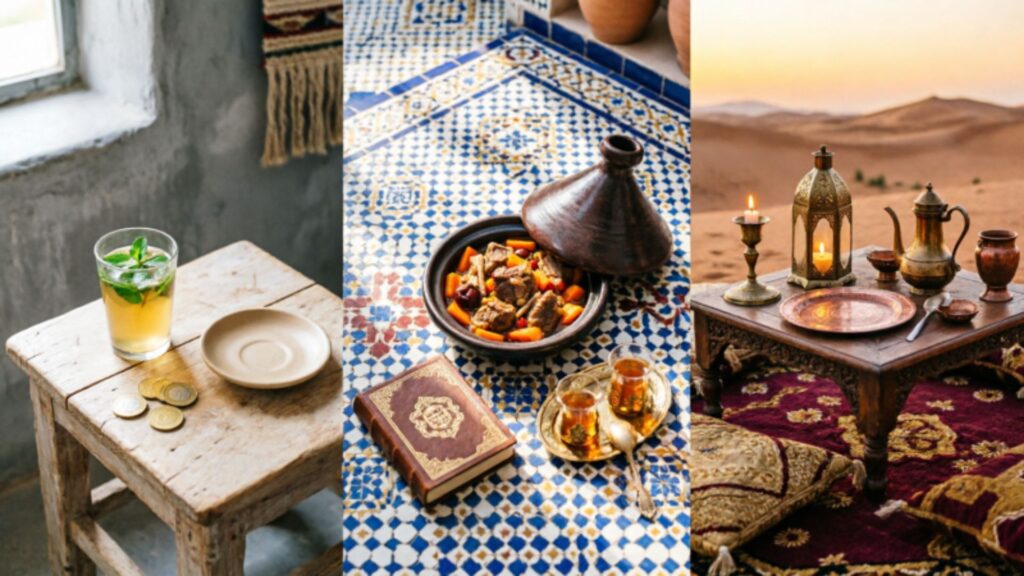
Morocco travel costs cluster around three distinct daily budgets that correspond to genuinely different travel styles and experiences. Understanding which category fits your priorities before you build a trip budget eliminates the most common planning frustration, which is arriving in Morocco expecting one experience and discovering the actual cost is calibrated for a different one.
The budget traveler spends between 40 and 65 US dollars per day. The mid-range traveler spends between 100 and 160 dollars per day. The comfortable traveler, who prioritizes quality accommodation, private guides, and curated experiences without crossing into luxury territory, spends between 180 and 280 dollars per day.
None of these budgets is better than another. They reflect different choices about what the trip is for, and the best Morocco experiences are not exclusively available at the top of the range. Some of the most memorable meals in the country cost three dollars. Some of the most atmospheric accommodation costs forty. Understanding the cost structure lets you allocate your specific budget to the things that matter most to you rather than discovering after arrival that you spent it on the wrong things.
Accommodation: The Biggest Variable in Your Morocco Budget
Accommodation is where Morocco’s price range is widest and where your choices have the most impact on the overall trip budget.
At the budget end, hostels in the medinas of Marrakech, Fes, and Chefchaouen offer dormitory beds for eight to fifteen dollars per night and private rooms for twenty to thirty-five dollars. The quality varies significantly. The best budget guesthouses in Morocco are genuinely charming, small family-run places in the medina alleys where the host brings you mint tea when you arrive and knows the good spots for breakfast. The worst are clean but characterless. Reading recent reviews rather than relying on star ratings is the reliable filter.
Mid-range riads, the converted traditional courtyard houses that define Morocco’s most distinctive accommodation category, run from sixty to one hundred and fifty dollars per night for a double room depending on the city, the season, and the specific property. A good mid-range riad in the Marrakech medina in October costs around eighty to one hundred dollars per night and delivers an experience that a four-star hotel in the new city at the same price cannot replicate: the courtyard breakfast, the rooftop terrace at sunset, the silence inside thick medina walls while the city moves loudly outside.
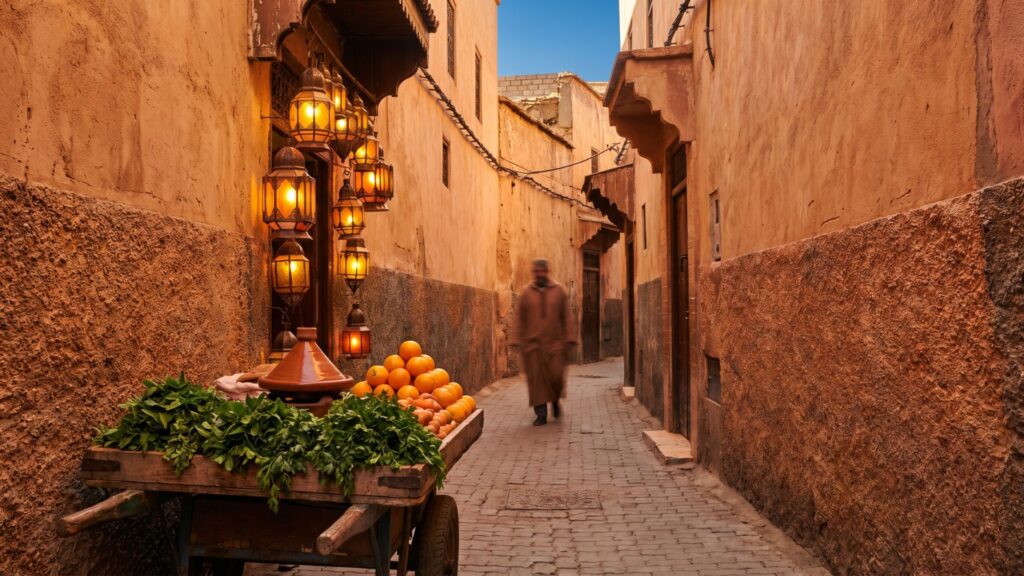
Fes mid-range riads tend to run slightly cheaper than Marrakech for equivalent quality. Chefchaouen is the most affordable of the major medina cities. Essaouira sits between Chefchaouen and Marrakech. Agadir and Casablanca operate on hotel pricing rather than riad pricing and are generally less distinctive for the money.
Peak season pricing in April and the last week of December adds twenty to forty percent to mid-range accommodation costs in the most popular destinations. The best Marrakech riads in the first two weeks of April are fully booked four to six weeks out and command prices that approach the comfortable traveler category regardless of what your intended budget is. Flexibility on dates or destinations is the most reliable way to manage this.
| Accommodation Type | Budget Range (per night) | Best For |
|---|---|---|
| Hostel dormitory | $8 to $15 | Solo budget travelers |
| Budget guesthouse private room | $20 to $35 | Couples, solo travelers |
| Mid-range riad | $60 to $150 | First-timers, couples |
| Quality riad with pool | $120 to $220 | Comfort seekers |
| Luxury riad or boutique hotel | $200 to $500+ | Special occasions |
| Desert camp standard | $80 to $120 per person | All budget levels |
| Desert camp private luxury | $150 to $300 per person | Comfort seekers |
Food: Where Morocco’s Affordability Is Most Genuine
Food in Morocco is where the affordability reputation is most accurately deserved, and it is also the category where travelers most consistently leave money on the table by eating at the wrong places.
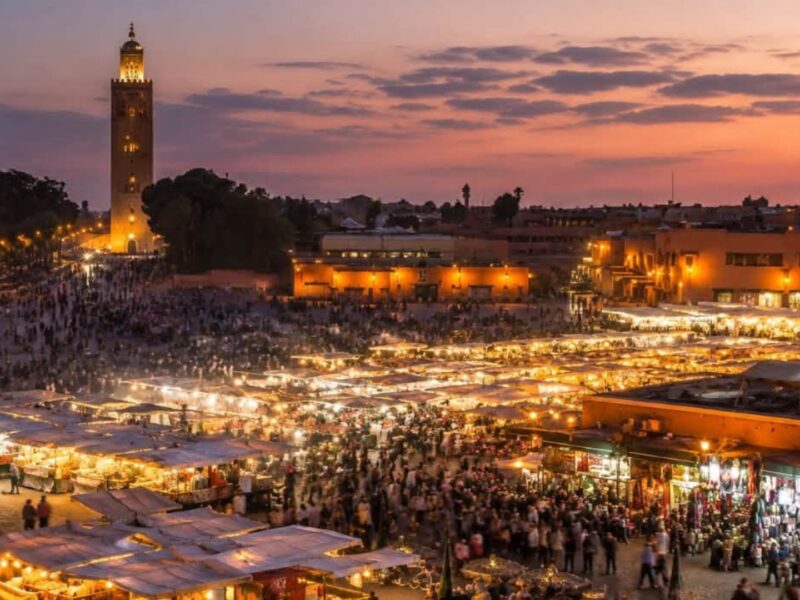
The tourist restaurant surcharge is real and unavoidable at the most prominent establishments in the Djemaa el-Fna and the main medina tourist routes. A tagine on the Djemaa el-Fna costs twelve to eighteen dollars and is almost certainly worse than the same dish at a local restaurant ten minutes into the medina that costs four to seven dollars. That gap, between tourist-track eating and local eating, is the single most impactful food budget decision you make in Morocco.
Breakfast is reliably cheap everywhere in Morocco. A traditional Moroccan breakfast of khobz, msemen or meloui, amlou paste, honey, olive oil, fresh-squeezed orange juice, and mint tea costs two to four dollars at a neighborhood cafe. Many riads include breakfast in the room rate, which is worth factoring into accommodation cost comparisons.
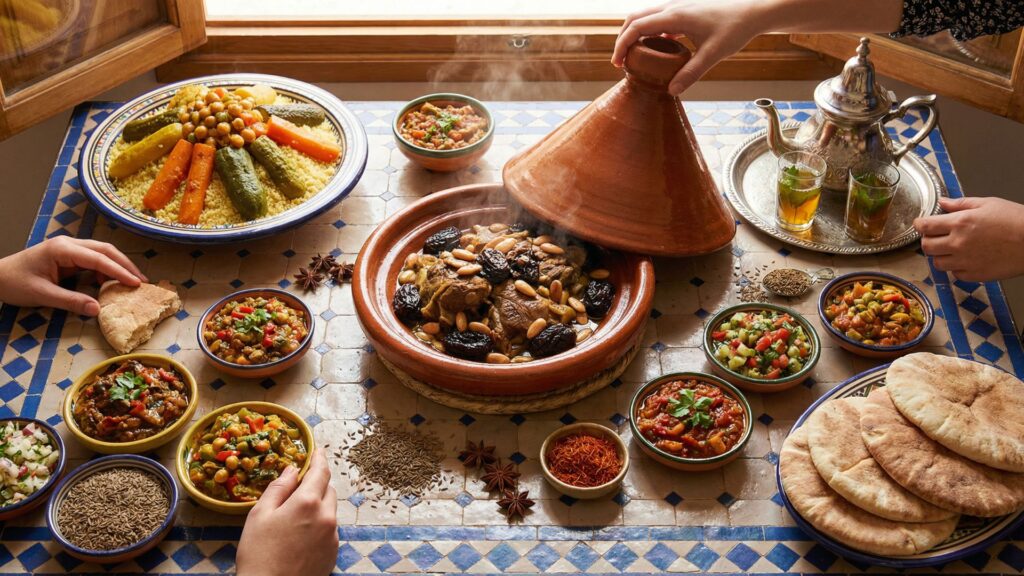
Lunch at a local restaurant, a bowl of harira soup with bread, a kefta sandwich from a medina grill, a plate of couscous on Friday when it is traditionally served: these run two to five dollars and represent some of the most satisfying eating in Morocco. The city food halls, covered markets with multiple vendors selling prepared food, exist in most major cities and provide the combination of variety, quality, and price that makes them worth seeking out specifically.
Dinner at a mid-range restaurant in the medina with a proper tagine, a shared pastilla, and mint tea runs fifteen to twenty-five dollars for two people. The evening meal at a tourist-facing riad restaurant with a fixed menu and courtyard setting runs thirty to fifty dollars for two, which is often worth it for the atmosphere on one or two nights of a longer trip.
Alcohol is available in Morocco at licensed restaurants and hotels and is expensive relative to the overall price level. A beer at a licensed restaurant costs four to seven dollars. Morocco is primarily a non-drinking country and alcohol is genuinely absent from most medina restaurants. Factoring alcohol costs into a Morocco trip budget requires accepting that the country’s low overall price level does not extend to this category.
| Meal Type | Approximate Cost Per Person |
|---|---|
| Neighborhood cafe breakfast | $2 to $4 |
| Riad breakfast included | Factored into room rate |
| Local lunch restaurant | $3 to $7 |
| Mid-range dinner restaurant | $10 to $18 |
| Tourist track restaurant | $15 to $25 |
| Riad fixed menu dinner | $20 to $30 |
| Street food snack | $0.50 to $2 |
| Fresh-squeezed orange juice | $0.75 to $1.50 |
Transport: Understanding Where Costs Accumulate
Getting to Morocco is the transport cost that dominates the budget for most international travelers, and it is also the cost most amenable to strategic management.
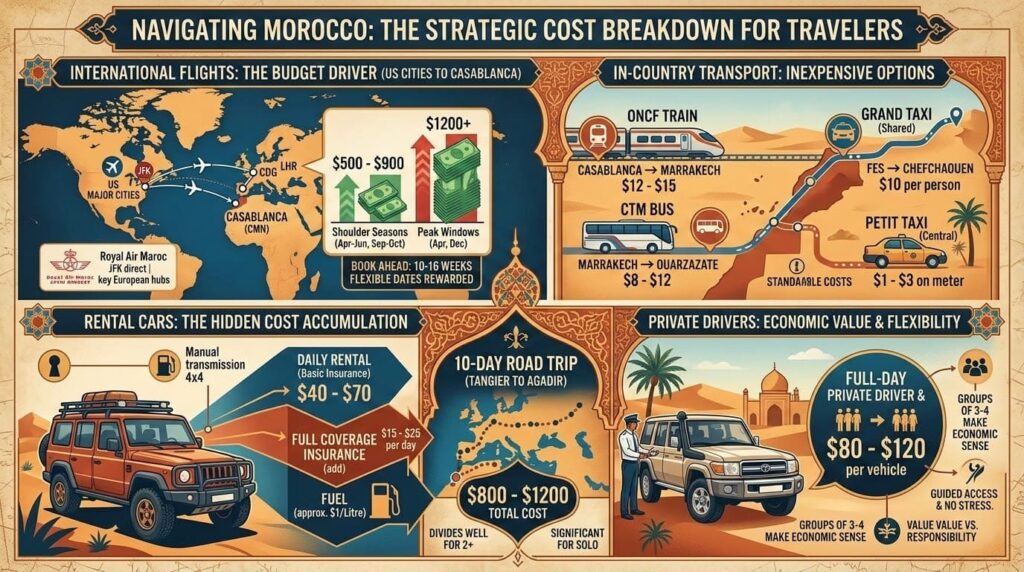
Flights from major US cities to Casablanca Mohammed V International Airport run between 500 and 900 dollars return in the shoulder seasons and can exceed 1,200 dollars during the April and December peak windows. Royal Air Maroc operates direct flights from New York JFK that are worth checking alongside European hub connections through Paris, Madrid, or London. The most reliable way to reduce flight costs is booking ten to sixteen weeks ahead and maintaining flexibility on dates within a travel window rather than requiring specific dates.
Once inside Morocco, ground transport is inexpensive by Western standards. An ONCF train ticket from Casablanca to Marrakech costs twelve to fifteen dollars in second class. A CTM bus from Marrakech to Ouarzazate costs eight to twelve dollars. A grand taxi shared ride from Fes to Chefchaouen costs around ten dollars per person. A petit taxi ride across central Marrakech costs one to three dollars on the meter.
Rental cars for travelers who choose to drive add a meaningful line item that most trip budgets underestimate. A standard manual transmission vehicle from an international rental company costs forty to seventy dollars per day including basic insurance. Full coverage insurance adds fifteen to twenty-five dollars per day. Fuel costs approximately one dollar per liter. A ten-day road trip covering the major Morocco driving route from Tangier to Agadir runs to eight hundred to twelve hundred dollars in total vehicle costs including fuel, which divides well between two travelers but represents a significant per-person addition on a solo road trip.
Private drivers are an alternative to rental cars for travelers who want flexibility without the responsibility of driving unfamiliar roads. A full-day private driver and vehicle typically costs eighty to one hundred and twenty dollars for the vehicle, which makes economic sense for groups of three or four and represents good value for the guided access to specific destinations it provides.
Experiences and Activities: Where the Budget Surprises Happen
The experience costs that most first-time Morocco trip budgets underestimate fall into two categories: the Sahara desert camp and the guided medina experiences.
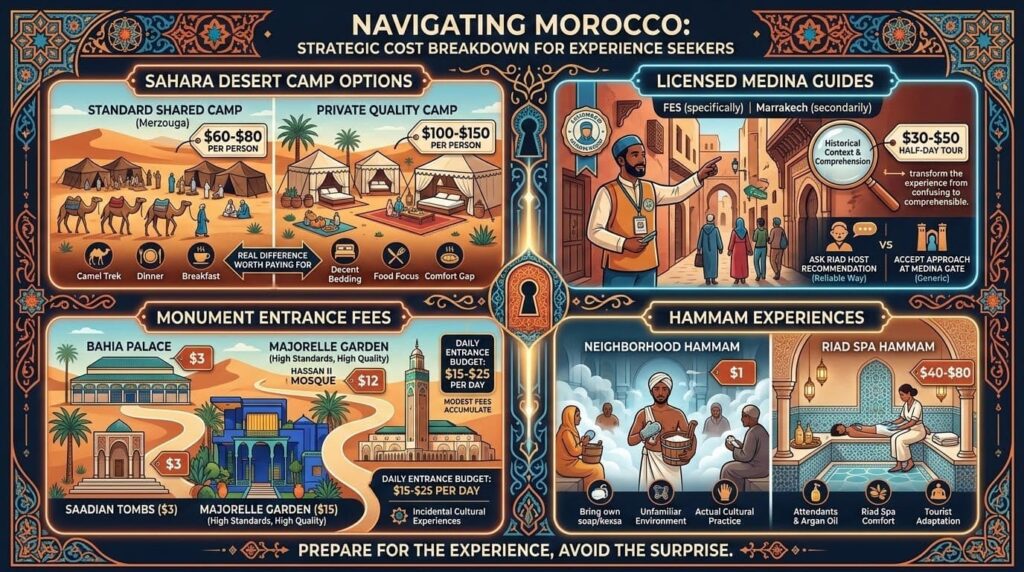
The desert camp is the most significant single discretionary cost in a Morocco trip and the one where the difference between budget and quality options is most pronounced. A standard shared camp experience at Merzouga including camel trek, dinner, breakfast, and accommodation in a Berber tent costs sixty to eighty dollars per person. A private tent in a quality camp with proper bathroom facilities, decent bedding, and food that does not feel like an afterthought costs one hundred to one hundred and fifty dollars per person. The gap between those experiences is real and worth paying for if the Sahara is a priority of the trip.
Guided medina tours are worth budgeting for in Fes specifically and in Marrakech secondarily. A licensed guide in Fes charges thirty to fifty dollars for a half-day tour that covers the medina’s major sights with the historical and cultural context that transforms the experience from confusing to comprehensible. The difference between a good guide and a generic one is significant, and asking your riad host for a specific recommendation rather than accepting the approach of whoever finds you at the medina gate is the reliable way to get the former.
Entrance fees to Morocco’s major monuments are modest but accumulate through a longer trip. The Bahia Palace costs three dollars. The Saadian Tombs cost three dollars. The Majorelle Garden costs fifteen dollars, which is high by Moroccan standards but justified by the garden’s quality and maintenance. The Hassan II Mosque guided tour costs twelve dollars. Budgeting fifteen to twenty-five dollars per day for entrance fees and incidental cultural experiences is adequate for most itineraries.
Hammam experiences range from one dollar at a neighborhood hammam where you bring your own soap and kessa scrubbing mitt, to forty to eighty dollars at a riad spa hammam with attendants and argan oil treatments. Both are genuine experiences. The neighborhood hammam requires more comfort with unfamiliar environments and a minimal amount of French or Arabic, but delivers the actual cultural practice rather than the tourist adaptation.
The Tipping Reality
Tipping in Morocco is expected, genuinely matters to the people who receive it, and adds a meaningful line item to the overall trip budget that most planning resources mention briefly and then leave uncalculated.
The standard tipping rates in 2026 run as follows. Restaurant servers expect ten percent of the bill at tourist-facing establishments and a round-up of a few dirhams at local restaurants. Riad staff who provide specific services, the person who brings your breakfast, the one who carries your bags, expect ten to twenty dirhams per service. Licensed guides expect fifty to one hundred dirhams per half-day from the group, not per person. Drivers expect one hundred to two hundred dirhams per day depending on the distance covered. Hammam attendants expect twenty to fifty dirhams.
Across a ten-day trip for two people with moderate activity levels, tipping adds approximately thirty to sixty dollars to the total trip cost. This is not an optional category. It is a built-in component of the Morocco travel economy and treating it as such, budgeting for it explicitly rather than treating it as an afterthought, reflects both accurate planning and respectful travel.
The Honest Per-Day Morocco Trip Cost in 2026
Combining all categories into an honest per-day figure for each budget level produces the following:
| Budget Level | Daily Cost Per Person | What It Covers |
|---|---|---|
| Budget | $45 to $65 | Hostel or cheap guesthouse, local food, public transport, some entrance fees |
| Mid-range | $110 to $160 | Decent riad, mix of local and restaurant dining, public transport plus occasional taxis, guided experiences |
| Comfortable | $180 to $260 | Quality riad, restaurant dining, private transfers for some legs, private guides, full desert camp |
| Luxury | $350 and above | Luxury riad or boutique hotel, private drivers, exclusive experiences |
These figures exclude flights and exclude the desert camp, which is best budgeted as a fixed cost of eighty to one hundred and fifty dollars per person added to the total trip budget rather than averaged into the daily rate.
A mid-range ten-day Morocco trip for two people, including flights from New York, accommodation, food, transport, experiences, and tipping, runs to approximately three thousand five hundred to four thousand five hundred dollars total. That figure is not a guarantee. It is the honest center of the range that fits a well-planned trip at a quality level that most travelers find satisfying without feeling either constrained or extravagant.
Where to Spend More and Where to Save
The travelers who come back from Morocco most satisfied are almost never the ones who spent the most. They are the ones who spent strategically, putting money into the things that genuinely improve the experience and not into the things that only look expensive in the planning stage.
Spend more on accommodation in Fes and Marrakech specifically. The difference between a mediocre riad and a good one in these cities is the difference between an average night’s sleep in a fine but forgettable room and waking up to a tiled courtyard with morning light and the sound of the city outside thick walls. That experience has a genuine dollar value and is worth paying for.
Spend more on the desert camp if the Sahara is on your itinerary. One night in a quality private camp is worth more than two nights in a budget shared camp for most travelers.
Transport costs drop significantly when you use public options where they work well, which covers most city-to-city movement. For medina food, eat where Moroccans eat rather than where the tourist map points. Entrance fees add up quickly, so be selective rather than comprehensive.
If you are still calibrating the overall shape of your trip alongside the budget, the complete Morocco itinerary planning framework covers how different route structures affect the cost distribution across a trip, and the best time to visit Morocco breakdown explains how seasonal timing moves prices up and down across every accommodation and experience category.
What aspect of Morocco travel costs surprised you most when you started planning your trip?