
Chefchaouen travel guide: how to plan your trip to Morocco’s blue city
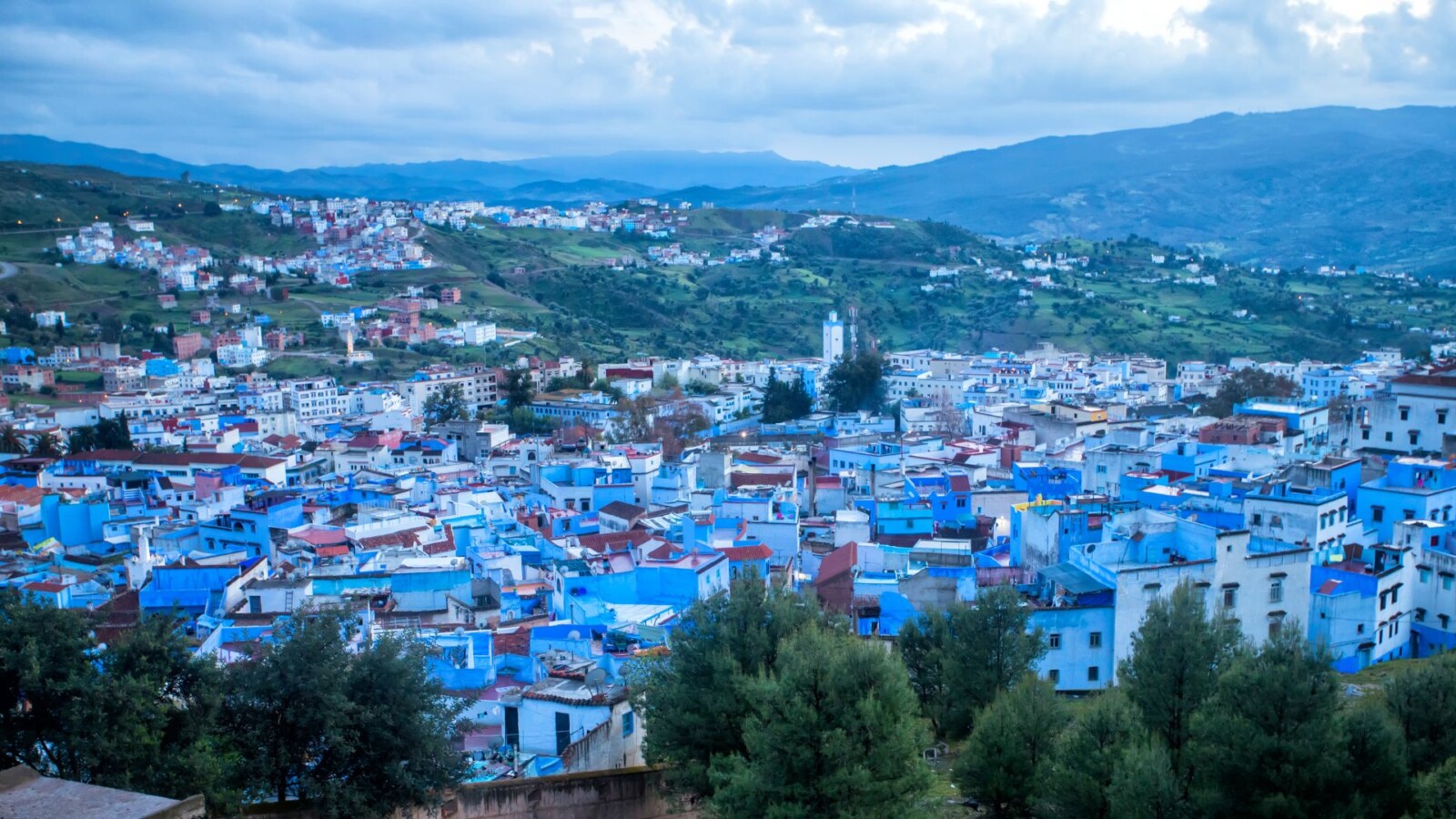
Nobody warns you that the silence will be the first thing you notice.
You expect the color. Every photograph of Chefchaouen prepares you for it: the cobalt walls, the powder-blue alleyways, the hand-painted staircases climbing into a hillside that the rest of Morocco seems to have forgotten exists. What no photograph communicates is the particular quality of quiet that settles over the medina at dawn, when the city belongs entirely to its residents and the only sounds are a fountain somewhere, the first call to prayer, and the unhurried footsteps of a baker carrying bread through lanes that will be full of visitors in three hours.
Chefchaouen sits in the Rif Mountains of northern Morocco, roughly 120 kilometers from Tangier and four hours from Fes, at an altitude of around 600 meters that keeps its evenings cool even in July and dusts its peaks with snow in January. It is a small city of approximately 45,000 people that has become, through a combination of extraordinary visual identity and social media amplification, one of the most recognizable destinations in Africa.
The reasonable question is whether it justifies the attention. The honest answer is yes, but not for the reasons most people expect. The blue walls are real and they are genuinely beautiful. The experience of being inside a city that looks like this, that has looked like this for decades, in the fold of forested mountains that extend in every direction, is something that photographs approximate but do not capture. What actually earns Chefchaouen its reputation is the full layered reality of the place: the history beneath the paint, the food culture rooted in mountain ingredients, the surrounding landscape that rewards day trips beyond the blue city, and the particular atmosphere that results from a small city that has absorbed extraordinary external attention without losing the thread of its own daily life. If you are planning a visit, it is worth reviewing the Chefchaouen travel tips every visitor should know before you go.
This guide covers everything needed to plan a trip that goes beyond the surface.
Why Chefchaouen is unlike any other city in Morocco?
The instinct to compare Chefchaouen to Morocco’s imperial cities is understandable and almost entirely unhelpful. Marrakech and Fes are large, complex, historically dense urban environments built around centuries of commercial and political power. Chefchaouen was founded in 1471 as a mountain fortress, grew through waves of Andalusian and Jewish refugees fleeing the Reconquista in Spain, and developed into a self-contained community shaped by isolation, altitude, and a distinct northern Moroccan identity that still feels palpably different from anything south of the Rif.
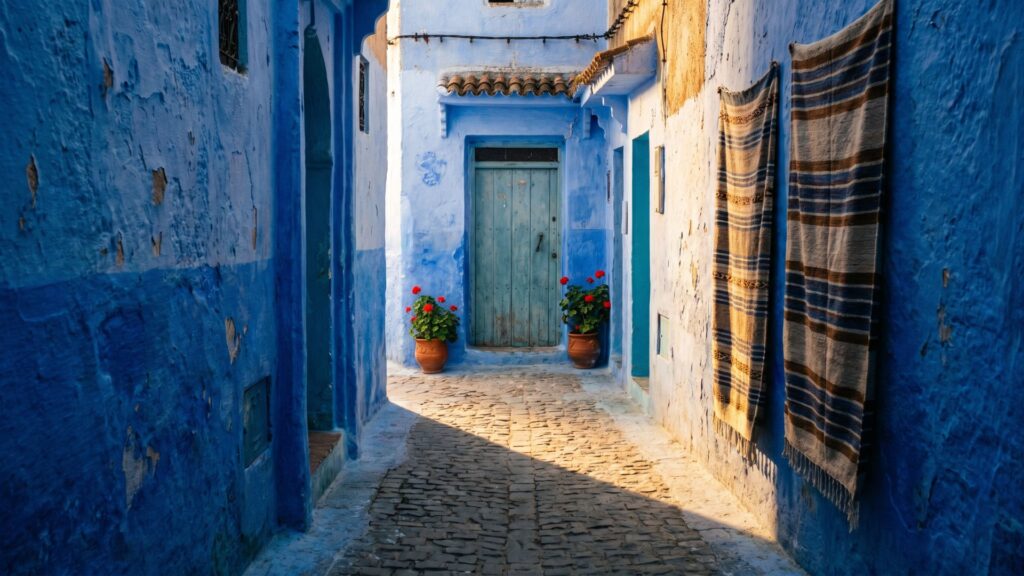
The blue paint is the detail that travelers ask about first and the one that generates the most contested explanations. The most widely cited origin links the color to the Jewish community that settled in Chefchaouen in the 1930s, for whom blue held spiritual significance connected to heaven and divine protection. Others point to practical reasoning: blue reportedly deters mosquitoes and reflects heat in ways that keep interiors cooler. Local historians note that the uniform blue aesthetic was not fully established until the 1970s, when tourism began developing and residents embraced the visual identity more deliberately. All three explanations may be partially true, which is usually how the most interesting cultural details work.
What the color creates, functionally, is a medina with a coherent visual atmosphere that other Moroccan cities, despite their own considerable beauty, do not replicate. Walking through Chefchaouen is a different sensory experience from walking through the souks of Fes or the Djemaa el-Fna in Marrakech. It is quieter. The salesmanship is less aggressive. The pace is slower. The city is small enough that you can walk from one end to the other in twenty minutes and large enough to reward several days of exploration without feeling you have covered everything.
The Spanish Mosque above the medina, the Ras el-Maa waterfall at its northeastern edge, the kasbah museum on the main square, and the network of hiking trails climbing into cedar forest above the rooftops all exist within a fifteen to thirty minute walk of any point in the old city. The geography is intimate in a way that creates a specific kind of travel experience: unhurried, walkable, oriented around the rhythm of the city rather than the logistics of getting between attractions.
| Feature | Chefchaouen | Marrakech | Fes |
| Medina size | Small (20 min walk end to end) | Very large | Large |
| Altitude | 600m | 466m | 415m |
| Crowd level (peak) | Moderate-high | Very high | High |
| Primary appeal | Visual identity, slow travel | Markets, nightlife | History, architecture |
| Pace | Relaxed | Intense | Immersive |
| Best for | Photography, atmosphere | First-time Morocco visitors | Deep cultural exploration |
The traveler and writer Sarah Okafor, who visited Chefchaouen in October 2023 after spending a week in Marrakech, described the transition as “arriving somewhere that isn’t trying to sell you anything, which in Morocco takes some getting used to.” That observation captures something real. Chefchaouen has adapted to tourism without centering its identity around it, and that distinction shapes every hour you spend inside the medina.
For a deeper look at what separates this city from the rest of Morocco and whether it belongs on your itinerary, the full breakdown of why Chefchaouen is worth visiting covers the honest trade-offs alongside the genuine rewards.
Best time to visit Chefchaouen
Timing a trip to Chefchaouen is a more consequential decision than it is for most Moroccan destinations, and the reason comes back to altitude. At 600 meters above sea level, the city does not follow the same weather logic as Marrakech or the Atlantic coast. The seasons here are more pronounced, the temperature differentials between day and night are more significant, and the crowd patterns follow a rhythm shaped by both international tourism and Moroccan domestic travel that peaks and thins in ways that meaningfully alter the experience of being there.
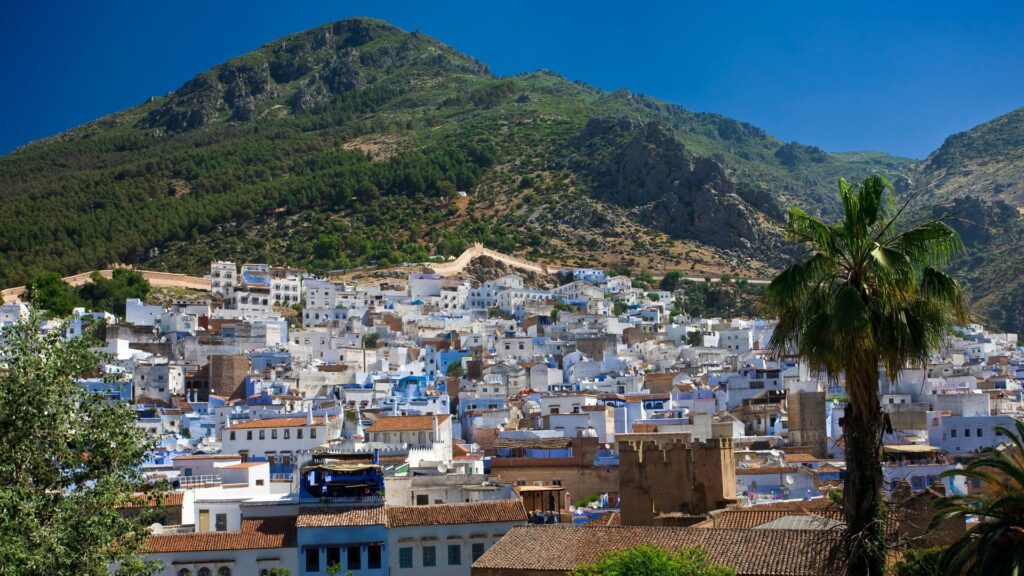
The short answer, for travelers who want one: late September through mid-October, or the first two weeks of June. Both windows deliver comfortable temperatures, manageable crowds, and a version of the city that feels lived-in rather than overwhelmed. Everything else on this spectrum involves trade-offs worth understanding before you book.
Spring: the obvious choice with one caveat
March through May is the most consistently recommended window, and the recommendation holds up. Daytime temperatures settle between 18 and 24 degrees Celsius, the hillsides surrounding the medina are intensely green from winter rainfall, and the light in the late afternoon has a softness that photographers specifically schedule trips around. The Ras el-Maa waterfall runs strong in spring, the almond trees flower in late February and carry into March, and the combination of blue walls against green mountain backdrop is, genuinely, the version of Chefchaouen that most travel photography attempts and rarely fully captures.
The caveat is April specifically. Tour groups from Tangier and Fes arrive on day excursions through the entire month, and the most photographed corners of the medina can feel genuinely congested between 10 a.m. and 4 p.m. The solution is consistent and requires only an early alarm: be in the alleyways before 8 a.m. and the city is yours. The day-trippers do not arrive before 9 at the earliest. Those early hours belong to overnight guests, which is one of the strongest practical arguments for staying at least two nights.
Summer: early June earns its reputation, August does not
June is underrated across Morocco and particularly so in Chefchaouen. The spring crowds have thinned, the days are long, and evenings on a riad rooftop are comfortable rather than cold. Experienced Morocco travelers quietly consider early June one of the best months to visit the north.
July changes the calculation. Moroccan domestic tourism peaks through July and August, and Chefchaouen absorbs a significant share of families seeking cooler mountain air than the coast provides. August combines peak domestic tourism with peak European summer travel, and the result is a medina that operates at a volume the infrastructure was not designed to handle. The city remains beautiful. It just requires more patience and earlier mornings to experience it clearly.
Fall: the season that experienced travelers know about
October is the month that appears most consistently on the lists of travelers who have been to Chefchaouen more than once. European summer tourism has ended. Moroccan families have returned to school schedules. Temperatures sit in the low-to-mid 20s during the day and cool pleasantly in the evenings. The light in fall has a directness and warmth that spring light, which can be slightly diffuse, does not always deliver.
More importantly, October gives you a city that moves at its own pace. Shopkeepers have time for actual conversation. The alleyways feel like what they are, a residential neighborhood in a mountain town, rather than a curated experience being performed for an audience.
November brings more rain and cooler temperatures, with wet cobblestones that make the medina’s stepped lanes genuinely slippery. Waterproof footwear becomes important. The trade-off is a city that is nearly empty of tourists and fully inhabited by its actual community.
Winter: cold, quiet, and worth considering
December through February is the season that most travel content skips entirely, which is its own recommendation for a certain type of traveler. Daytime highs in January sit around 12 to 14 degrees Celsius, nights drop to 4 or 5 degrees, and snow on the peaks above the medina is not uncommon in heavy winters. In exceptional years, snow falls inside the city itself, producing a visual of blue walls under white snow that almost nobody is there to photograph.
The medina in winter is authentic in a way that no other season matches. Cafes fill with locals rather than travelers. Hammams become genuinely essential rather than optional cultural experiences. The city operates entirely for itself, and being inside it as a visitor produces a quality of experience that is harder to find when the tourist economy is running at full capacity.
Ramadan: a different kind of visit
Ramadan shifts approximately eleven days earlier each year on the Gregorian calendar. Traveling during it requires practical adjustment: restaurant hours compress significantly during daylight, street food culture largely pauses until iftar at sunset. What you gain is access to one of the most genuinely atmospheric evenings in Moroccan travel. The hour after iftar transforms the medina into something communal and deeply alive. For travelers willing to adapt their eating schedule and approach the experience with genuine curiosity, it can become the most memorable visit of all.
| Month | Temp (day) | Crowds | Best for |
| March-April | 16-20°C | Moderate-high | Photography, hiking |
| May-June | 23-28°C | Moderate | Best overall balance |
| July-August | 31-33°C | Very high | Early mornings only |
| September-October | 22-28°C | Low-moderate | Atmosphere, slow travel |
| November-February | 12-17°C | Very low | Authenticity, solitude |
For a full month-by-month breakdown including photography timing, Ramadan logistics, and specific booking lead times by season, the detailed guide to the best time to visit Chefchaouen covers every variable that should inform your decision.
Getting to Chefchaouen and finding the right place to sleep
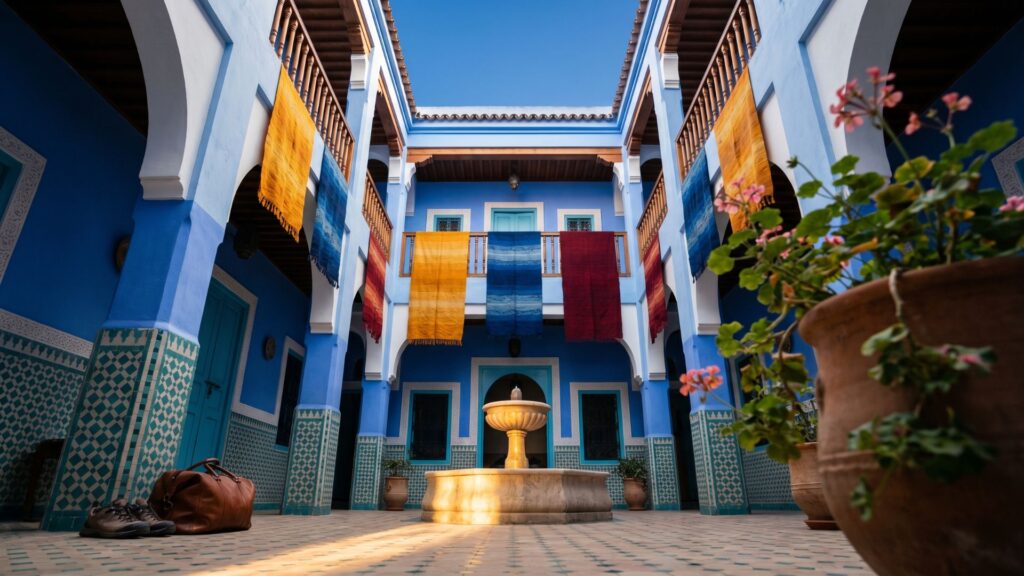
These two decisions are more connected than they might initially appear. How you arrive shapes what you carry. What you carry shapes how difficult your arrival at your accommodation will be. And in Chefchaouen, where your vehicle stops and where you actually sleep can be separated by fifteen minutes of uphill walking through narrow cobblestone lanes, the sequence of these choices matters in a practical way that most destination guides treat as an afterthought.
The transport reality: no trains, limited options, clear solutions
Chefchaouen has no train station and no airport. Every traveler arrives by road, which means bus, shared taxi, private transfer, or rental car. The two most common entry points are Tangier to the north and Fes to the southeast, and both connections are well-serviced enough that the logistics, once understood, are entirely manageable.
From Tangier, the CTM national bus company runs multiple daily departures to Chefchaouen covering roughly 120 kilometers in two and a half to three hours. Tickets cost between 60 and 80 Moroccan dirhams and can be booked in advance through the CTM website, which is worth doing in April and May when departures fill. Grand taxis cover the same route for slightly more per seat and depart when full rather than on a fixed schedule, which suits travelers with flexible timing and less luggage.
One detail that catches ferry arrivals off guard: the Tangier-Med ferry port sits approximately 40 kilometers east of Tangier city. Budget for a taxi or shuttle into Tangier proper before connecting onward, and factor that leg into your timing when planning same-day connections to Chefchaouen.
From Fes, CTM runs a direct service taking four to five hours across approximately 200 kilometers of mountain terrain that is worth staying awake for. The final hour of approach into the Rif from either direction produces views that make the journey feel like an event rather than a transfer. Grand taxis from Fes require at least one change in Ouezzane, which adds time and organizational effort that the direct bus eliminates cleanly.
Travelers coming from Casablanca or Rabat face a longer haul. The most practical approach is connecting by train to Tangier, which is fast and comfortable, and continuing by bus. A same-day connection from Rabat to Chefchaouen is realistic with a morning departure. From Casablanca, the train to Tangier takes around four and a half hours, leaving enough runway for the bus connection if you depart early.
Renting a car offers flexibility for day trips once you arrive but comes with two caveats worth knowing upfront. The mountain roads require genuine attention and are best avoided after dark. More importantly, vehicles cannot enter the medina. You will park at the edge of the old city and carry everything on foot from there, which is fine with a manageable bag and less fine with a large rolling suitcase on stepped cobblestone lanes.
| Route | Mode | Duration | Approx. cost |
| Tangier to Chefchaouen | CTM bus | 2.5-3 hrs | 60-80 MAD |
| Tangier to Chefchaouen | Grand taxi | 2-2.5 hrs | 80-100 MAD |
| Fes to Chefchaouen | CTM bus | 4-5 hrs | 80-110 MAD |
| Casablanca to Chefchaouen | Train + bus | 7-8 hrs total | 150-200 MAD |
| Any city | Private transfer | Varies | $50-120 USD |
Private transfers arranged through your accommodation cost significantly more than the bus but offer door-to-accommodation service and are worth considering for families with children, late arrivals, or anyone carrying more luggage than mountain stairs were designed to accommodate.
For a complete breakdown of every route including grand taxi logistics, private transfer costs, and the specific detail of what happens between the bus station and your accommodation door, the full guide on how to get to Chefchaouen covers every realistic option with honest timing and cost comparisons.
Where to sleep: a decision that shapes the entire trip
The most important accommodation decision in Chefchaouen is not which property to choose. It is whether to sleep inside the medina or outside it.
Sleep inside and you wake up before the day-trippers arrive. The early morning alleyways, empty and blue and lit by the particular quality of mountain dawn light, are accessible only to people staying within the old city walls. That access is worth more than any amenity a hotel outside the medina can offer, and travelers who prioritize it consistently report it as the detail that most elevated their experience.
Sleep outside the medina walls and you gain easier vehicle access, lower prices at comparable comfort levels, and a slightly less complicated arrival. The new town surrounding the medina has conventional two and three-star hotels that are perfectly comfortable and entirely missing the point of being in Chefchaouen.
Within the medina, the options span a genuine range. Budget guesthouses run by local families offer private rooms from around 150 to 300 dirhams per night, simple Moroccan breakfasts, and the kind of local knowledge that no review platform can replicate. The quality at this tier in Chefchaouen is notably better than in comparably priced accommodation in Morocco’s larger cities. Casa Perleta and Dar Meziana appear consistently in traveler recommendations and reflect the standard of small owner-operated properties that form the backbone of the medina’s accommodation economy.
The mid-range tier, between 400 and 800 dirhams per night, opens up the boutique riad experience that Chefchaouen does particularly well. Traditional courtyard houses converted into guesthouses with en suite bathrooms, rooftop terraces, carved plaster details, and zellige tilework that would cost significant money to replicate anywhere outside Morocco. Location matters at this tier. A riad in the upper medina near the Bab el-Ain gate is quieter and more residential. A riad just off Plaza Uta el-Hammam puts you closer to the city’s social center but accepts the corresponding noise until late in the evening.
At the upper end of the market, a small number of heritage properties occupy converted historic houses with multiple floors, mountain-view terraces, and a level of personal service that turns a stay into something closer to a hosted experience than a hotel visit. Prices range from 800 to 1,500 dirhams and upward in peak season, and the best properties at this tier sell out weeks ahead in April and October. Booking with genuine lead time is not optional here.
One practical reality that every medina property shares regardless of tier: stairs. Narrow ones, steep ones, sometimes many of them. The hillside construction of a historic mountain medina is not designed for flat access, and if mobility is a consideration, asking specifically about the physical layout before booking is worth the direct question.
For a full breakdown of every accommodation tier, the best neighborhoods within the medina, and specific booking timing advice by season, the complete guide to where to stay in Chefchaouen covers the decision in the detail it deserves.
The arrival experience: what to expect after the taxi drops you off
The CTM bus station in Chefchaouen sits at the foot of the hill below the medina, roughly fifteen minutes on foot from the main entrance gate. Grand taxis stop in the same general area. From there, the medina is uphill.
Most guesthouses share walking directions from the main gate when you confirm your reservation. Follow them carefully. Map applications lose accuracy inside dense medina environments, and the visual uniformity of blue walls makes orientation slower than usual on a first visit. Message your accommodation the morning of arrival to confirm timing and ask whether someone can meet you near the medina entrance. Most owners are genuinely happy to do this, and it converts a potentially disorienting arrival into a straightforward one.
Once you are inside and settled, the city opens up in a way that no amount of reading quite prepares you for.
For a full breakdown of every accommodation tier, the best neighborhoods within the medina, and specific booking timing advice by season, the complete guide to where to stay in Chefchaouen covers the decision in the detail it deserves.
What to do, eat, and experience in Chefchaouen
The travelers who leave Chefchaouen underwhelmed almost always made the same mistake: they treated it like a backdrop rather than a destination. They walked the blue alleyways, took the photographs, ate a tagine on the main square, and left having experienced the surface of a place that rewards a different kind of attention entirely.
The city is small enough to feel manageable from the first morning and layered enough that three days of genuine exploration still leaves corners unexplored. Understanding where to put your time, and where not to, is the difference between a trip that produces good photographs and one that produces something harder to categorize and considerably more valuable.
The morning hours belong to those who claim them
The single most important activity in Chefchaouen costs nothing and requires only willingness to set an alarm. Be inside the medina by 6:30 a.m.
The alleyways that will be shoulder-to-shoulder with visitors by 10 a.m. are completely empty at dawn. The light falls sideways through gaps between buildings and turns the blue walls into something closer to a painting than a photograph. Cats move through the lanes with complete ownership. A baker somewhere is pulling bread from a communal oven. The only sounds are water from a fountain and the first call to prayer echoing off stone that has absorbed that same sound for five centuries.
This is not a minor upgrade to the standard Chefchaouen experience. It is a fundamentally different one. Day-trippers arriving by bus from Tangier and Fes do not reach the medina before 9 a.m. at the earliest. The two and a half hours between sunrise and their arrival belong entirely to overnight guests, which is one of the strongest arguments for staying at least two nights that exists anywhere in Morocco.
Beyond the famous staircase: how to walk the medina properly
The most photographed spot in Chefchaouen is the staircase on Rue Targhi, a blue-washed stepped alleyway that appears in what feels like a significant portion of all Morocco travel content published in the last decade. It is genuinely beautiful. See it at dawn. Then move on.
The more rewarding walk climbs through the upper medina, starting from the Bab el-Ain gate and threading through neighborhoods where the blue paint gives way to white, then to bare stone, then back to blue in combinations that feel organic rather than curated. These lanes are steeper, quieter, and more honestly lived-in. Children play in doorways. Elderly men sit outside their houses on low walls. The tourist infrastructure thins out noticeably, and what replaces it is the actual texture of daily life in a small Moroccan mountain city.
The kasbah museum on the western edge of Plaza Uta el-Hammam is worth an hour of any curious traveler’s time. The fortified structure dates from the 15th century and contains an archaeological collection alongside a rooftop terrace that delivers one of the best elevated views of the medina available anywhere in the city. Entry costs a few dirhams. The crowds inside are a fraction of what they are on the square itself.
The Spanish Mosque hike: the view that puts everything in context
Twenty minutes on foot above the upper medina, following a well-worn dirt trail through scrubby hillside vegetation, sits an abandoned mosque built during the Spanish colonial period of the early 20th century. It has never been used for worship. It stands open on a hilltop with a terrace that looks down over the entire medina, the valley, and the Rif Mountain ridgelines extending in both directions.
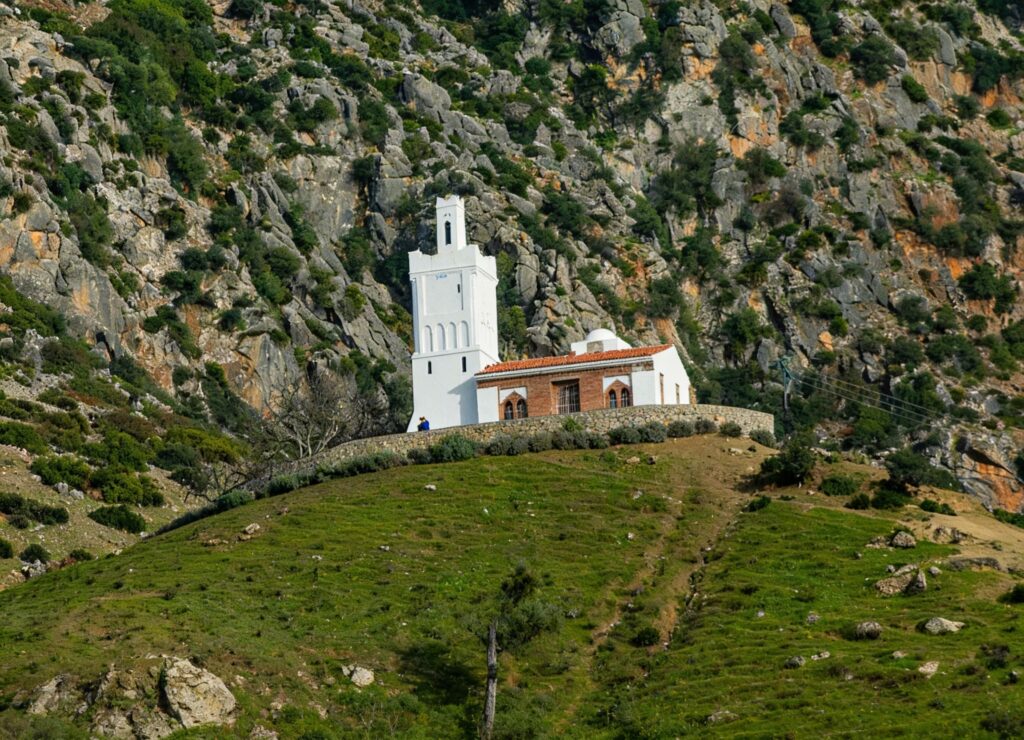
Sunrise from the Spanish Mosque is the benchmark experience in Chefchaouen for photographers and non-photographers alike. The light arrives behind the mountains and fills the valley gradually, and the medina shifts through a sequence of colors over roughly forty minutes that justifies every early alarm ever set. Sunset delivers equally strong light and draws a slightly larger crowd for the same reason.
The trail continues past the mosque into cedar forest that climbs high enough above the city to see it from a distance that makes it look exactly like what it is: a blue city tucked into a fold in the mountains. Even a thirty-minute extension past the mosque and back is enough to shift your understanding of the landscape entirely.
Ras el-Maa and the waterfall quarter
At the northeastern edge of the medina, where the old city meets the hillside and stone lanes give way to a path alongside a stream, Ras el-Maa offers one of the most lived-in scenes in the city. The small waterfall and the natural spring feeding it are modest in scale and significant in atmosphere. Local women still use the stream for laundry, washing textiles on flat stones and spreading them to dry in colors that photograph beautifully against the surrounding vegetation and stone.
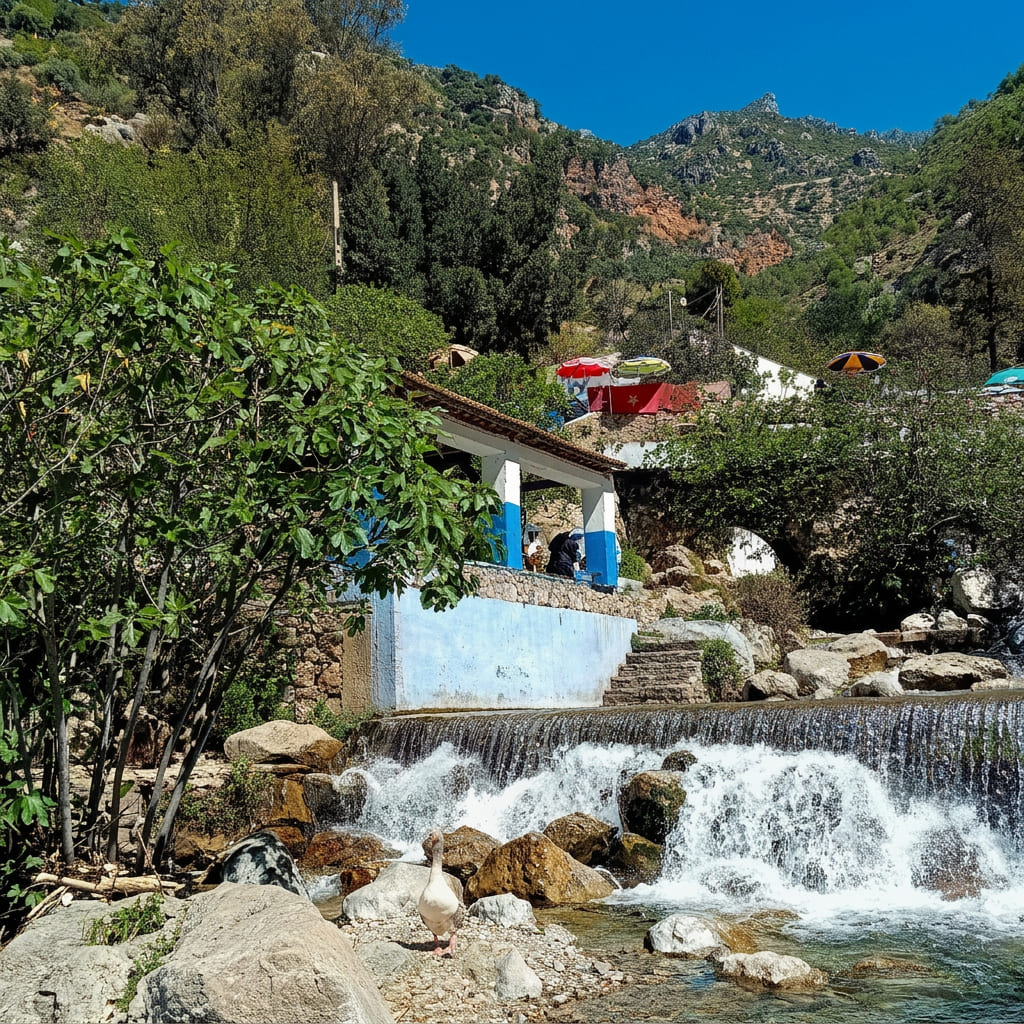
Approaching this scene with genuine respect for what it is, a working neighborhood activity rather than a staged cultural demonstration, shapes how the experience unfolds. Ask before pointing a camera at anyone. Many women will decline, and that is entirely their prerogative. The landscape is freely photographed. The human activity around it should be treated with the courtesy you would expect in return.
The path from Ras el-Maa continues uphill toward Ain Tissimane, a spring area popular with locals for picnics and one of the starting points for longer mountain trails. Walking thirty minutes up this path and turning back gives you a genuine taste of the Rif landscape that the medina, for all its beauty, cannot provide.
What to eat: the food culture that most visitors miss entirely
Chefchaouen does not appear prominently on Morocco’s culinary map, which is an oversight worth correcting. The city’s food tradition is rooted in Rif Mountain ingredients, specifically the goat herds, small farms, wild herbs, and olive groves that surround it, and it produces flavors that the imperial city cooking traditions of Marrakech and Fes do not replicate.
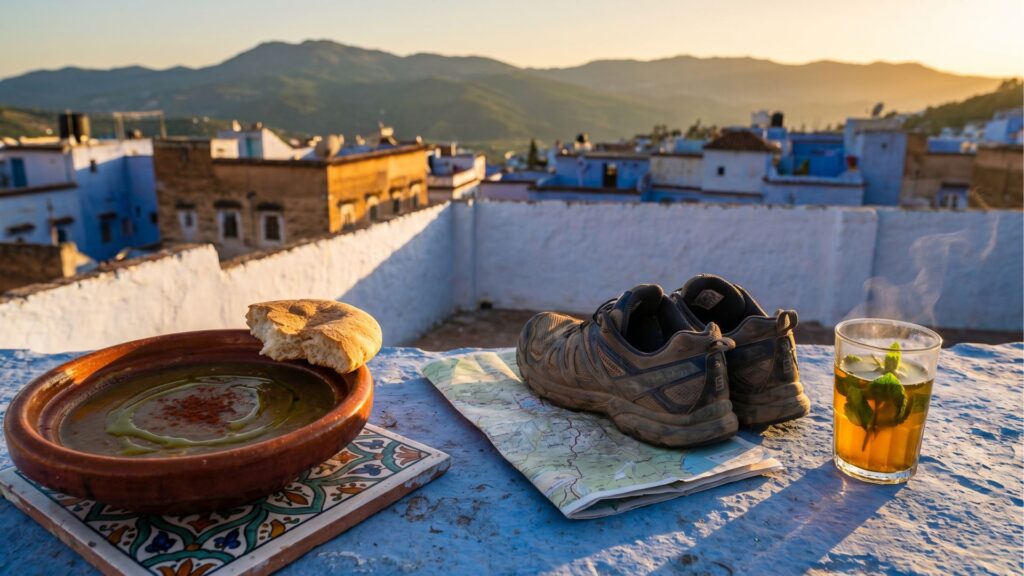
The best meal you will eat in Chefchaouen will probably cost less than four dollars and happen before 8 a.m. A clay bowl of bissara, thick fava bean soup finished with a pour of local olive oil and a pinch of cumin, eaten at a small counter near the residential edge of the medina while the city is still mostly quiet around you. It is made from ingredients grown in the surrounding mountains and prepared in a way that has not changed significantly in generations.
Fresh goat cheese is the most locally specific food product the city offers and deserves more attention than it receives in most travel coverage. Small rounds of soft, lightly salted cheese sold at the market near the medina entrance are made from the milk of goats raised on hillsides visible from the medina and sold the same day or the day after production. Eat it for breakfast on bread with local honey. Take a round back to your riad and eat it on the rooftop with mint tea as the evening light changes on the city below you. It does not travel or keep well enough to bring home, which makes eating it here feel specifically valuable.
The tagine worth ordering in Chefchaouen is lamb with prunes and almonds, a northern Moroccan classic that, when made properly in a terracotta tagine over low heat with quality lamb, is one of the great dishes of the country’s cooking tradition. The tell is time: a proper tagine takes the better part of an hour and arrives still steaming with the sauce reduced to a dark, glossy consistency. If it appears in fifteen minutes, it was not made to order.
The restaurants facing directly onto Plaza Uta el-Hammam operate under conditions, high rent, high turnover, menus in four languages, a customer base that will never return regardless of the experience, that do not tend to produce memorable food. Walk one block off the plaza in any direction and the ratio of quality to price shifts noticeably in your favor.
The hammam: non-negotiable regardless of season
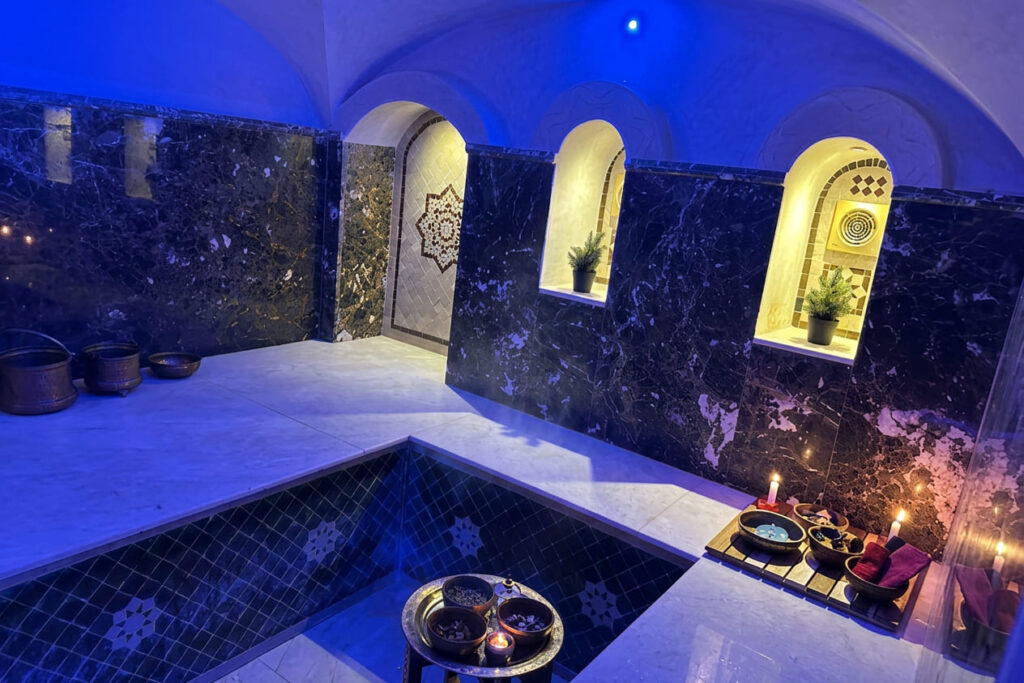
Every Moroccan city has hammams but there is something specific about visiting one in Chefchaouen that earns its place on any itinerary. The contrast between mountain cold outside and steam inside is more pronounced here than in warmer cities, and the local hammams have not yet been fully converted into tourist-oriented spa experiences.
A traditional visit involves a progression through rooms of increasing heat, a kessa scrub that removes an amount of dead skin that will surprise you, and an application of beldi black soap made from olive oil. The entire experience costs a fraction of what a spa treatment would run anywhere in Europe. Ask your accommodation to recommend a neighborhood hammam rather than the tourist-oriented options near the main square.
The evenings: how to end your days correctly
Chefchaouen’s evenings have their own rhythm and deserve as much intentional planning as the days. The hour between 8 and 10 p.m. is when Plaza Uta el-Hammam transforms from tourist attraction to neighborhood living room. Families settle onto the benches. Vendors set up carts of roasted nuts and fresh juice. The atmosphere acquires a warmth that is genuinely communal rather than performed for an audience.
Rooftop terraces at this hour offer a different pleasure: the medina quieting gradually below, the mountains dark against a sky that at altitude holds stars invisible from lower elevations. Live gnawa music occasionally appears in the square and in small medina venues. Hearing it performed in a small space rather than amplified at a tourist event is the kind of experience that does not always find you but is worth seeking out.
| Activity | Best timing | Duration | Cost |
| Upper medina walk | Before 8 a.m. | 1-2 hours | Free |
| Spanish Mosque hike | Sunrise or sunset | 1-1.5 hours | Free |
| Kasbah museum | Late afternoon | 1 hour | 10 MAD |
| Ras el-Maa and forest path | Morning | 2-3 hours | Free |
| Hammam visit | Afternoon | 1-2 hours | 50-100 MAD |
| Plaza evening | After 8 p.m. | Open-ended | 5-15 MAD (tea) |
| Akchour Waterfalls day trip | Full day departure | 6-8 hours | 15-20 MAD + driver |
For the full detail on every activity, walk, and quieter discovery inside the city, including the corners that most visitors never reach, the complete guide to things to do in Chefchaouen covers the activity layer of your trip from first light through the evening in the depth this city rewards.
The food dimension specifically, from market breakfast logistics to rooftop dinner recommendations and the specific restaurants worth finding versus avoiding, is covered in full in the guide to what to eat in Chefchaouen, where the mountain ingredient tradition gets the space it deserves.
Finding your own version of the blue city
Chefchaouen does not reveal itself all at once.
That is the detail that separates it from destinations built around a single defining experience. The blue walls reveal themselves in an afternoon. A hike to the Spanish Mosque and back fits comfortably before lunch. Bissara, a wool blanket, the kasbah museum, and a rooftop sunset are all within reach of a single well-organized day. And you will have seen Chefchaouen without having experienced it in any way that will stay with you.
The city’s real offer is something slower and less schedulable. The third morning is when you navigate the upper medina without consulting a map and find a corner you did not know existed. Then comes the conversation with a riad owner who grew up in the house you are sleeping in and remembers when the streets outside were quieter than they are now. Nothing quite prepares you for the specific quality of light at high altitude on a clear October evening, when the mountains turn a shade of purple that no photograph has ever quite reproduced and the medina below settles into the particular stillness that drew you here in the first place.
Northern Morocco rewards travelers who resist the impulse to move quickly. Chefchaouen specifically rewards travelers who stay long enough to stop performing the act of visiting and simply be somewhere genuinely worth being.
The practical architecture of a good trip here is not complicated. Arrive with cash, pack a layer for the evenings, book inside the medina rather than outside it, and give yourself a minimum of two nights and ideally three. Build in one unscheduled half-day. Walk the upper medina before the city wakes up at least once. Eat breakfast at a counter where nobody speaks your language and the soup costs less than a dollar.
Everything else, the day trips, the hammam, the rooftop dinners, the hike above the treeline, the gnawa music if you are lucky enough to find it on a given evening, layers on top of a foundation that requires only showing up with enough time and enough willingness to pay attention.
For travelers still in the early planning stages, the most immediately useful starting point is the guide to the best time to visit Chefchaouen, which covers every variable from weather and crowd patterns to photography timing and Ramadan logistics in the detail that a decision this consequential deserves.
The blue city has been waiting in its fold of mountains for five hundred years. It is not going anywhere. The more relevant question is what kind of traveler you want to be when you finally arrive there.
What is it that draws you to a place like Chefchaouen: the beauty you can photograph, the history you can read about, or the particular quality of experience that only reveals itself after you have been somewhere long enough to stop being a visitor?


