Chefchaouen travel tips every visitor should know before they go
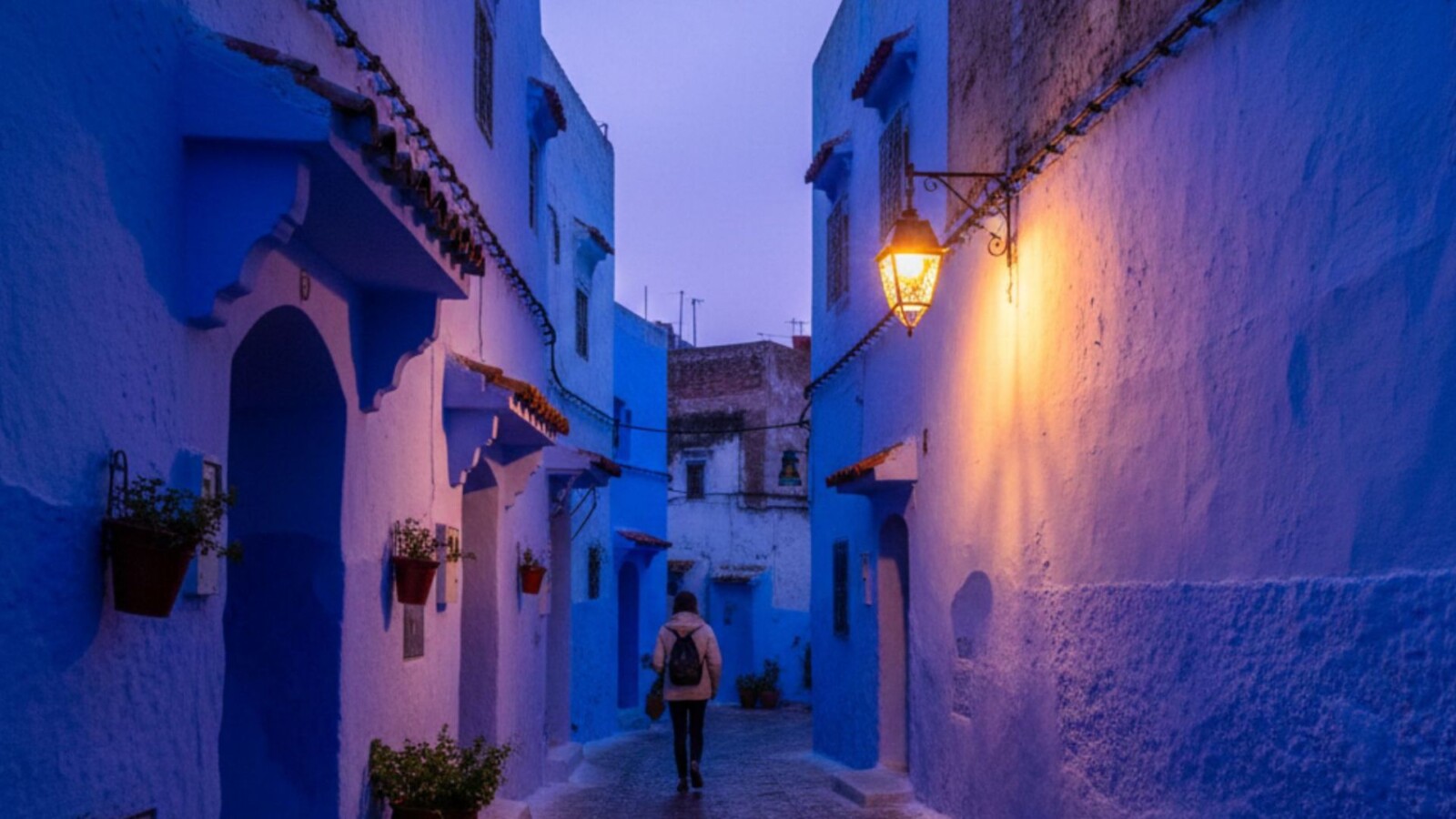
The ATM was out of cash. The riad was at the top of a staircase that had not been mentioned in the listing. The medina gate was locked at midnight and nobody had told the traveler staying inside it that this was a possibility.
None of these situations are emergencies. All of them are avoidable with thirty minutes of preparation before you arrive. Chefchaouen is one of the most welcoming and logistically forgiving destinations in Morocco, but it runs on its own mountain-town logic that differs from what most travelers expect based on experience elsewhere in the country. Understanding that logic in advance is the difference between a trip that unfolds smoothly and one that spends its first day recovering from small preventable friction.
This guide covers the practical layer of a Chefchaouen visit: money, language, etiquette, safety, connectivity, packing, and the question of how many days you actually need. None of it is complicated. All of it matters. For everything beyond the practical, our complete Chefchaouen travel guide covers what to do, where to eat, and where to stay once you arrive prepared.
Money: the cash reality in a mountain city
Chefchaouen operates almost entirely on cash. This is not unusual in Morocco broadly, but the specific cash situation in Chefchaouen is more constrained than in Marrakech, Fes, or Casablanca, and it catches a meaningful number of visitors off guard every year.
There are ATMs in Chefchaouen. There are not many of them. The machines that do exist cluster near the new town rather than inside the medina, and they run out of cash with some regularity during peak season when visitor numbers climb and resupply lags behind. On a busy April weekend, no guarantee exists that you will find an ATM that works, dispenses the currency you need, and accepts your card.
Morocco Currency Converter
Convert to Moroccan Dirham (MAD) — live exchange rates
The practical solution is simple: withdraw cash before you arrive. Tangier and Fes both have reliable ATM infrastructure at train stations, bus stations, and city centers. Coming to Chefchaouen with 500 to 800 dirhams in hand covers two to three nights of mid-range accommodation, meals, and incidental spending without requiring you to locate a working ATM on arrival.
The Moroccan dirham is a closed currency, meaning it cannot be purchased outside Morocco and must be exchanged or withdrawn inside the country. Major currencies including US dollars and euros exchange easily at banks and official exchange offices. The rate at airport exchange counters is reliably worse than at city center banks, so if you are exchanging cash rather than using an ATM, wait until you reach a proper bank branch.
Credit cards are accepted at a small number of larger riads and restaurants in Chefchaouen but cannot be relied upon as a primary payment method. Assume cash for everything and treat card acceptance as a pleasant surprise rather than an expectation.
Language: what to expect and how to navigate it
Chefchaouen’s linguistic landscape is specific to northern Morocco in ways that differ from the rest of the country and are worth understanding before you arrive.
The primary spoken language is Darija, the Moroccan Arabic dialect that serves as the everyday vernacular throughout Morocco. Across the Rif Mountains more broadly, older residents and rural communities surrounding the city speak Tarifit, the local Berber language, as a living everyday tongue.
What makes Chefchaouen linguistically distinct from most Moroccan cities is the relative prominence of Spanish over French in the tourist and commercial economy. Northern Morocco spent decades under Spanish colonial administration, and Spanish remains a living second language for many residents of Chefchaouen, Tetouan, and Tangier in a way that it simply does not in Marrakech or Casablanca, where French dominates the educated and professional class.
For American travelers, this creates an interesting practical reality. If you have any Spanish, it will serve you more reliably in Chefchaouen than French. If you have neither, English is understood in most accommodation and tourist-facing businesses, though the coverage is patchier than in Morocco’s larger southern cities.
A small investment in basic Darija phrases pays dividends that far exceed the effort required. Greetings matter enormously in Moroccan social culture.
| Phrase | Darija | Pronunciation guide |
| Hello / Peace be upon you | As-salamu alaykum | Ah-sa-LA-moo ah-LAY-koom |
| Response to greeting | Wa alaykum as-salam | Wa ah-LAY-koom ah-SA-lam |
| Thank you | Shukran | SHOO-kran |
| Thank you very much | Shukran bzaf | SHOO-kran B-zaf |
| Please | Afak | Ah-FAK |
| How much? | Bshhal? | B-SHHAL |
| No thank you | La, shukran | La, SHOO-kran |
| Good / Fine | Mzyan | M-ZYAN |
| God willing | Inshallah | In-SHA-lah |
The phrase “la, shukran” delivered with a smile and continued walking is your most useful tool for declining the attention of persistent souvenir vendors without creating friction or embarrassment on either side.
Dress code and cultural etiquette: reading the room correctly
Chefchaouen sits in a predominantly Muslim and relatively conservative Rif Mountain community. It receives large numbers of tourists and has adapted to that reality with considerable grace, but dressing and behaving with basic cultural awareness is both respectful and practically beneficial in terms of how your interactions with locals unfold.
The standard guidance for Morocco applies: shoulders and knees covered in the medina and at religious sites. Swimwear is for the hammam or a private riad terrace, not for walking the streets. This is not enforced with any particular vigilance in Chefchaouen, which is more accustomed to tourists than most Rif Mountain towns, but it is noticed and appreciated when visitors make the effort.
For women traveling solo or in pairs, Chefchaouen is notably comfortable by the standards of the region. The city has a long history of receiving independent female travelers, and the general atmosphere is more relaxed and less attention-generating than in larger Moroccan cities. Standard awareness, knowing your route before you walk it at night, trusting your instincts in unfamiliar situations, applies here as it does anywhere, but the baseline is genuinely welcoming.
Physical affection between couples is best kept low-key in the medina and public spaces. This is not a legal restriction but a social one, and observing it requires approximately zero sacrifice while generating measurable goodwill.
When entering a private home, a riad, or a mosque (if open to visitors), removing shoes is standard. Follow what others do and you will not go wrong.
Photography etiquette: the rules that actually matter
Chefchaouen is one of the most photographed cities in Africa, and the relationship between its residents and the cameras pointed at them is a nuanced one that every visitor should understand before unpacking their gear.
The walls, the alleyways, the doors, the cats, the fountains, the rooftop views: photograph all of it freely. Nobody owns a blue wall and nobody requires permission to point a camera at architecture.
People are different. Most Moroccan women, particularly older women and women in traditional dress, consider unsolicited photography disrespectful and in some cases genuinely offensive. This norm predates tourism entirely. It reflects a specific cultural value around privacy and dignity that exists independently of whether visitors are present.
The correct approach is direct and simple: make eye contact, gesture toward your camera, and read the response. A smile and a nod means yes. A turned head or a hand raised means no. Accept both responses with equal grace and move on. Many locals, particularly younger residents and shopkeepers accustomed to tourist interaction, are entirely comfortable being photographed and occasionally enjoy it. The assumption that every interaction will end in a demand for payment is both inaccurate and unnecessarily transactional.
Some residents near the most heavily photographed spots in the medina have developed a practice of requesting small payment after being photographed, sometimes after the fact. This is their prerogative and worth budgeting for if you are photographing people extensively. A few dirhams is the standard expectation and is entirely reasonable given the volume of cameras pointed at their daily lives.
Children are sometimes photographed in ways that their parents have not explicitly consented to. Apply the same standard you would want applied to your own children: ask first, accept the answer, and do not persist.
Safety: what the reputation gets right and what it misses
Chefchaouen is safe. This deserves plain statement because kif culture in the Rif region, real and visible as it is, generates a degree of concern among some travelers that the actual risk environment does not justify.
The Rif Mountains have historically been one of the world’s significant cannabis-producing regions, and kif, the locally produced cannabis preparation, has a cultural presence in Chefchaouen that is visible in the form of pipe shops, occasional smoke in certain cafes, and vendors who may offer product to tourists on quieter streets. The Moroccan government’s position on cannabis production has evolved in recent years, with limited legalization for medical and industrial use, but recreational possession remains technically illegal for both locals and visitors.
The relevant practical point for travelers is this: the kif culture in Chefchaouen is low-pressure in the context of tourist interactions. A polite “la, shukran” handles most vendor approaches quickly and cleanly, as vendors rarely push beyond that point in ways most travelers find genuinely uncomfortable. Cannabis culture exists visibly in parts of the city but poses no safety concern for visitors who choose not to engage with it, and Chefchaouen maintains one of the more benign crime environments in Morocco.
Standard urban travel awareness applies: keep valuables in your accommodation safe when not needed, be alert to pickpocket risk in crowded market areas, and do not leave bags unattended. These precautions are less urgently necessary in Chefchaouen than in Morocco’s larger cities but remain reasonable habits regardless of destination.
Connectivity: SIM cards, Wi-Fi, and staying in touch
Morocco has three main mobile operators: Maroc Telecom, Orange Morocco, and Inwi. All three provide coverage in Chefchaouen, though signal strength inside the thick-walled medina can be inconsistent depending on your carrier and the specific location within the old city.
Tourist SIM cards are available at the airport in Casablanca and Marrakech and at shops throughout Morocco’s cities. Maroc Telecom and Orange tend to have the most reliable coverage in northern Morocco specifically. A data-only SIM with several gigabytes of data costs between 50 and 100 dirhams and is valid for a month, which covers a typical Morocco trip without any difficulty. Having a local SIM is worth it for navigation, translation apps, and accommodation communication.
Wi-Fi is available at virtually all riads and guesthouses in Chefchaouen and at most cafes in the medina and new town. The connection quality varies considerably between properties, and travelers who rely on high-bandwidth applications for work should not assume that riad Wi-Fi will support video calls reliably. Ask specifically about connection speed if this matters for your trip.
Offline maps downloaded before arrival are worth having regardless of your SIM situation. The medina’s layout presents real navigational challenges – street names appear inconsistently, and map applications sometimes lose accuracy in dense historic urban environments – but an offline map lets you find your way through moments when poor signal cuts you off from real-time data.
Power and electronics: the basics
Type E
Most common in Morocco- ● 2 round pins + grounding hole
- ● 220–240 V / 16 A
- ● Grounded
- ● Compatible with Type C & F plugs
Type C
Also widely used- ● 2 round pins, no grounding
- ● 220–240 V / 2.5–16 A
- ● Not grounded
- ● Fits into Type E sockets
Morocco uses Type C and Type E electrical sockets, operating at 220 volts and 50 hertz. American devices built for 110 volts require a voltage converter in addition to a plug adapter unless they are dual-voltage, which most modern laptops, phone chargers, and camera chargers are. Check the label on your device or charger before assuming compatibility.
A small universal travel adapter covers Morocco’s socket types without requiring a separate purchase for each country on a longer trip. Power banks are worth bringing for long hiking days where you are away from outlets for extended periods.
Packing for the Rif: what most guides get wrong
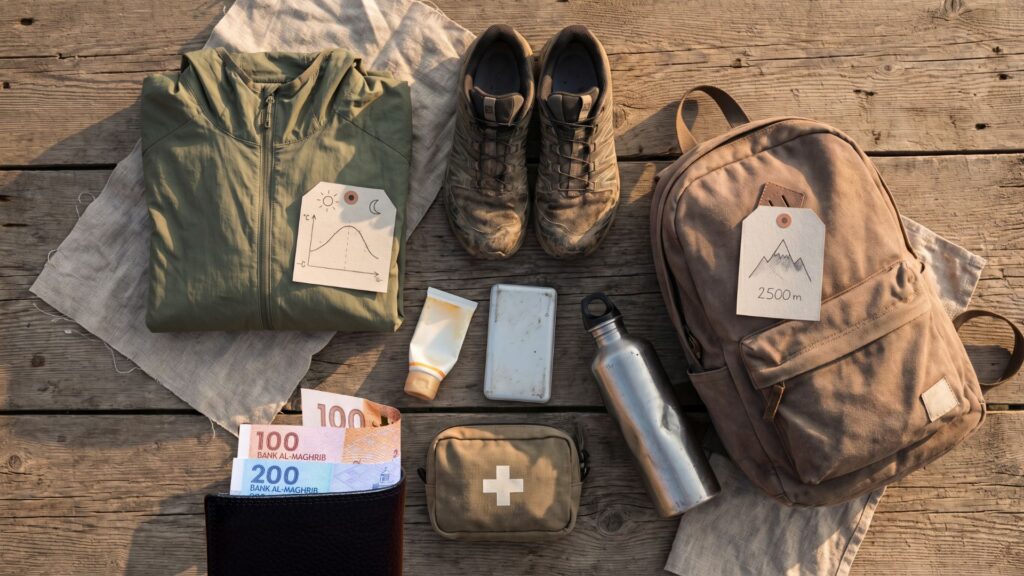
The mistake most travelers make when packing for Chefchaouen is treating it like a standard warm-weather Mediterranean destination. The altitude changes the calculation in ways that catch people off guard.
At 600 meters above sea level, evenings in Chefchaouen are cooler than the daytime temperature by a margin that surprises visitors arriving in summer expecting continuous warmth. A July afternoon in the medina might reach 30 degrees Celsius. The same evening on a rooftop terrace can drop to 18 or 19 degrees, cold enough to want a light jacket or layer that you absolutely did not think you would need when you packed for Morocco in July.
In spring and fall, the temperature differential is more pronounced. April evenings require a proper jacket. October nights call for something warmer still. November and March can feel genuinely cold after dark.
The practical packing list that serves Chefchaouen well regardless of season:
| Item | Why it matters in Chefchaouen specifically |
| Light jacket or layer | Essential for evenings at altitude, even in summer |
| Comfortable walking shoes | Medina cobblestones and stairs punish flat soles |
| Waterproof footwear or trail runners | Required for Akchour day trip river crossings |
| Daypack | Medina walking and day trips; no vehicle access inside |
| Power bank | Long hiking days without outlet access |
| Small flashlight | Medina lanes are poorly lit at night |
| Reusable water bottle | Tap water is not reliably safe to drink; buying plastic is wasteful |
| Sunscreen | High altitude means stronger UV exposure than at sea level |
| Small first aid kit | Basic medical supplies; nearest hospital is in Tetouan |
| Cash in dirhams | ATM availability is limited and unreliable in peak season |
How many days: the honest answer
Two nights is the minimum that allows you to experience Chefchaouen rather than simply visit it. One night is a logistical deposit that gives you the morning alleyways before you leave. Three nights is comfortable and allows for one day trip without feeling rushed inside the city itself. Four nights edges toward the point where some travelers begin to feel they have covered the ground available, unless a longer hiking excursion or a particularly slow pace is intentional.
The travelers who most consistently leave wishing they had stayed longer are the ones who came for one night and the ones who packed their days so completely with activities that they never had the experience of the city operating around them at its own pace.
The travelers who most consistently feel they timed it right spent two or three nights, built in one genuinely unscheduled half-day, and left carrying at least one small discovery that no list had pointed them toward before arriving.
That last part is not accidental. Chefchaouen is small enough that if you move through it with complete intentionality, you will finish before the city has had a chance to show you anything unexpected. Leaving room for the unexpected is not a vague philosophical position. It is a practical itinerary decision, and it is the one most worth making.
For the full context of where Chefchaouen fits within a northern Morocco itinerary, including how to sequence your days between the city and the surrounding region, our guide to the best day trips from Chefchaouen covers every realistic excursion with honest transport logistics and timing so you can build a schedule that does not require a spreadsheet to manage.
What is the one piece of practical travel information you wish you had known before your first trip to Morocco, or to any destination that surprised you with its specific local logic?