Food in Chefchaouen: what to eat, where to go, and what makes this city’s cuisine different
The best meal you will eat in Chefchaouen will probably cost less than four dollars and happen before 8 a.m.
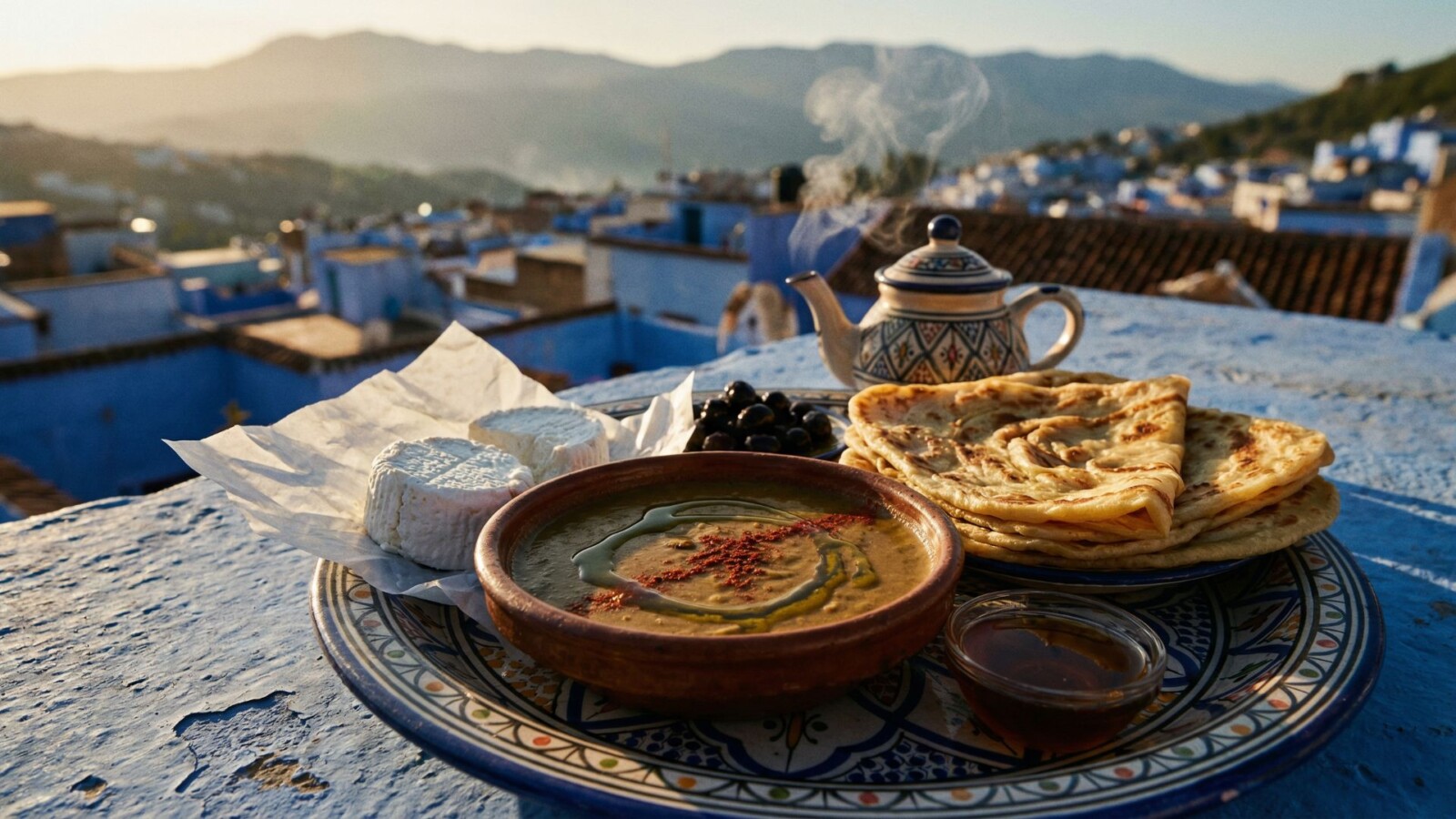
It will involve a clay bowl of bissara, a thick fava bean soup finished with a pour of olive oil and a pinch of cumin, eaten at a small counter somewhere near the edge of the medina while the city is still mostly asleep around you. The soup will be hot enough to warm your hands through the bowl. The bread will have come out of a shared neighborhood oven thirty minutes earlier. And the experience of eating something that genuinely belongs to a place, made from ingredients grown in the surrounding mountains and prepared in a way that has not changed significantly in generations, will set a standard that the rooftop restaurants in the tourist quarter will spend the rest of your visit trying to match.
Chefchaouen is not a city that appears prominently on Morocco’s culinary map, which is unfair and worth correcting. The food here is quieter than in Marrakech, less showy than in Fes, and rooted in a Rif Mountain ingredient tradition that produces flavors you will not find replicated in the same form anywhere else in the country. If you are planning your trip around more than just the food, our complete Chefchaouen travel guide covers everything from where to stay to how to get there.
Why Chefchaouen’s food culture is different from the rest of Morocco
Morocco’s most celebrated cuisine comes from its imperial cities. Marrakchi cooking leans on ras el hanout spice blends, preserved lemons, and slow-braised meats that have been refined over centuries of court cooking. Fassi cuisine is arguably even more complex, drawing on Andalusian and Jewish culinary influences to produce dishes like pastilla and bastilla that are technically demanding and historically layered, a depth explored across our guide to Moroccan food.
Chefchaouen does something different. Sitting in the Rif Mountains at altitude, surrounded by small farms, goat herds, and mountain herb cultivation, the city’s food tradition is fundamentally rural and seasonal. The ingredients are local in a way that most destinations in Morocco are not. The goat cheese comes from animals grazing on hillsides you can see from the medina. The olive oil is pressed in the region. The herbs, including wild thyme, rosemary, and the aromatic mountain mint that ends up in your tea, grow in the landscape surrounding the city.
This creates a food culture that rewards curiosity and punishes impatience. The best eating in Chefchaouen is not in the restaurants with the best views or the longest menus. It is in the places that have been doing one or two things well for decades and see no particular reason to change.
Bissara: the breakfast that defines the city
If there is one dish that captures the essence of eating in Chefchaouen, it is bissara. Dried fava beans are soaked overnight, cooked until completely soft, and blended into a thick, earthy soup that is finished to order with a generous pour of local olive oil, a dusting of paprika or cumin, and sometimes a few dried chili flakes depending on the vendor.
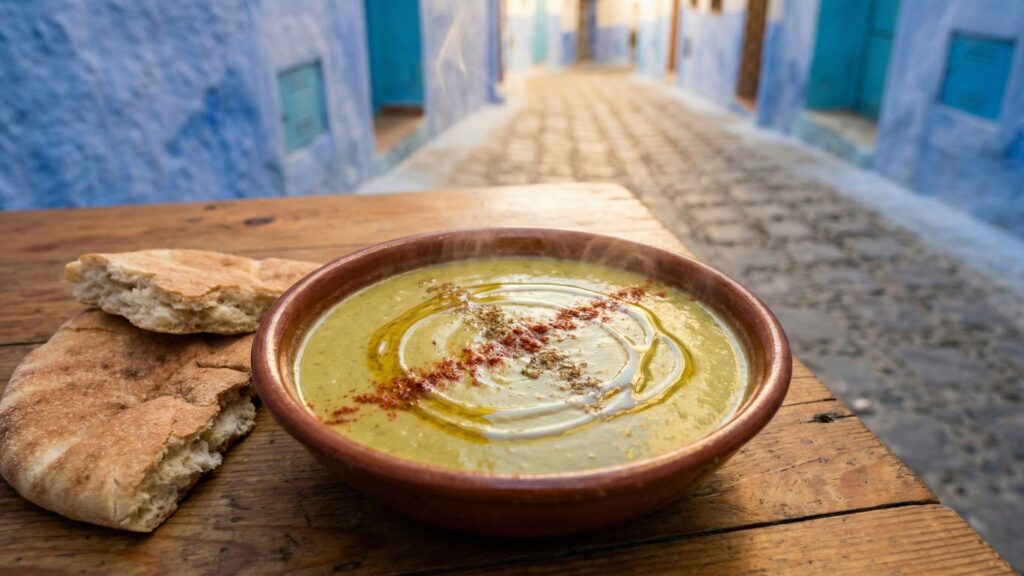
It is served with khobz, the round Moroccan flatbread that functions as both utensil and accompaniment throughout the country. You tear the bread, drag it through the soup, and eat. That is the entire transaction, and it is one of the most satisfying food experiences Morocco has to offer.
Bissara vendors typically operate in the early morning and disappear by 9 or 10 a.m. when the supply runs out. Finding them requires a short walk away from the main tourist circuits, toward the residential edges of the medina where the clientele is predominantly local. The price is minimal, usually 5 to 10 dirhams for a bowl with bread, and the quality is almost universally good because the vendors who make it bad do not stay in business for long.
Goat cheese: Chefchaouen’s most distinctive ingredient
Fresh goat cheese is the single most locally specific food product in Chefchaouen, and it deserves more attention than it receives in most travel coverage of the city.
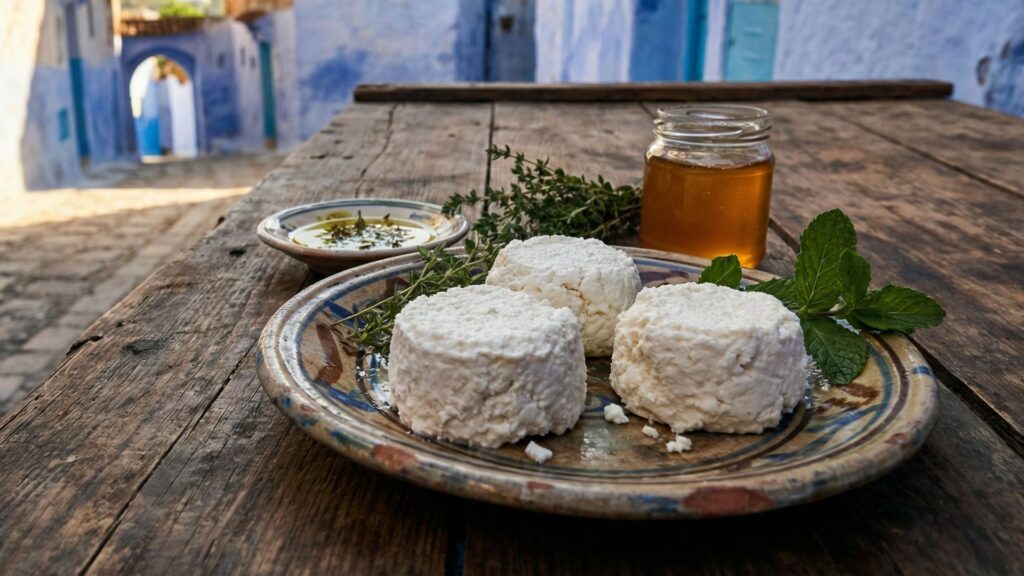
Small rounds of soft, lightly salted goat cheese are sold at the informal market near the medina entrance and at a handful of stalls inside the old city. The cheese is made from the milk of goats raised in the surrounding Rif Mountains and is sold the same day or the day after it is made. It tastes entirely different from the factory-aged or imported goat cheese that appears in European grocery stores: fresher, milkier, with a gentle tang and a texture somewhere between ricotta and a young chèvre.
Eat it for breakfast on bread with local honey and olive oil. Eat it in the afternoon as a snack bought directly from the market. Take a round or two back to your riad and eat it on the rooftop with a glass of mint tea as the evening light changes on the medina below you. It does not travel or keep well enough to bring home, which makes eating it here feel specifically valuable rather than merely convenient.
The market near the medina entrance operates in the mornings and is usually done by noon. Arriving early gives you the best selection and the freshest product.
Harira: the soup that runs through everything
Harira appears throughout Morocco but holds particular significance in northern cities where the Andalusian culinary heritage remains strong. It is a tomato and lentil based soup enriched with chickpeas, fresh coriander, celery, and a small amount of meat, typically lamb, thickened slightly with flour and finished with a squeeze of lemon.
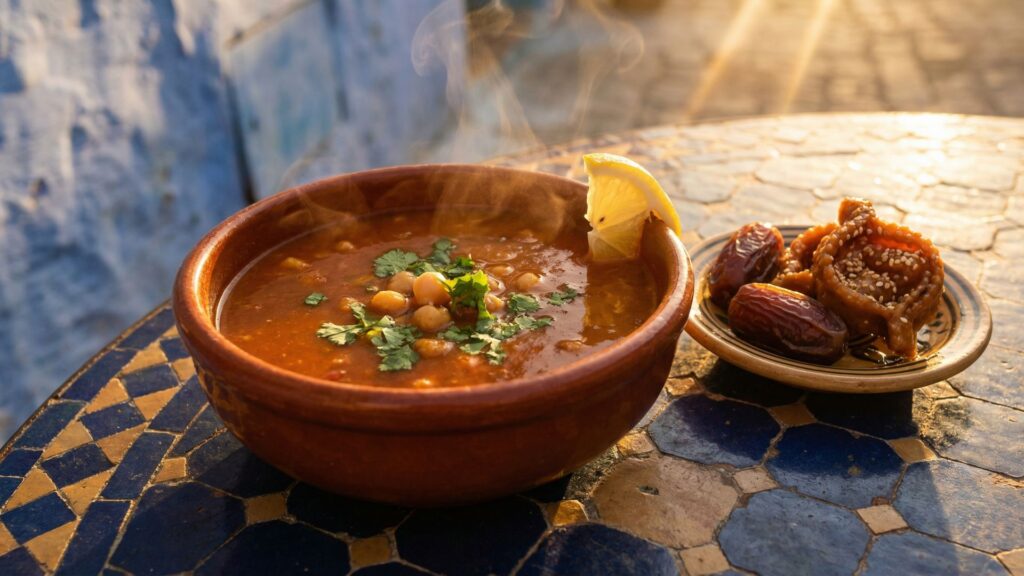
In Chefchaouen, harira is most visibly present during Ramadan, when it becomes the first thing consumed at iftar, the evening meal that breaks the daily fast. During this period, the smell of harira cooking drifts through the medina from mid-afternoon onward, and the communal ritual of sharing it at sunset is one of the most moving food experiences available to a traveler who happens to be there at the right time.
Outside of Ramadan, harira appears on most restaurant menus as a starter and is available from small street stalls in the late afternoon and evening. A bowl with dates and chebakia, a sesame and honey pastry traditionally served alongside, costs around 10 to 15 dirhams and functions as one of the best value eating experiences in the city.
Tagine: what to order and what to avoid
Tagine is everywhere in Chefchaouen, and the quality range is wide enough to warrant specific guidance rather than a general recommendation to try it.
The version worth seeking out is lamb tagine with prunes and almonds, a Moroccan classic that appears with particular frequency in northern cities and relies on the combination of slow-braised meat, sweetness from the fruit, and texture from the nuts to produce something genuinely complex from a relatively simple technique. When made properly in a terracotta tagine over low heat with good quality lamb, it is one of the great dishes of Moroccan cooking. When assembled quickly for tourist turnover and served lukewarm, it is a mediocre stew.
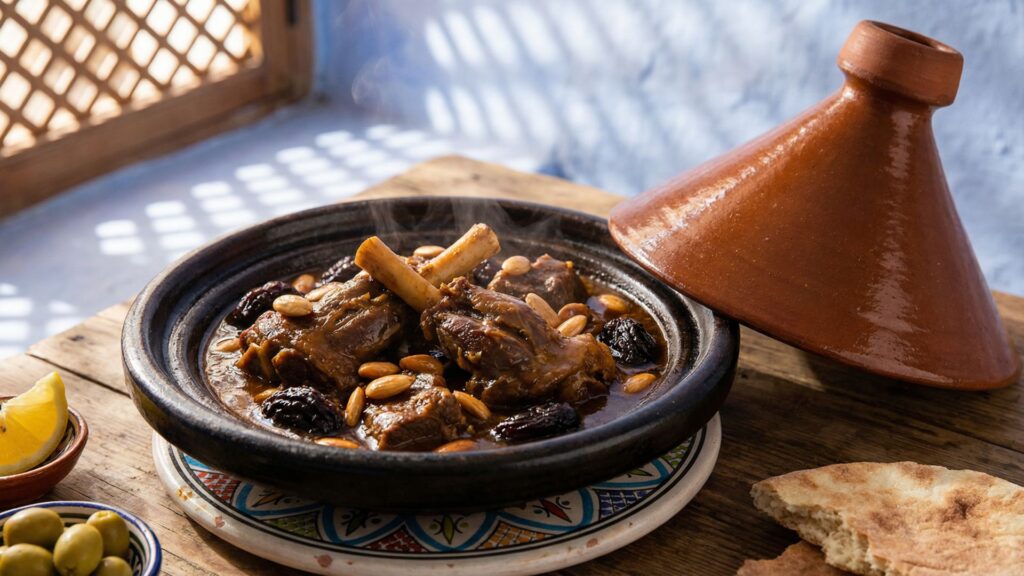
The tell is time and heat. A proper tagine takes the better part of an hour to cook and arrives at the table with the lid still steaming and the sauce reduced to a dark, glossy consistency. If your tagine arrives in fifteen minutes, it was not made to order.
Chicken tagine with preserved lemon and olives is the other version that appears consistently and reliably across Chefchaouen’s better restaurants. The preserved lemon gives the sauce a bright, saline quality that cuts through the richness of the chicken, and in a city surrounded by olive production the quality of the olives is typically above average.
Avoid tagines served in obviously tourist-oriented restaurants directly on Plaza Uta el-Hammam. Not because they are universally bad, but because the turnover pressure in those locations works against the slow cooking that good tagine requires. Walk one or two streets off the plaza and the ratio of quality to price shifts noticeably in your favor.
Msemen and Meloui: breakfast breads worth waking up for
Alongside bissara and fresh cheese, the morning food landscape in Chefchaouen includes two flatbreads that deserve specific mention.
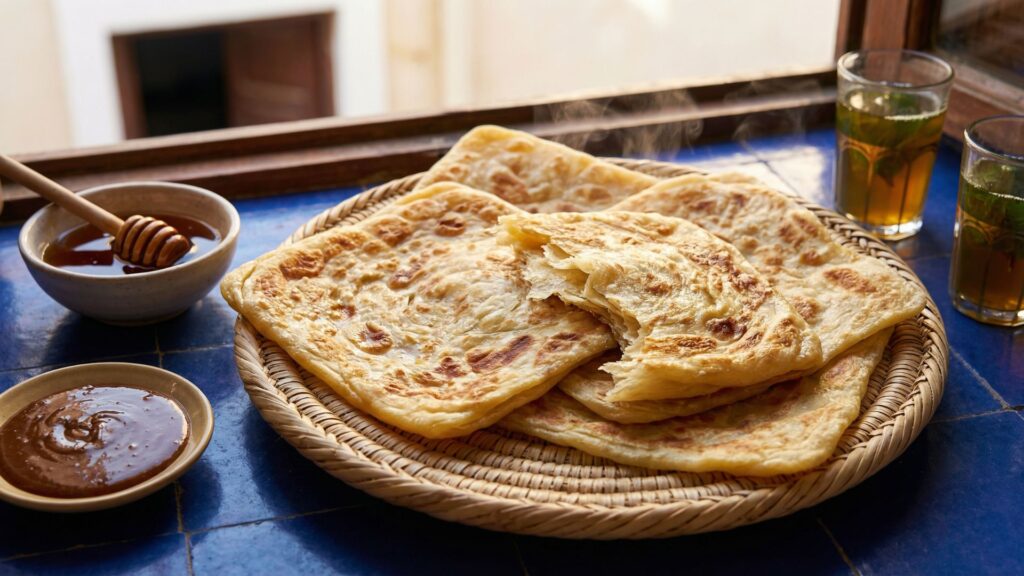
Msemen is a square, layered flatbread made from semolina dough that is folded repeatedly to create a flaky, slightly chewy texture. It is cooked on a dry griddle until the exterior develops a golden, slightly crisp surface while the interior remains soft. Eaten warm with argan oil and honey, or simply with a spreading of amlou, a paste of ground almonds, argan oil, and honey that is specific to Morocco’s Souss region but appears throughout the country’s breakfast culture, it is one of the most satisfying things you can eat anywhere in Morocco.
Meloui is a close relative, round rather than square and slightly thinner, with a more pronounced flakiness from the folding technique. The two are often sold side by side from the same counter and are interchangeable for most practical purposes.
Both are made fresh throughout the morning by women running small griddle operations near the medina’s residential areas. Follow the smell of cooking dough in the early morning and you will find them.
Vegetarian and vegan eating: better here than most of Morocco
Chefchaouen is notably more accommodating for plant-based travelers than Morocco’s larger cities, and this is worth stating clearly because vegetarians and vegans sometimes approach Moroccan travel with unnecessary anxiety.
The city’s mountain ingredient tradition means that vegetable-forward dishes are genuinely central to the cuisine rather than an afterthought. Zaalouk, a cooked salad of roasted eggplant and tomatoes with cumin and paprika, appears as a standard accompaniment on most tables. Taktouka, a similar preparation using roasted peppers and tomatoes, is equally common. Moroccan salads, typically several small cold preparations served simultaneously as starters, are almost universally plant-based.
Couscous with seven vegetables, traditionally served on Fridays throughout Morocco as a communal meal, appears in Chefchaouen’s restaurants without meat by default or with meat easily omitted on request.
The main practical challenge for vegans is dairy, which appears in unexpected places including some bread preparations and the occasional sauce. Asking specifically about butter in bread and cream in sauces is worth the conversational effort, and most restaurant owners in Chefchaouen’s medina now handle this question without any particular difficulty.
Where to eat: a simple tier guide
For breakfast: Follow local foot traffic away from the tourist circuit toward the residential medina edges. Look for counters with clay pots of bissara and women making msemen on griddles. No English menu required or expected.
For a proper lunch: The restaurants on the streets running parallel to but one block away from the main tourist path deliver significantly better value than the plaza-facing options. Look for a handwritten daily menu and a room that is at least half-filled with Moroccan customers by 1 p.m.
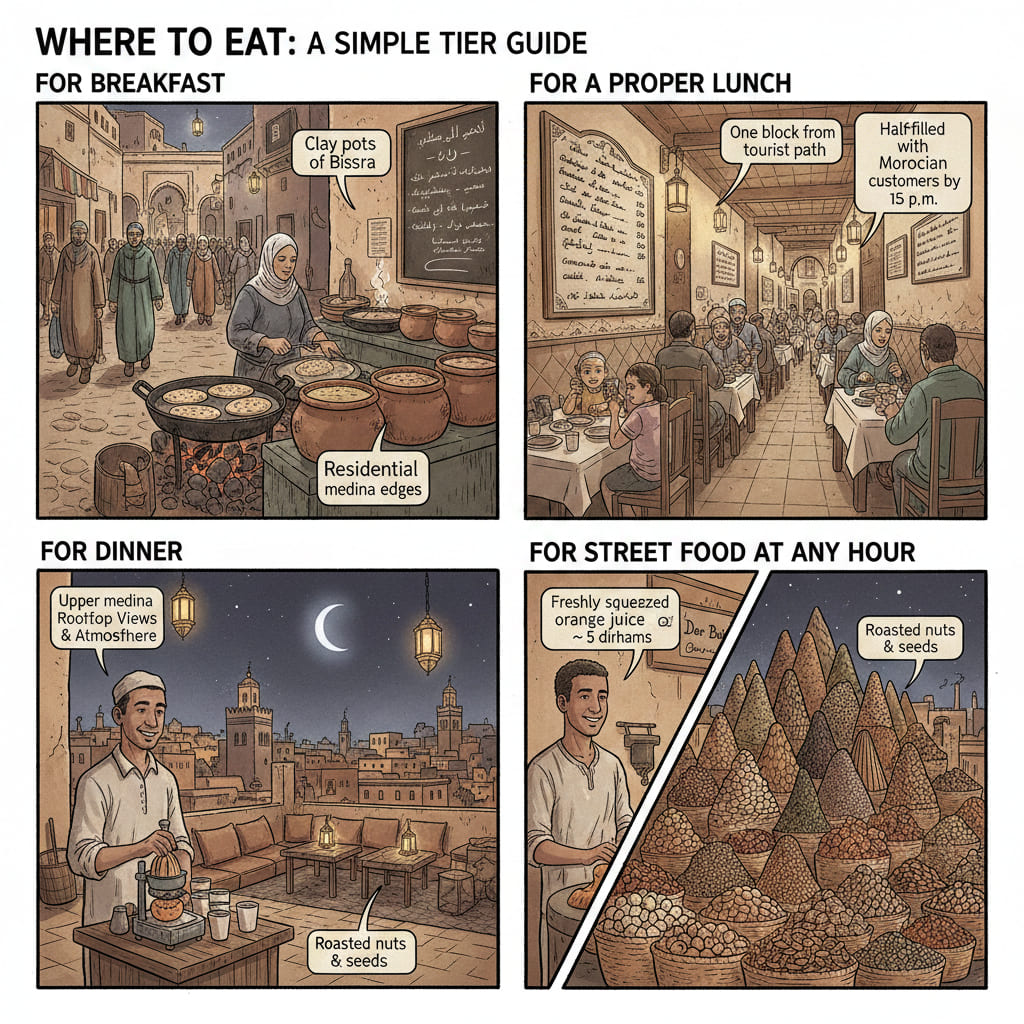
For dinner: The upper medina has a cluster of rooftop restaurants that justify their slightly higher prices with views and a quality of evening atmosphere that the plaza-level options cannot match. Dar Baibou and similar small operations run by owner-cooks rather than hired staff tend to produce more consistent results than the larger tourist-focused establishments.
For street food at any hour: Freshly squeezed orange juice from carts near the medina entrance costs around 5 dirhams and is pressed to order. Roasted nuts and seeds from vendors in the plaza area make for a genuinely good late-afternoon snack.
A quick reference for food in Chefchaouen
| Dish | Best time to eat | Where to find it | Approx. cost |
| Bissara | Early morning | Residential medina edges | 5-10 MAD |
| Fresh goat cheese | Morning | Medina entrance market | 10-20 MAD per round |
| Msemen with honey | Breakfast | Griddle counters in medina | 5-10 MAD |
| Harira | Late afternoon / evening | Street stalls, restaurants | 10-15 MAD |
| Lamb tagine with prunes | Lunch or dinner | Mid-range medina restaurants | 70-120 MAD |
| Couscous with vegetables | Friday lunch | Most traditional restaurants | 50-80 MAD |
| Fresh orange juice | Any time | Plaza carts | 5 MAD |
| Mint tea | Any time | Every cafe and riad | 5-10 MAD |
Mint tea: more than a drink
No food guide to Chefchaouen is complete without addressing mint tea, which functions less as a beverage and more as a social institution throughout Morocco and particularly in northern cities where the tea culture has a distinct ceremonial quality.
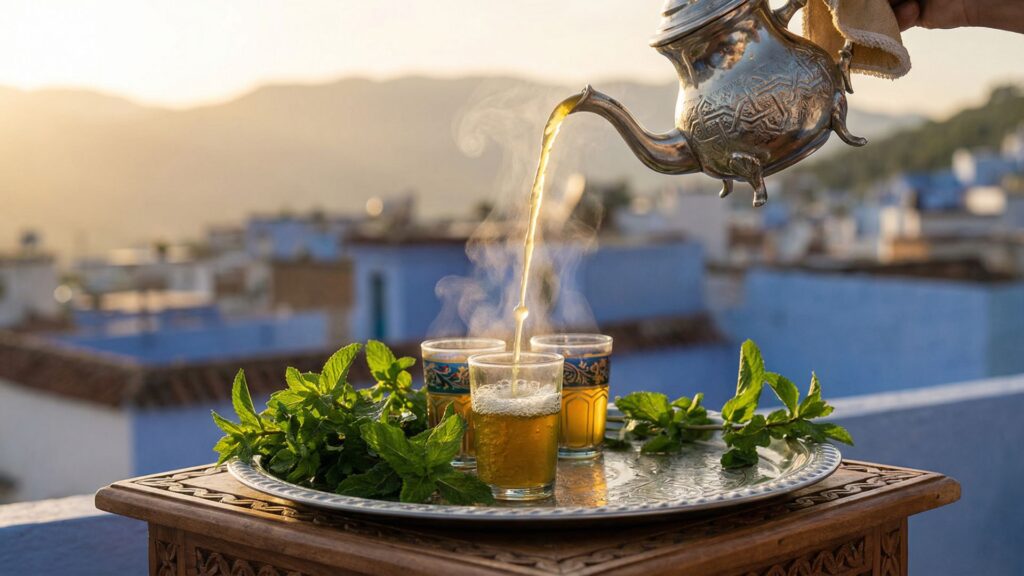
Moroccan mint tea is made with Chinese gunpowder green tea, fresh spearmint, and a quantity of sugar that surprises most first-time drinkers. It is poured from height, a technique that aerates the tea and produces the characteristic froth on the surface, and served in small glass cups. Refusing tea when it is offered is considered impolite in most social contexts, and accepting it is one of the simplest ways to signal genuine interest in the people and place around you.
The mint in Chefchaouen’s tea is mountain-grown and noticeably more aromatic than what you encounter in lowland Moroccan cities. It is a small difference that regular travelers to Morocco notice immediately and that first-time visitors sometimes cannot identify precisely but sense as an upgrade in quality without knowing why.
In cafes, tea service is a transaction. In a riad or a private home, it is a gesture. Receiving it gracefully, without rushing the pour or the conversation that typically accompanies it, is one of those small cultural fluencies that makes any Moroccan experience meaningfully better.
The trap to avoid around the main square
The restaurants facing directly onto Plaza Uta el-Hammam are not universally bad, but they operate under conditions that work against quality cooking. High rent, high turnover, menus printed in four languages, and a customer base that will not return regardless of the experience creates a specific set of incentives that do not tend to produce memorable food.
The tell is a tout at the door with a laminated menu. If someone is actively trying to pull you in from the street, walk past and find somewhere that does not need to.
The best meal you eat in Chefchaouen will happen somewhere that required a small amount of effort to find. That is true of most things worth eating anywhere in the world, and it is particularly true in a city where the tourist economy and the actual local food culture are separated by a distance of roughly two blocks in any direction from the main square.
Once you have sorted out the eating question, the practical orientation of your days falls into place relatively naturally. For the activity and neighborhood context that fits around these meals, the guide to what to do in Chefchaouen covers the full range of how to structure your time from first light through the evening.
What is it that matters most to you when you eat while traveling: finding something genuinely local, or the experience of sharing a meal in a beautiful setting?