Things to do in Chefchaouen: beyond the blue streets and the obvious stops
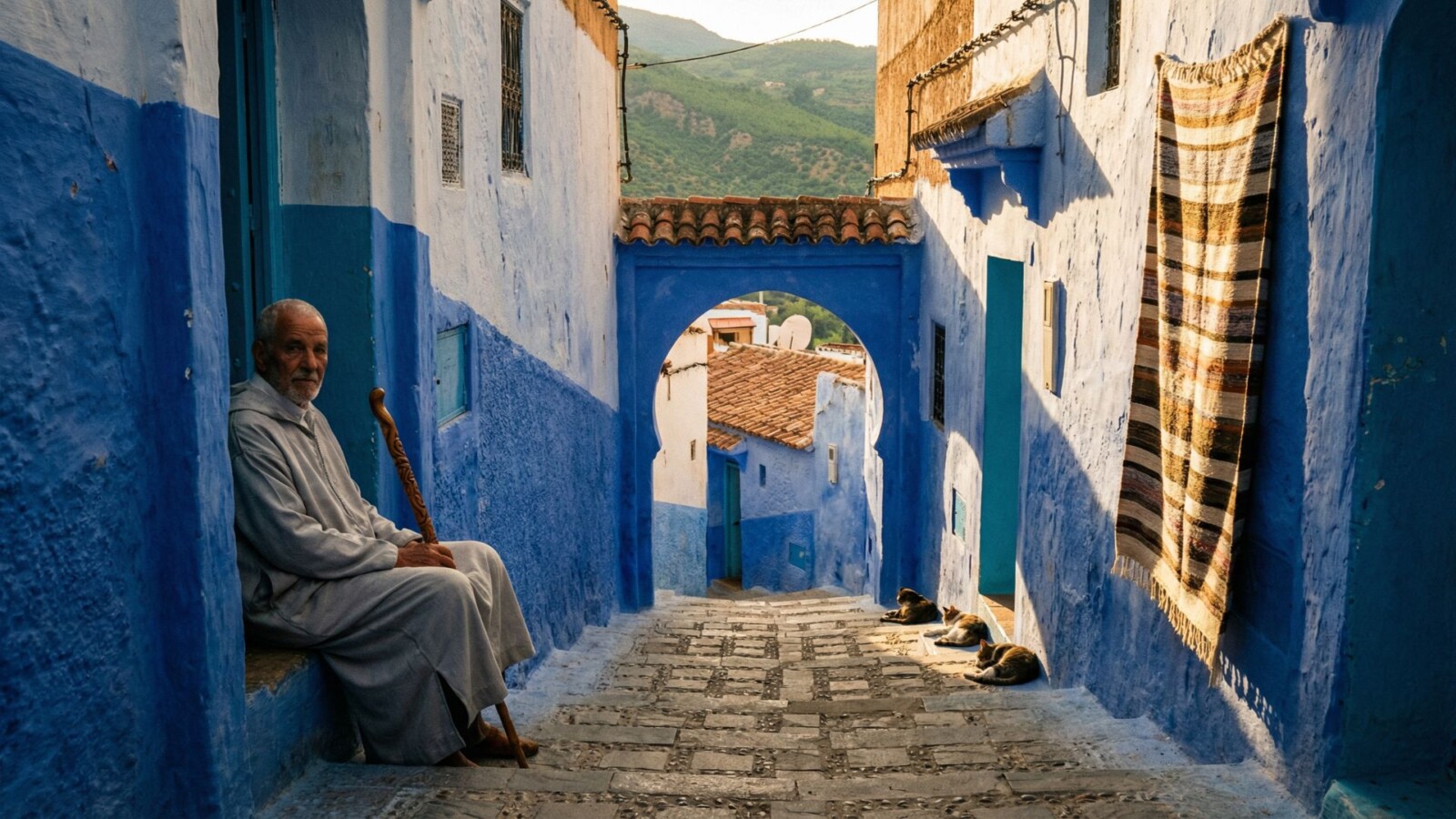
Most people arrive in Chefchaouen with one plan: walk the blue alleyways, take the photos, leave.
The ones who stay longer almost always wish they had built a completely different itinerary from the start. Not because the alleyways are not worth it, they absolutely are, but because Chefchaouen has enough layered beneath its photogenic surface that treating it like a backdrop rather than a destination means missing the actual point of being there.
This guide covers the full range of what to do in the city. It includes the unmissable classics alongside quieter discoveries that rarely appear on most lists. Everything is organized around how you will actually move through your days, not an arbitrary ranking of attractions. If you are still building your broader trip plan, our complete Chefchaouen travel guide covers logistics, accommodation, and everything else you need before you arrive.
Start before the city wakes up
The single best piece of advice for any Chefchaouen visit costs nothing and requires only a willingness to set an alarm.
Be in the medina by 6:30 a.m.
The alleyways that will be shoulder-to-shoulder with visitors by 10 a.m. are completely empty at dawn. The light at that hour, particularly in spring and fall, falls sideways through gaps between buildings and turns the blue walls into something closer to a painting than a photograph. Cats move through the lanes with complete ownership. A baker somewhere is pulling bread from an oven. The only sounds are water from a fountain and the first call to prayer echoing off stone that has been absorbing that same sound for five centuries.
This is not a minor upgrade to the Chefchaouen experience. It is a fundamentally different one. Day-trippers arriving by bus from Tangier and Fes do not reach the medina before 9 a.m. at the earliest. The two and a half hours between sunrise and their arrival belong entirely to overnight guests, which is one of the strongest arguments for staying at least two nights.
Walk the blue streets: the right way
The most photographed location in Chefchaouen is the staircase on Rue Targhi, a blue-washed stepped alleyway that appears in what feels like half of all Morocco travel content published in the last decade. It is genuinely beautiful. It is also genuinely crowded from mid-morning onward.
See it at dawn. Move on.
The more rewarding walk is not a single street but a loose circuit through the upper medina. Start from the Bab el-Ain gate and climb through neighborhoods where the blue paint gives way to white, then to bare stone, then back to blue again. These color combinations feel less deliberate and more organic than the lower medina’s curated prettiness. These upper lanes are steeper, quieter, and more honestly lived-in. Children play in doorways. Elderly men sit on low walls outside their houses. The tourist infrastructure, the souvenir shops and the rooftop restaurants with laminated menus in four languages, thins out noticeably.
Rue Targhi and the lanes around it are worth your time. The upper medina is worth more of it.
Plaza Uta el-Hammam: the living room of the city
The main square is unavoidable and does not need to be avoided. Plaza Uta el-Hammam is where the city’s social life organizes itself, and sitting at a cafe table there at different times of day produces entirely different experiences.
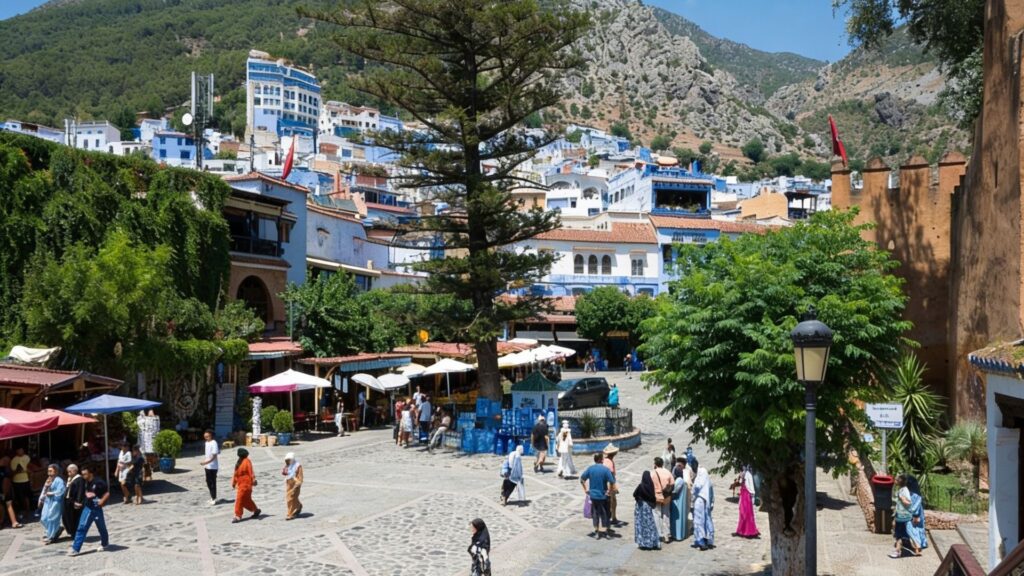
At 8 a.m. it belongs to locals having coffee before work. By 11 a.m. tour groups are arranging themselves for photographs in front of the Grand Mosque. By 4 p.m. the day-trippers are thinning out and a different crowd arrives: travelers settling in for the afternoon with mint tea and no particular agenda. After 8 p.m. in summer and fall, the square transforms into an outdoor living room where families spread across the benches, vendors set up carts of roasted nuts and fresh juice, and the atmosphere acquires a warmth that is genuinely communal rather than performed for tourism.
The kasbah museum on the western edge of the square is worth an hour of your time. The fortified structure dates from the 15th century, contains an archaeological collection, a small ethnographic display, and a rooftop terrace that offers one of the best views of the medina from above. Entry costs a few dirhams and the crowds inside are a fraction of what they are on the square itself.
Hike to the Spanish mosque: the view that puts everything in context
About twenty minutes on foot above the medina, following a dirt trail that climbs through scrubby hillside vegetation and loose stone, sits an abandoned mosque built during the Spanish colonial period of the early 20th century. It has never been used for worship. It stands empty and open on a hilltop with a terrace that looks down over the entire medina, the valley, and the Rif Mountain ridgelines extending in both directions.
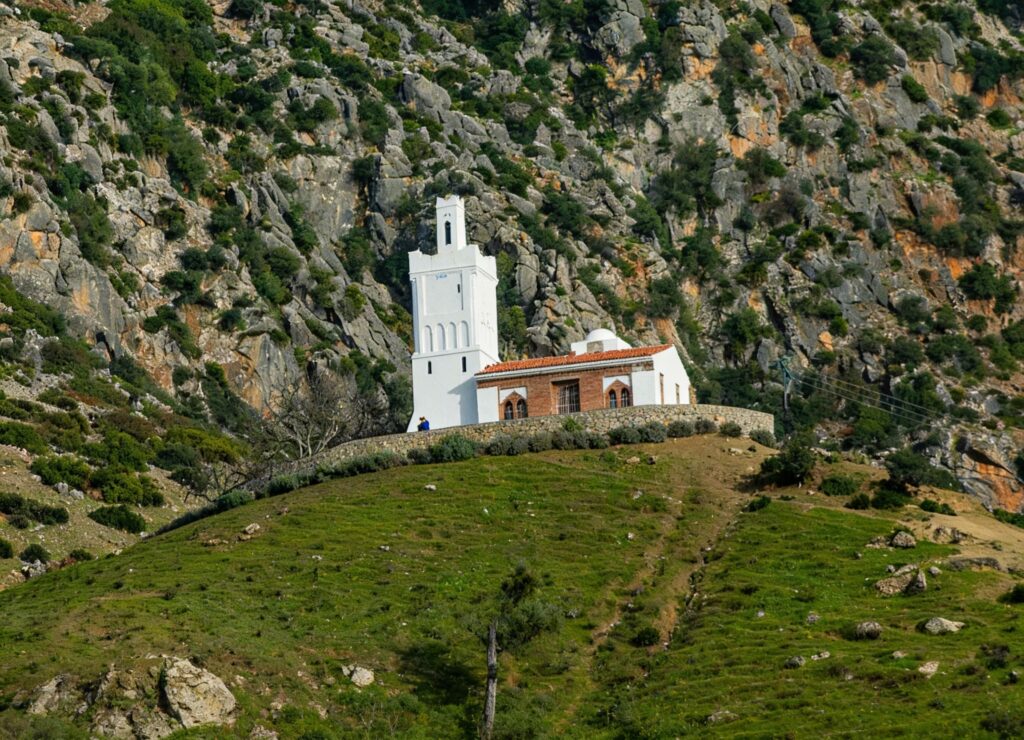
The hike takes around twenty minutes from the medina’s upper edge and is well-worn enough that route-finding is not a challenge. The trail starts near the cemetery above the northern end of the medina; ask at your accommodation for the current path if you want to avoid the one or two false starts that catch first-time visitors.
Sunrise from the Spanish Mosque is the benchmark experience for photographers and non-photographers alike. The light arrives behind the mountains and fills the valley gradually, and the medina below shifts through a sequence of colors, deep shadow to pale gray to blue to full morning gold, over about forty minutes that justifies every early alarm you have ever set.
Sunset is equally strong and draws a slightly larger crowd for the same reason. Arrive thirty minutes before the sun drops to the ridgeline to find a spot on the terrace wall before it fills.
The trail can be combined with a longer loop through the forested hills above the mosque if you are looking for a half-day hike rather than a short walk. The cedar forest above Chefchaouen is accessible and genuinely beautiful, and the extended walk takes you far enough from the city that you can turn around and see it from a distance that makes it look exactly like what it is: a blue city tucked into a fold in the mountains.
Ras el-Maa: the waterfall and the laundry scene
At the northeastern edge of the medina, the old city meets the hillside. Stone lanes give way to a path running alongside a stream. There you will find Ras el-Maa. The name means “head of the water” and refers to a small but lively waterfall and the natural spring that feeds it.
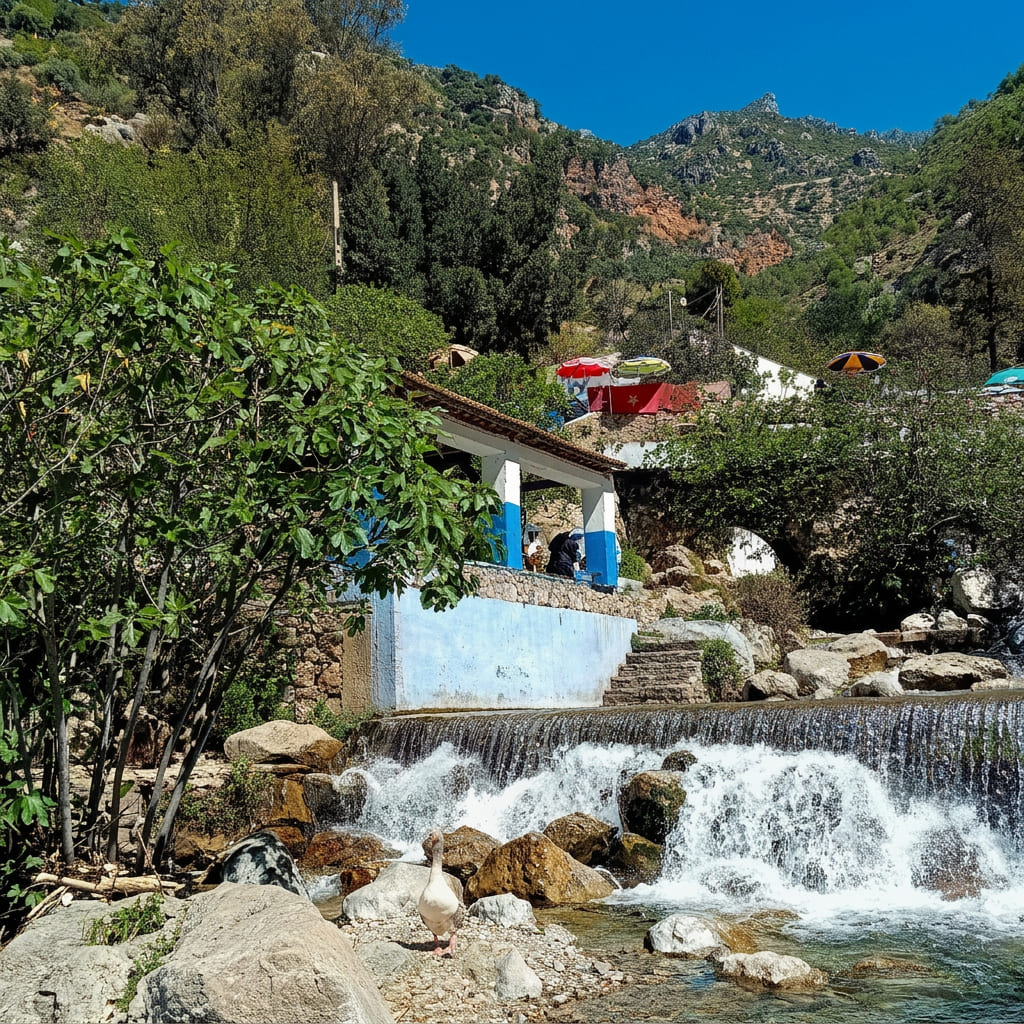
The waterfall itself is modest, a few meters high and more of a cascade than a dramatic drop. What makes Ras el-Maa worth visiting is the scene around it. Local women still use the stream for laundry, washing textiles by hand on flat stones and spreading them to dry on the banks in colors that photograph extraordinarily well against the surrounding vegetation and stone. It is a living practice in a working neighborhood, not a staged cultural demonstration, and approaching it with that understanding matters.
Photographing the women at work requires a degree of sensitivity that is worth stating plainly. Ask before pointing a camera at anyone. Many women will decline, and that is entirely their prerogative. The landscape and the waterfall itself are freely photographed. The human activity around it should be treated with the same courtesy you would expect in return.
The walk from Ras el-Maa continues uphill into a forested path toward Ain Tissimane. This spring area is popular with locals for picnics and marks one of the starting points for longer mountain trails. Even walking thirty minutes up this path and turning back gives you a genuine taste of the Rif landscape. The medina, for all its beauty, cannot provide that.
Shopping in the Medina: what to buy and what to skip
Chefchaouen has a genuine artisan tradition that predates the tourism economy, and there are things worth bringing home here that you will not find in the same form anywhere else in Morocco.
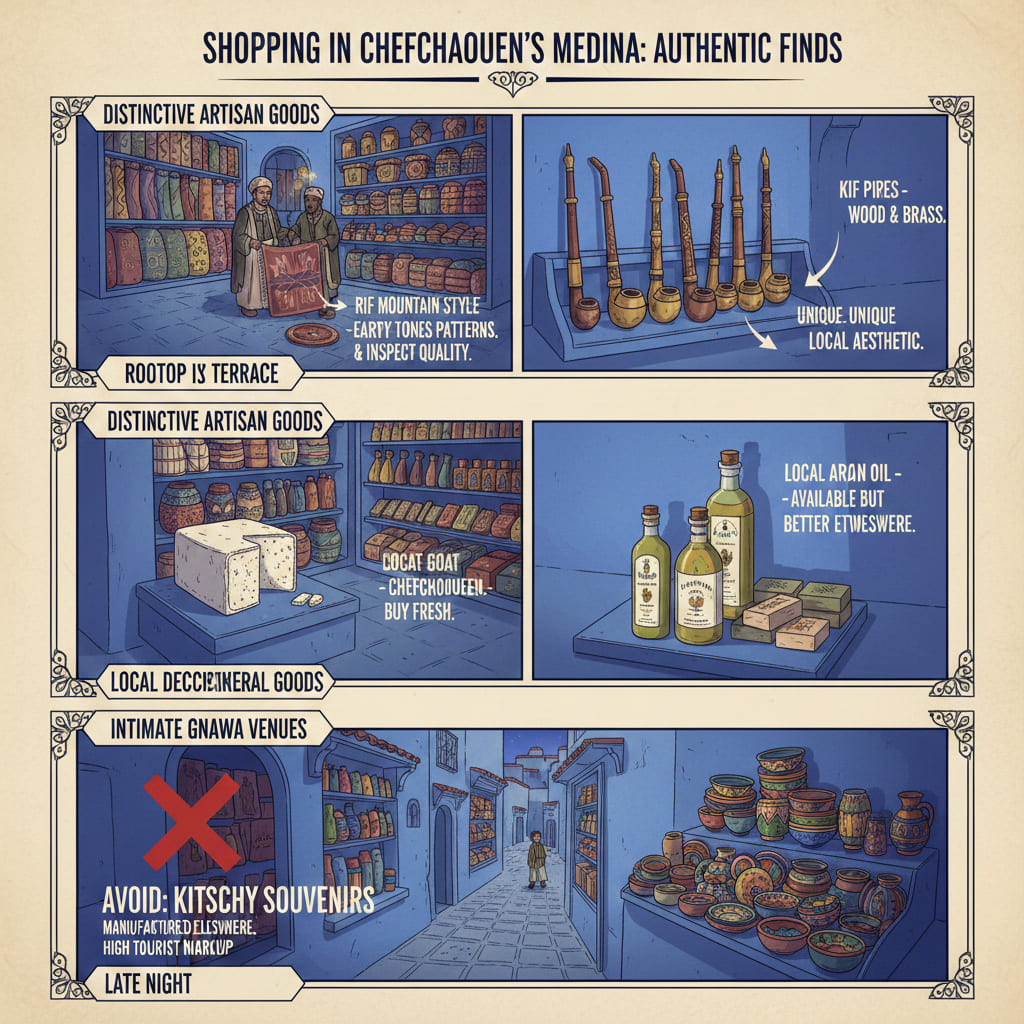
Wool blankets and rugs woven in the Rif Mountain style are among the most distinctive. The color combinations tend toward earthy tones, deep reds and undyed creams, with geometric patterns that differ visibly from the more elaborate Berber designs of the south. Prices are negotiable and the quality range is wide; take time to examine what you are buying rather than accepting the first piece you are shown.
Kif pipes, the long-stemmed traditional smoking implements associated with the Rif region, are widely available and make genuinely interesting objects whether or not you use them for their intended purpose. The craftsmanship on the better ones involves carved wood and brass fittings that reflect a distinct local aesthetic.
Argan oil and locally produced soap are available in the medina but are not specific to Chefchaouen. You will find better quality-to-price ratios in dedicated argan cooperatives further south. The goat cheese sold at the small market near the medina entrance, on the other hand, is completely specific to this area. Buy it fresh for a morning in the riad.
Avoid the painted ceramic and kitschy souvenir items clustered around the plaza area. They are manufactured elsewhere and sold here at significant tourist markup. The genuinely local craft economy is slightly further into the medina and worth the extra five minutes of walking to reach.
The Hammam: a non-negotiable experience
Every Moroccan city has hammams, but there is something specific about visiting one in Chefchaouen that earns its place on any itinerary: the contrast between the mountain cold outside and the steam inside is more pronounced here than in warmer cities, and the local hammams have not yet been fully converted into tourist-oriented spa experiences.
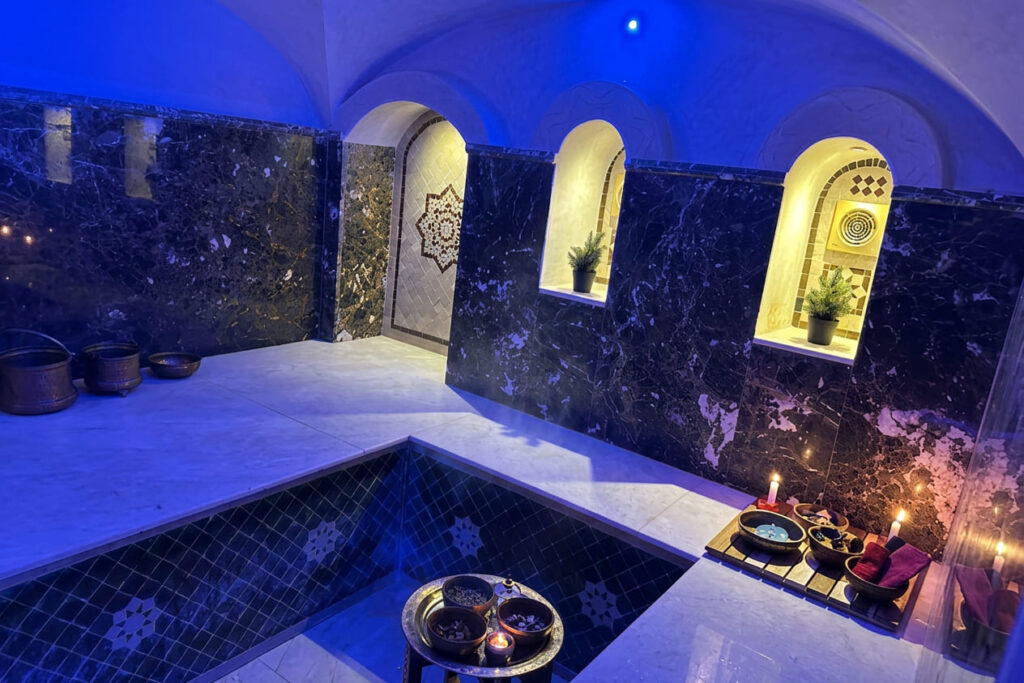
A traditional hammam visit involves a progression through rooms of increasing heat, a scrub with a kessa mitt that removes an amount of dead skin that will surprise you, and a soap application using beldi, a natural black soap made from olive oil. The entire experience costs a fraction of what a spa treatment would run in Europe and is both more effective and more culturally interesting.
Ask your accommodation to recommend a local hammam rather than the tourist-oriented ones that have emerged near the main square. The experience in a neighborhood hammam, where you are the only foreigner in the room, is not intimidating. It is, with a minimum of basic communication and a willingness to follow what others do, entirely accessible and genuinely memorable.
Evening in the Medina: how to end your days right
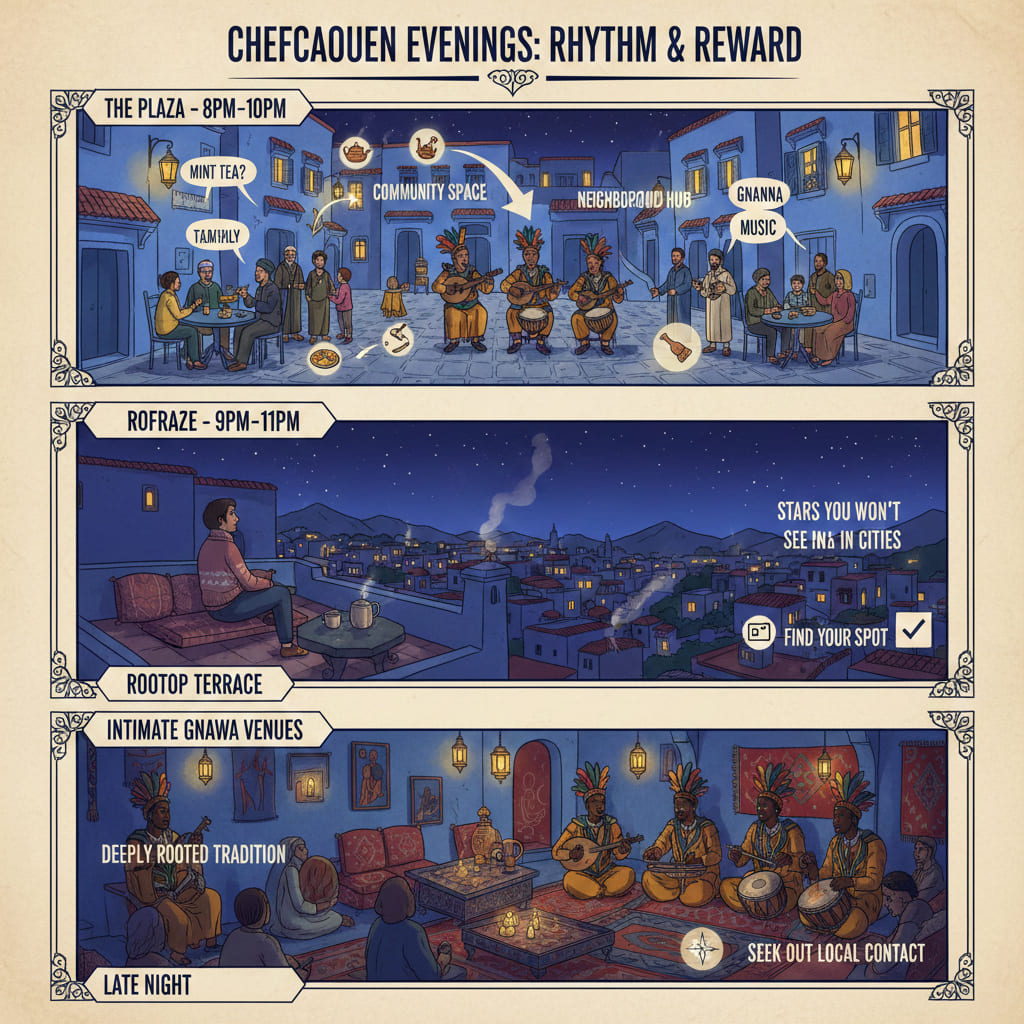
Chefchaouen’s evenings have their own rhythm and deserve as much planning as the days.
The hour after iftar during Ramadan, and the equivalent post-dinner window outside of that month, around 8 to 10 p.m., is when the plaza fills with families, vendors, and an unhurried sociability that is one of the most pleasant things about the city. Pull up a cafe chair, order mint tea, and watch the square operate as a genuine community space rather than a tourist attraction. That shift, from attraction to neighborhood, happens every evening and is worth staying up for.
Rooftop terraces at this hour offer a different pleasure: the medina below quieting slowly, the mountains dark against a sky that at altitude holds stars you will not see from a city. Several riads have rooftop seating open to non-guests for tea or a drink, and finding one that suits you on the first evening is one of those small logistical wins that shapes an entire trip.
Live gnawa music occasionally appears in the square and in a handful of small venues in the medina. Gnawa is a deeply rooted Moroccan musical tradition with spiritual origins, and hearing it performed in a small space rather than amplified at a tourist event is the kind of experience that does not always find you but is worth seeking out through your accommodation or a knowledgeable local contact.
A simple day-by-day framework
| Time | Activity | Notes |
| Day 1 morning | Spanish Mosque sunrise hike | Depart by 6 a.m. in summer |
| Day 1 mid-morning | Upper medina walk | Before crowds arrive |
| Day 1 afternoon | Kasbah museum, plaza | Quieter after 4 p.m. |
| Day 1 evening | Rooftop tea, plaza people-watching | Stay out past 8 p.m. |
| Day 2 morning | Ras el-Maa and forest trail | Allow 2-3 hours |
| Day 2 afternoon | Hammam | 1-2 hours, deeply worthwhile |
| Day 2 evening | Medina shopping, dinner | Upper medina restaurants |
| Day 3 (optional) | Day trip to Akchour Waterfalls | Full day, bring water |
The thing Chefchaouen does that other cities do not
There is an activity in Chefchaouen that does not appear on any formal list of attractions. It involves finding a quiet corner of the upper medina, sitting down on a step or a low wall, and doing nothing for thirty minutes.
This sounds like nothing. In practice it is one of the more valuable things you can do in a travel itinerary that has probably been optimized within an inch of its life. The city is small enough that you are never more than ten minutes from everything else on this list. But it is quiet enough and beautiful enough that simply being inside it, without a task or a camera or a destination, produces a quality of experience that is harder to manufacture in a larger, busier place.
The travelers who remember Chefchaouen most vividly are not usually the ones who ticked the most items off a list. They are the ones who stayed long enough to notice what happens between the attractions.
For planning the food dimension of those days, our guide to what to eat in Chefchaouen covers every meal from market breakfast to rooftop dinner. The practical questions about where to eat will not interrupt the rhythm you build on the ground.
What draws you to a place like this? Is it the visual beauty, the slow pace, or the sense of being somewhere that still belongs primarily to the people who live there?