Where to stay in Chefchaouen: neighborhoods, riads, and what to expect on arrival
The accommodation you book in Chefchaouen will define your trip more than it does in almost any other city in Morocco.
That is not an exaggeration. Sleep inside the medina walls and you wake up inside the city before the day-trippers arrive. Sleep outside and you save a little money, gain easier access for a vehicle, and lose the one thing that makes Chefchaouen what it is. The choice is genuinely consequential, and the options within the medina itself range enough in price, character, and location that the decision deserves real attention before you book.
This guide covers every tier and every relevant neighborhood so you can make a choice that fits your budget, your travel style, and the experience you are actually trying to have.
Understanding the layout before you choose
Chefchaouen’s medina is compact by Moroccan standards. Walking from the main entrance gate to the far end of the old city takes around twenty minutes at a relaxed pace. But within that relatively small footprint, the character of different neighborhoods varies more than the map suggests.
The lower medina, centered around Plaza Uta el-Hammam, is the social and commercial heart of the city. The main square, the kasbah, and the densest concentration of cafes and restaurants are all here. It is lively, convenient, and genuinely atmospheric. It is also where foot traffic peaks earliest and stays latest.
The upper medina, which climbs toward the Bab el-Ain gate and beyond toward the hillside neighborhoods near the Spanish Mosque trail, is quieter and more residential. Fewer tourists make it this far. The alleyways narrow further. Cats outnumber visitors. If you are looking for the version of Chefchaouen that feels least like a curated experience, this is the part of the city to prioritize.
Outside the medina walls, a modern town has developed with hotels that function more like conventional accommodation. These are perfectly comfortable and meaningfully cheaper, but they require you to walk into the medina rather than simply stepping out of your door into it.
Budget options: guesthouses and hostels inside the Medina
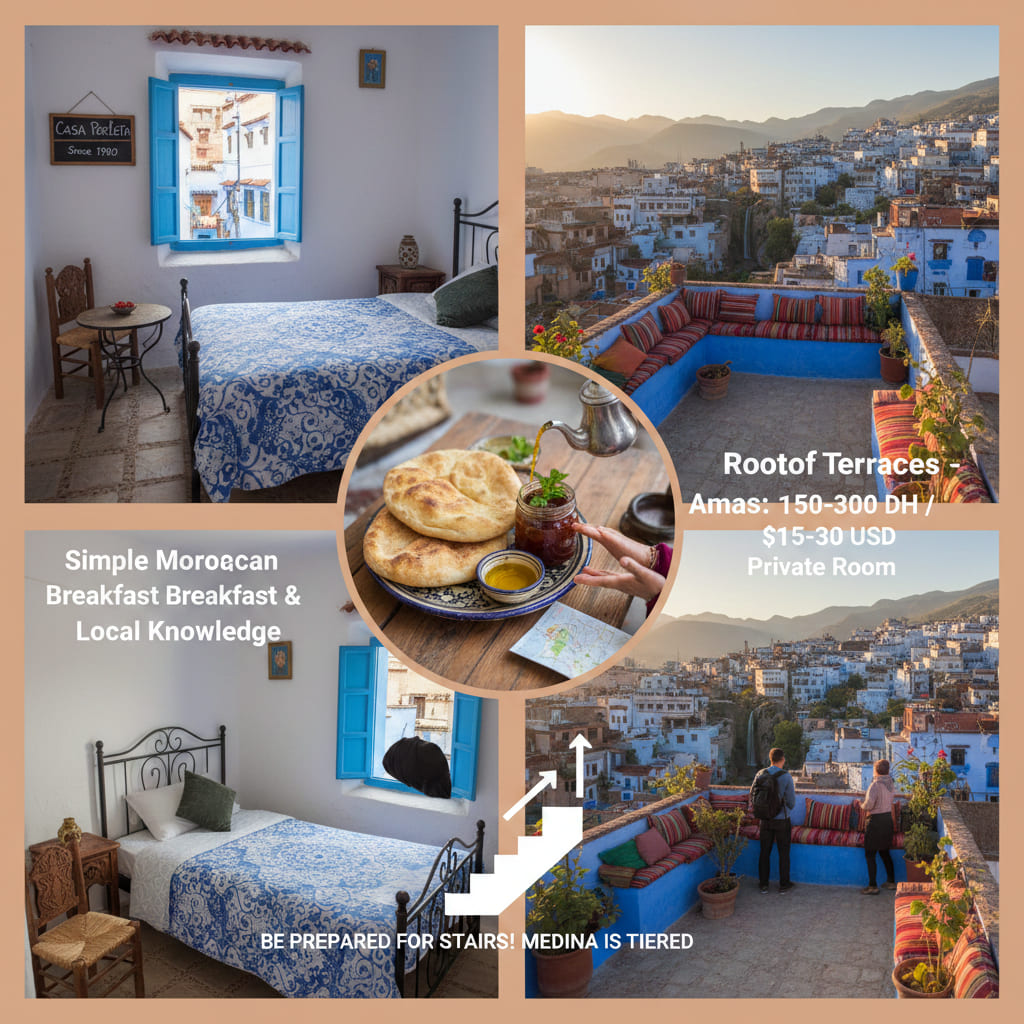
The budget tier in Chefchaouen is notably better than in most Moroccan cities of comparable size. The medina has a good supply of small family-run guesthouses that offer clean rooms, simple Moroccan breakfasts of bread, olive oil, and jam, and the kind of local knowledge that no review site can replicate.
Prices for a private room in a medina guesthouse range from around 150 to 300 dirhams per night, roughly 15 to 30 US dollars, depending on the season and how far ahead you book. Dorm beds in the handful of proper hostels inside and near the medina run from 80 to 120 dirhams.
What to expect at this tier: small rooms with basic furnishings, shared or private bathrooms depending on the property, and rooftop terraces that often punch well above their price point in terms of views. Air conditioning is not standard at this level; the altitude keeps nights cool enough that it is rarely needed except in July and August.
Casa Perleta and Dar Meziana are two guesthouses that appear repeatedly in traveler recommendations for this tier, both located inside the medina and both run by owners who are actively involved in the day-to-day operation. Independently owned guesthouses like these tend to offer a more authentic experience than the larger properties that have shifted toward tour group accommodation.
One thing worth knowing at any budget level: most medina properties involve stairs. Some involve a lot of stairs. If mobility is a consideration, ask specifically about accessibility before booking. The narrow lanes and tiered construction of a hillside medina are not easily made flat.
Mid-range options: boutique riads and terrace views
The mid-range tier is where Chefchaouen really delivers. For between 400 and 800 dirhams per night (roughly 40 to 80 US dollars), you enter the world of the boutique riad: a traditional courtyard house converted into a guesthouse that combines Moroccan architectural detail with the kind of comfort that makes a stay feel genuinely memorable.
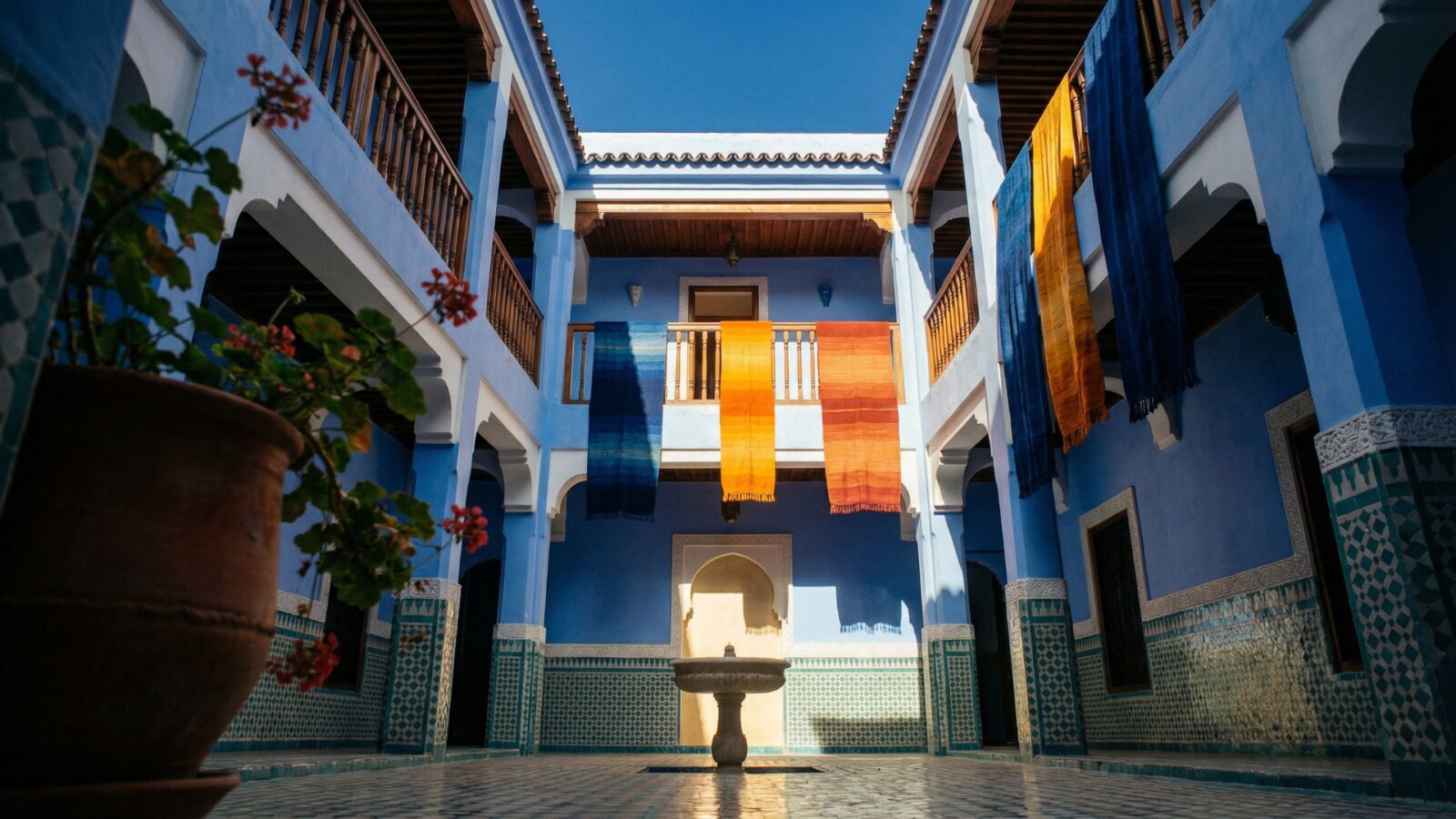
Riads at this level typically offer en suite bathrooms, proper beds with quality linens, a central courtyard with a fountain or garden, and a rooftop terrace where breakfast is served on clear mornings. The best ones layer in handwoven textiles, carved plaster details, and zellige tilework that would cost serious money to replicate in a design hotel in any Western city.
The location question matters more at this tier than at the budget level. A riad in the upper medina near the Bab el-Ain area will be quieter and slightly more removed from the tourist circuit, which some travelers prefer and others find inconvenient when they want to be near the square in the evening. A riad just off Plaza Uta el-Hammam puts you in the middle of everything but means accepting the corresponding noise level until the city quiets down after midnight.
Read recent reviews specifically for noise and for the practicalities of arrival, including whether the owner meets guests at the medina gate or sends directions that assume familiarity with the layout. The difference between a smooth arrival and a frustrating one with luggage in an unfamiliar medina often comes down to this single detail.
Splurge tier: heritage houses with mountain views
At the upper end of the market, Chefchaouen offers a small number of genuinely special properties that justify their price not through luxury in the conventional hotel sense but through architecture, location, and the quality of the experience they create.
These properties typically occupy converted historic houses with multiple floors built around central courtyards, feature terraces with unobstructed views of the medina rooftops and the Rif Mountains, and offer a level of personal service, including private hammam sessions, in-house dinners, and curated local recommendations, that turns a stay into something closer to a hosted experience than a hotel visit.
Prices at this tier range from around 800 to 1,500 dirhams per night and upward for the most sought-after properties in peak season. The value proposition is not about comparing thread counts with a five-star chain hotel. It is about staying somewhere that is genuinely irreplaceable and feels specific to this city rather than interchangeable with an upscale property anywhere else in the world.
Booking well ahead is essential for this tier. The best properties in this category carry occupancy rates in peak season that leave no room for last-minute decisions. April, May, September, and October are the months where availability tightens earliest.
Outside the Medina: when it makes sense
The new town surrounding the medina has conventional hotels ranging from two to four stars that offer reliable comfort, easier vehicle access, and pricing that typically runs 30 to 40 percent lower than comparable medina accommodation.
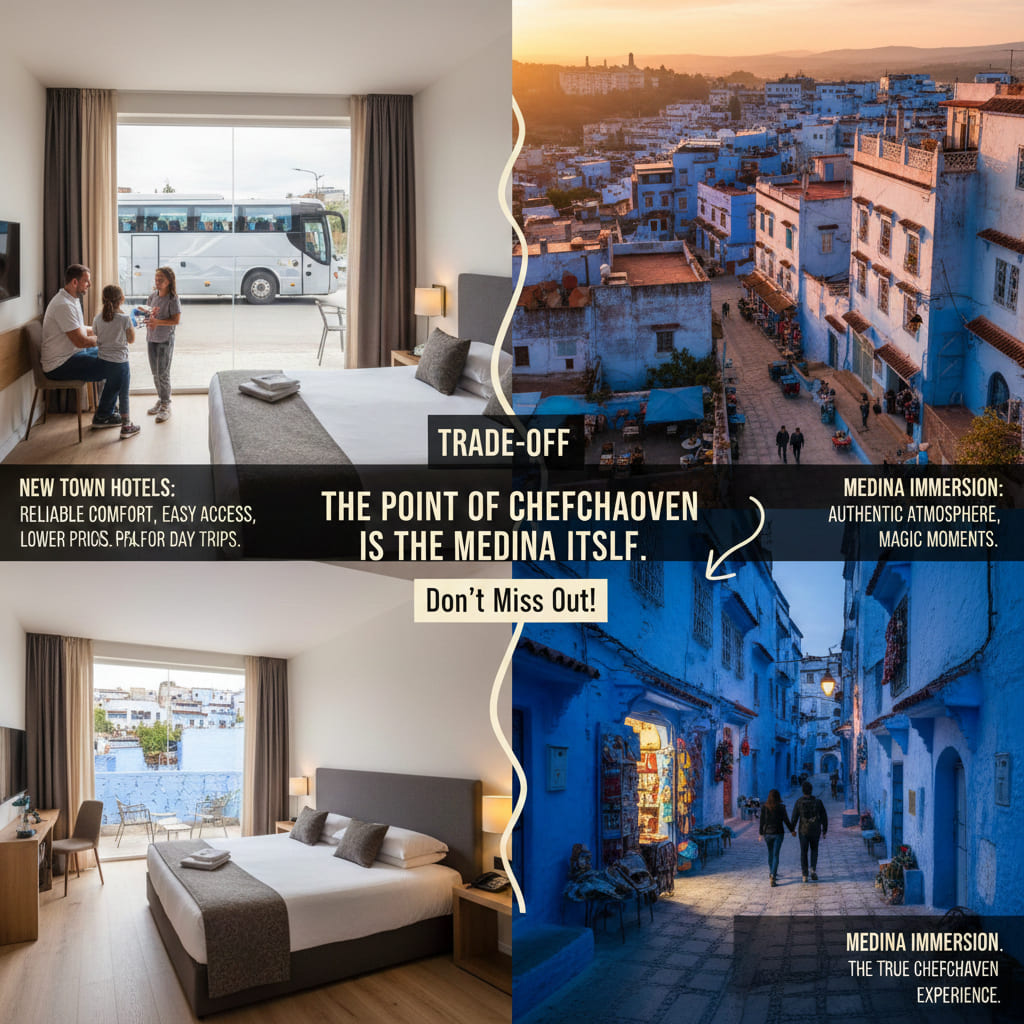
If you are primarily using Chefchaouen as a logistical base for day trips to Akchour or Tetouan rather than as a destination to be immersed in, outside-the-medina accommodation is a reasonable and cost-effective choice. Families with young children who need to move quickly between vehicle and room will appreciate the practical advantages.
Most travelers, though, come to Chefchaouen for the medina itself. Staying outside it to save money is a trade-off that many visitors regret, particularly when they realize how much the early morning and late evening atmosphere in the old city depends on being inside it when those hours happen.
A practical comparison by tier
| Tier | Price range (per night) | Location | Best for |
| Budget guesthouse | 150-300 MAD ($15-30) | Inside medina | Solo travelers, backpackers |
| Hostel dorm | 80-120 MAD ($8-12) | Near medina | Budget travelers, social stays |
| Mid-range riad | 400-800 MAD ($40-80) | Inside medina | Couples, comfort seekers |
| Splurge heritage house | 800-1,500+ MAD ($80-150+) | Upper medina | Special occasions, slow travelers |
| New town hotel | 200-500 MAD ($20-50) | Outside medina | Vehicle access, budget flexibility |
Booking timing: when to plan ahead and when you can wing it
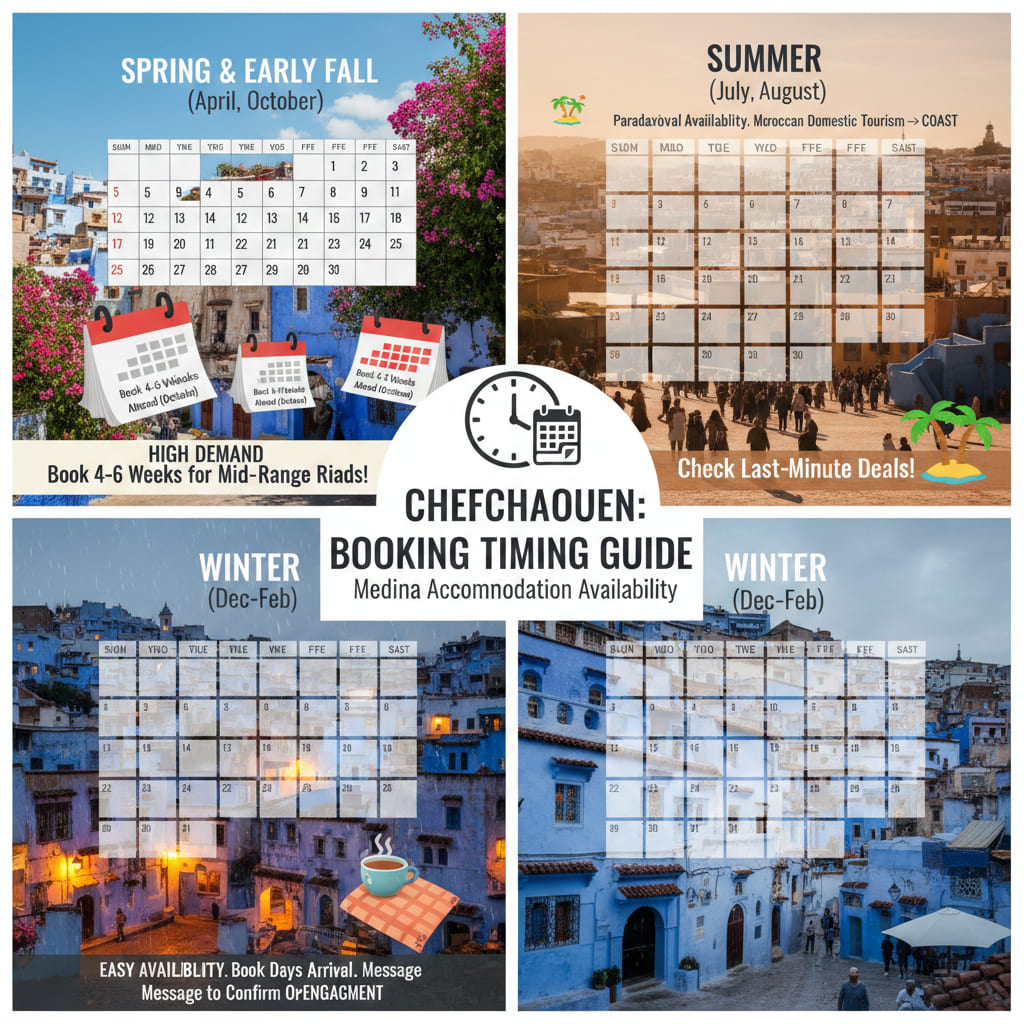
Spring and early fall are the windows where booking ahead matters most. April in particular can see medina accommodation fill four to six weeks out, especially for the more sought-after mid-range riads. If you are traveling in October, the lead time is shorter but still worth acting on two to three weeks in advance for anything in the mid-range tier.
Summer is paradoxically the period where last-minute availability sometimes opens up despite high overall visitor numbers, because Moroccan domestic tourism skews toward coastal destinations rather than mountain ones. July and August are busy, but less so than the logic of peak season might suggest.
Winter is genuinely easy for availability. December through February, you can often book within a day or two of arrival and have your pick of medina properties. Some smaller guesthouses reduce their operating schedule in January, so confirming that a property is actively open before you arrive is worth a quick message. Our complete Chefchaouen travel guide includes a breakdown of where to stay and what to expect from different accommodation types across the medina.
What arriving at your accommodation actually looks like
This is the part of the Chefchaouen accommodation experience that most booking platforms and review sites fail to prepare travelers for adequately.
Your vehicle, whether a taxi or your own rental car, cannot enter the medina. It will drop you somewhere near the main entrance gate. From there, you navigate on foot with your luggage through lanes that are often less than two meters wide, sometimes stepped, occasionally inhabited by donkeys carrying supplies to properties that have no other delivery mechanism.
Most guesthouses and riads will share a detailed walking route from the main gate when you confirm your reservation. Follow it carefully and do not rely solely on map applications, which frequently lose accuracy inside dense medina environments.
The walk from the gate to most medina properties takes between five and fifteen minutes. On a cool October morning with a manageable bag, it is genuinely enjoyable. In August heat with a large suitcase, it is a different experience. Pack accordingly, and consider what you actually need versus what you are bringing out of habit.
A practical habit that experienced Morocco travelers develop: message your accommodation the morning of arrival to confirm timing and ask whether someone will meet you at a landmark near the medina entrance. Most owners are happy to do this, and it removes the uncertainty from an arrival that involves unfamiliar geography and the end of a long travel day.
Once you are inside and settled, the city opens up in a way that no amount of reading quite prepares you for. The decision of where to stay within it becomes the architecture of your entire experience.
For everything that comes after the check-in, our guide to the best things to do in Chefchaouen covers the activities, walks, and less obvious discoveries that make the most of however many days you have inside the Blue City.
What matters more to you when choosing accommodation in a place like this: location and atmosphere, or the practical comforts that make a stay easy?