The secret language of Moroccan doors: what ancient medina entryways reveal about culture and hospitality

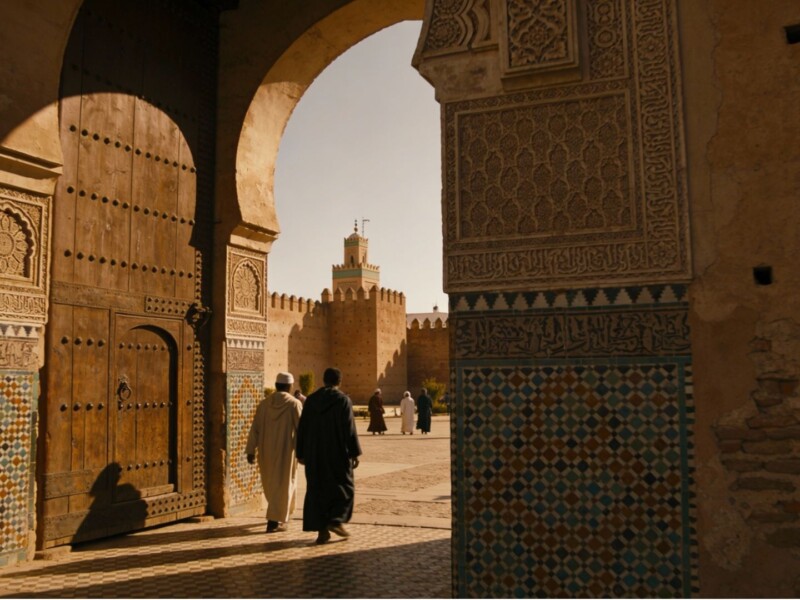
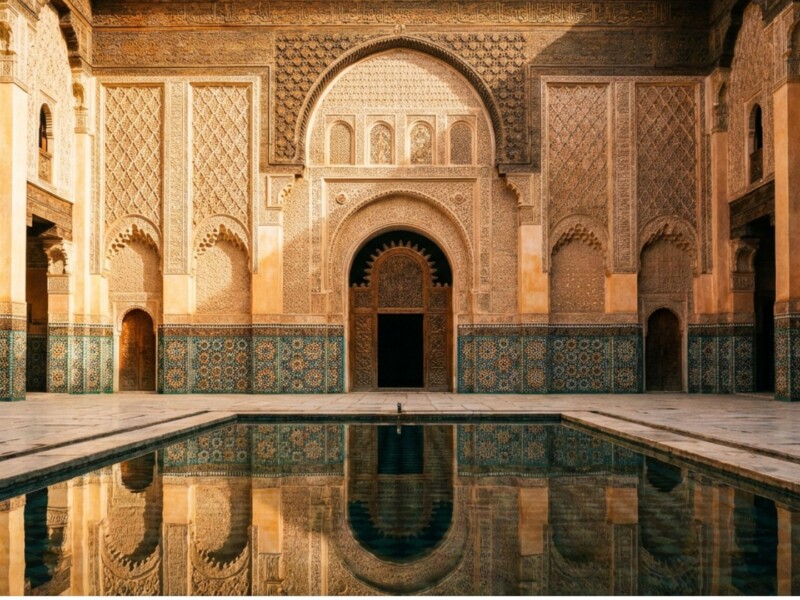
Step into the labyrinthine alleyways of Marrakesh or Fez, and you’ll notice something extraordinary hiding in plain sight. The ornate wooden doors lining these medieval quarters aren’t simply functional barriers between public streets and private homes. They’re intricate communication systems, cultural artifacts, and architectural storytellers that have whispered secrets about Moroccan domestic life for centuries. Each brass knocker, carved panel, and decorative element serves a specific purpose rooted in tradition, revealing a sophisticated social code that modern doorbells and intercoms have rendered nearly obsolete elsewhere. These doorways are one thread in Morocco’s broader Moorish heritage, and they come alive alongside the country’s Moorish architecture sites.
Most travelers rush past these magnificent entryways, snapping quick photos of their Instagram-worthy craftsmanship before moving on to the next souk or riad. But pausing to understand the ingenious design of traditional Moroccan doors transforms how you experience the medina. Suddenly, these aren’t just pretty architectural features but living examples of how communities developed elegant solutions to social challenges long before digital communication existed.
The dual knocker system that announces your identity
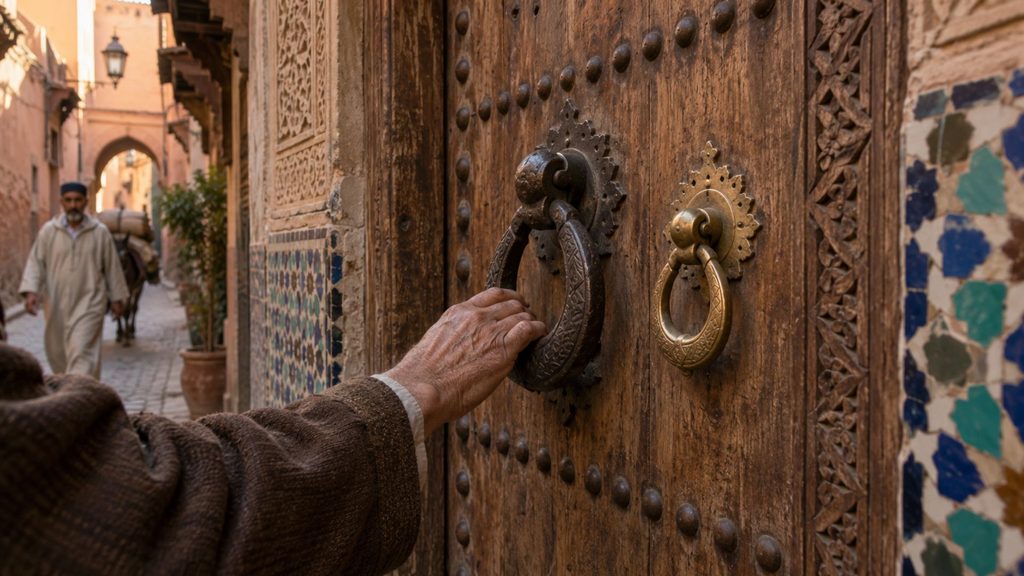
The most fascinating feature adorning Moroccan doors is the presence of multiple knockers positioned at different locations and crafted from various metals. This isn’t decorative redundancy but rather an ancient acoustic identification system that allowed households to know who stood outside before ever opening the door.
Typically, you’ll find two knockers placed side by side at mid-height. One knocker, often slightly larger or heavier, produces a deep, resonant sound when struck. Family members, close friends, and regular visitors use this knocker because its distinctive tone signals to everyone inside that someone familiar has arrived. The household can relax their formality, and any family member, regardless of gender, may answer the door without concern.
The second knocker creates a noticeably different sound, lighter and sharper in tone. Strangers, merchants, or unfamiliar guests use this alternative knocker, immediately alerting the household that protocol must be observed. In traditional Moroccan culture, this meant a male family member should answer the door. If only women were home, they would quickly cover their hair and ensure modest dress before responding to the stranger’s knock.
This elegant system solved a significant privacy concern in densely populated medinas where extended families often shared interconnected riads. The acoustic distinction gave households precious seconds to prepare appropriately, maintaining cultural norms around modesty and male-female interactions without the awkwardness of opening the door to discover who stood outside.
Elevated knockers designed for mounted visitors
Look higher on many doors, and you’ll spot a third knocker positioned well above the standard ones. This elevated placement initially puzzles many visitors until the practical reason becomes clear. In traditional medinas where narrow passages prevent car access, residents and merchants relied heavily on donkeys, mules, and horses for transportation and hauling goods.
When the homeowner returned riding a mule or when deliverymen arrived atop their pack animals, they physically couldn’t reach the lower knockers without dismounting. The upper knocker solved this problem elegantly, allowing mounted visitors to announce their arrival without the inconvenience of dismounting just to knock on a door.
Postal carriers, textile merchants delivering fabrics, and food vendors transporting supplies all utilized these higher knockers as they made their rounds through the medina. The distinct positioning also helped household members recognize delivery arrivals versus social visits, adding another layer of useful information to the knocker communication system.
Child-height knockers that welcomed the smallest visitors
Observant travelers sometimes notice a fourth knocker positioned quite low on certain doors, placed at a height perfect for children to reach. This touching detail reveals something beautiful about traditional Moroccan neighborhood culture and the value placed on community bonds.
In earlier times, children roamed medina neighborhoods freely, welcomed at any household regardless of whether their own family lived there. The low knocker ensured even the smallest neighborhood kids could announce themselves at any door. Families would open their homes to these young visitors, offering tea, snacks, and playmates without hesitation.
This practice reflected a communal approach to child-rearing where neighborhood adults collectively looked after all children, not just their own. The low knocker symbolized this openness, literally giving children equal access to community spaces and reinforcing that they belonged everywhere within their neighborhood, not just their own homes.
While this practice has diminished in modern times, the low knockers remain on many historic doors as reminders of when medina life operated more communally and doors stayed open to neighbors regardless of age.
The practical purpose behind double door designs
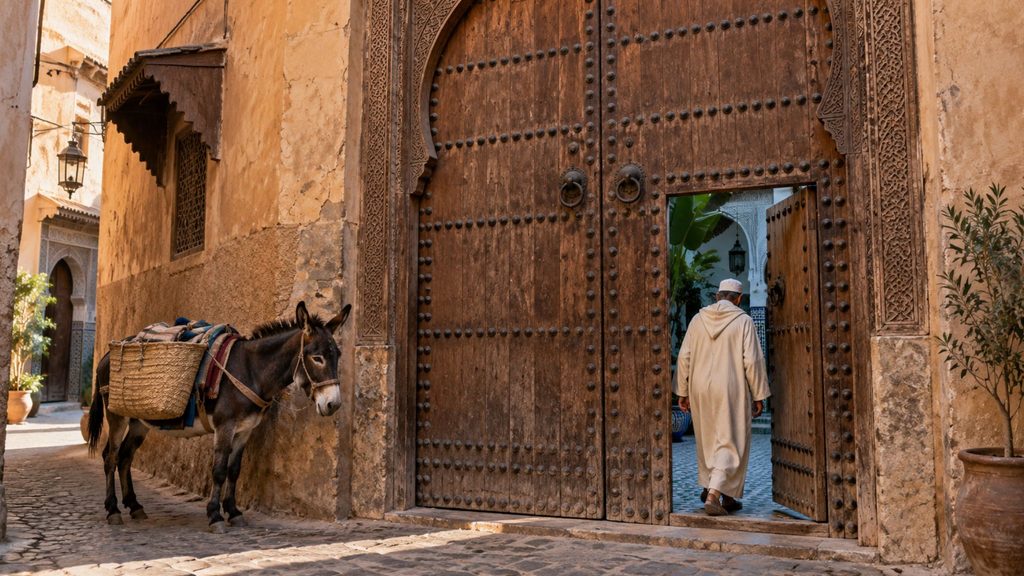
Many Moroccan doors feature a distinctive design element: a smaller door cut into a larger one. This door-within-a-door arrangement serves multiple practical purposes that become obvious once explained.
The smaller door handles daily traffic efficiently. Every time someone enters or exits, opening just the small door conserves effort and maintains interior temperature control better than swinging open the massive main entrance. During hot Moroccan summers, this minimizes heat entering the cool interior spaces. In winter, it prevents cold drafts from flooding the home.
The larger door only opens for specific purposes. When the family owns a donkey or mule, the animal can enter the interior courtyard through the big door opening. Many traditional riads featured ground-floor stables where household animals spent nights safely secured. The large door also accommodated delivery of substantial furniture pieces, construction materials for renovations, or large merchant shipments that couldn’t squeeze through the smaller daily entrance.
This dual-size system maximized functionality while minimizing the physical space and materials needed. Rather than installing two separate entrances, Moroccan craftsmen ingeniously integrated both sizes into a single doorframe.
Decorative pins that may (or may not) count interior rooms
Examining doors closely reveals decorative metal pins or studs arranged in patterns across the wooden surface. Local legends claim these pins indicate how many rooms exist inside the riad, with each pin representing one interior space. Count five pins, and supposedly the home contains five rooms.
This makes for a charming story that tour guides love sharing, and it adds mystery to the medina exploration experience. However, architectural experts caution that this interpretation is more folklore than fact. While some doors may coincidentally have pin counts matching interior room numbers, this wasn’t a deliberate architectural code.
The pins more likely served decorative purposes while also reinforcing the door’s structural integrity. The metal studs helped hold together the wooden planks and added visual interest through their geometric arrangements. That some households might have chosen pin counts matching their room numbers as a personal touch doesn’t mean this was standard architectural practice.
Regardless of their true purpose, these metal embellishments contribute to the doors’ overall aesthetic beauty and give travelers one more detail to observe and appreciate.
The hand of Fatima: a knocker with romantic implications
Some Moroccan doors feature knockers shaped like an open hand, known as the hand of Fatima or hamsa. This symbol holds deep religious and cultural significance throughout North Africa and the Middle East, representing protection, power, and strength. But according to local tradition, these hand-shaped knockers also conveyed information about the romantic availability of women inside.
The folklore explains that a hand of Fatima knocker without a ring indicates at least one unmarried woman resides within, signaling that the household might be open to marriage proposals from suitable families. Conversely, a hand wearing a ring means all the women inside are married, effectively closing the door (pun intended) on matchmaking inquiries.
Whether families genuinely used this system for communicating marital status or whether it’s another charming urban legend remains debated. Practical concerns arise with this interpretation: Would families really advertise their daughters’ availability so publicly? Would they update the knocker’s ring status as daughters married or divorced?
More likely, the ring represented general good fortune and protection rather than serving as a precise marital status indicator. However, the romantic interpretation adds another layer of storytelling to these remarkable doors and reminds visitors that doorways represented more than physical thresholds. They were interfaces between private family life and public community life, where information flowed both directions.
Geographic specificity: where to find these remarkable doors
While decorative doors exist throughout Morocco, the elaborate multi-knocker examples primarily appear in the historic medinas of Marrakesh and Fez. These two cities represent Morocco’s most significant cultural centers, where traditional architecture has been preserved most completely.
Marrakesh’s medina, a UNESCO World Heritage site, features countless examples of these doors lining the narrow passages radiating from Jemaa el-Fna square. The red city’s doors often showcase vibrant colors alongside their brass knockers, with paint choices indicating different neighborhoods and family traditions.
Fez’s medina, even more extensive and complex than Marrakesh’s, contains some of Morocco’s oldest and most ornate examples. Walking through Fez’s ancient quarters, you’ll encounter doors that have stood for centuries, their wood darkened and smoothed by countless hands but their knocker systems still intact and functional.
Other Moroccan cities like Essaouira, Rabat, and Chefchaouen feature beautiful doors, but often with simpler designs lacking the elaborate multi-knocker systems. The Marrakesh and Fez examples represent the pinnacle of this architectural tradition.
Preservation challenges in modern medinas
As Morocco modernizes and medinas evolve, these traditional doors face increasing threats. Rising real estate values in historic quarters attract investors who convert traditional riads into boutique hotels and restaurants. Renovations sometimes prioritize aesthetic appeal over historical accuracy, resulting in reproduction doors that look beautiful but lack authentic functionality.
Additionally, as fewer families maintain traditional gender separation practices and as mobile phones replace acoustic door signals, the practical need for multi-knocker systems has diminished. Why maintain multiple knockers when you can simply call or text ahead to announce your arrival?
Some historic preservation organizations work to document and protect these remarkable doors, recognizing them as important cultural artifacts. Photography projects catalog remaining examples before they disappear. Craftsmen’s cooperatives train younger generations in traditional door-making techniques to ensure this knowledge doesn’t vanish entirely.
Your journey through medina doorways
Understanding the sophisticated communication systems embedded in Moroccan doors transforms how you experience medina exploration. Suddenly, you’re not just wandering through picturesque alleyways but reading an architectural language that speaks volumes about hospitality, privacy, community bonds, and cultural adaptation.
Take time during your medina visits to really observe these doors. Notice the knocker placements and imagine the acoustic codes they created. Appreciate the craftsmanship in the carved wooden panels and metal work. Consider the countless hands that have grasped these knockers over centuries, announcing arrivals, departures, deliveries, and social calls.
These doors represent more than obstacles between you and Instagram-worthy riad courtyards. They’re cultural documents preserving traditions that shaped daily life for generations. They demonstrate how communities developed elegant, low-tech solutions to social challenges that remain relevant even in our hyperconnected age.
The genius of Moroccan door design lies not in its complexity but in its thoughtful simplicity. Every element serves multiple purposes, nothing exists purely for decoration, and form follows function in ways that created beautiful objects meeting genuine needs.
Final thoughts on architectural storytelling
Morocco’s ornate medina doors remind us that architecture tells stories if we pause long enough to listen. These entryways encode information about gender roles, family structures, neighborhood bonds, economic activities, and cultural values into wood, metal, and careful design. They demonstrate how physical spaces shape social interactions and how communities adapted architectural elements to serve multiple purposes simultaneously.
For travelers willing to look beyond surface beauty and dig into the cultural meanings behind decorative elements, Moroccan doors offer endless fascination. They prove that some of the most interesting travel experiences come not from famous monuments or must-see attractions but from paying attention to everyday objects that locals might barely notice anymore.
The next time you find yourself wandering a Moroccan medina, pause before a particularly elaborate door. Study its knockers, admire its craftsmanship, and imagine the centuries of stories it could tell about the families sheltered behind it. That moment of connection with history and culture represents travel at its finest, creating understanding that transcends simple sightseeing.
What traditional architectural elements in your travels have surprised you with their hidden meanings or ingenious functionality?