The Alawite Dynasty: 350 years of Moroccan royal history that shaped the kingdom
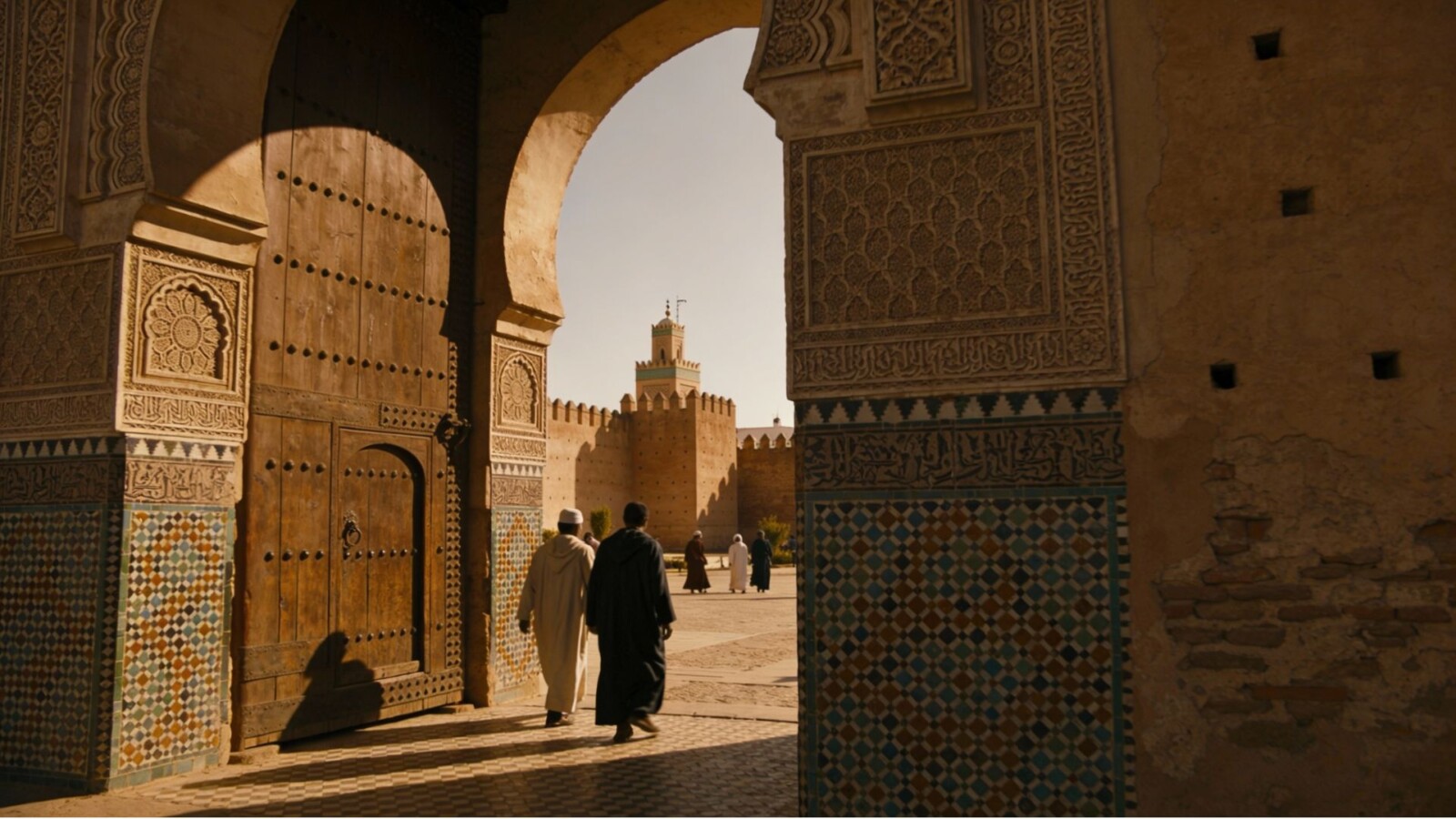
The man who built the palace you’ll photograph in Meknes allegedly fathered over a thousand children.
That detail about Sultan Ismail tends to grab attention, but it’s merely one thread in a tapestry spanning three and a half centuries of Alawite rule over Morocco. For travelers wandering through imperial cities, exploring ancient medinas, or simply trying to understand why Morocco feels different from its neighbors, the story of this dynasty provides essential context. The kingdom’s stability, its unique political character, and even the architectural monuments that anchor most itineraries all trace back to decisions made by Alawite rulers across generations.
King Mohammed VI, who has occupied the throne since 1999, represents the continuation of a lineage that claims descent from the Prophet Muhammad himself. That genealogical connection isn’t merely historical trivia. It has shaped Moroccan politics, legitimized royal authority, and created a form of governance that distinguishes Morocco from virtually every other nation in Africa and the Arab world.
Origins in the desert oases
The Alawites entered Morocco in the 13th century, settling in the southern oasis region of Tafilalt. For several hundred years they remained regional figures, building influence gradually in a land where political authority fragmented and reconsolidated repeatedly.
The dynasty’s name derives from Ali, the Prophet Muhammad’s cousin and son-in-law, who married Fatima, the Prophet’s daughter. This connection to Islam’s founding family would prove crucial. In a society where religious legitimacy translated directly into political power, claiming descent from the Prophet provided a foundation that military strength alone could not match.
The 1630s found Morocco in chaos. The Saadian dynasty, which had previously united the country, had collapsed into competing factions. Sharif ibn Ali, considered the dynasty’s founder, emerged as a leader in Tafilalt during this period, though his son Muhammad ibn Sharif struggled for three decades without expanding family territory significantly.
The real consolidation came through violence within the family itself. Rasheed ibn Sharif killed his brother Muhammad in 1664 and immediately set about conquering the rest of Morocco. Within five years he had taken Fez, and by 1669 he controlled Marrakech and the south. When he died in 1672, the Alawites effectively controlled all of Morocco.
The golden age under Sultan Ismail
What followed represents the dynasty’s peak. Sultan Ismail ruled for 55 years, from 1672 to 1727, an extraordinary tenure that allowed him to reshape Morocco fundamentally.
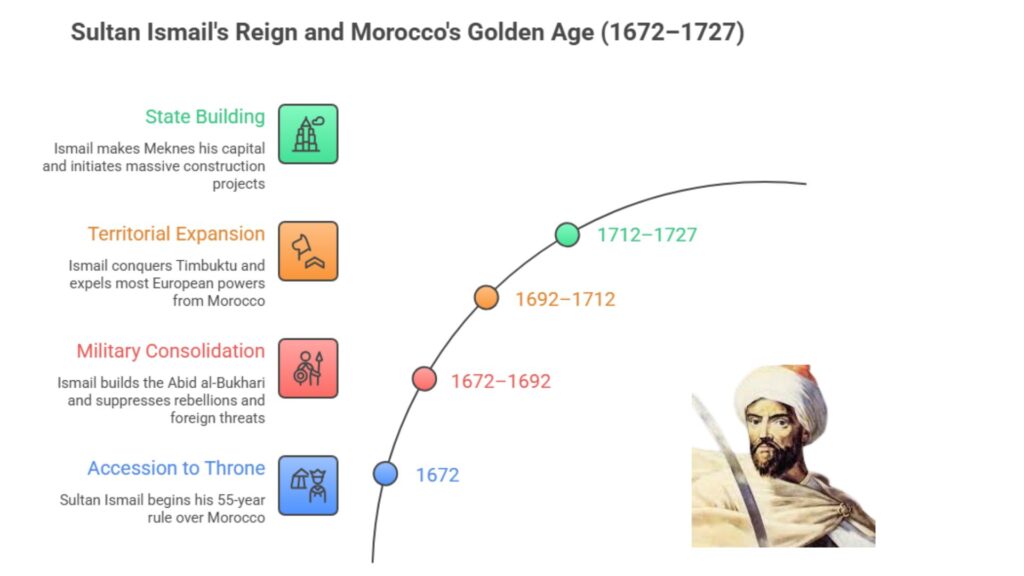
His early reign was anything but stable. Rebellions came from his own family members. Ottoman pressure from Algeria threatened the east. Internal tribes contested central authority. Ismail’s response was to create something unprecedented: a massive standing army built around the Abid al-Bukhari, known in English as the Black Guard.
This military corps, comprised largely of African slaves along with some freedmen, underwent years of training and developed fierce loyalty to the sultan personally. They collected taxes, enforced royal authority across distant provinces, and provided the muscle that allowed Ismail to project power deep into the Sahara, conquering legendary cities like Timbuktu.
Sultan Ismail also tackled European presence on Moroccan soil. Previous political chaos had allowed Spain, Portugal, and England to establish coastal footholds. Ismail systematically expelled most of these foreign powers, though some enclaves like Ceuta and Melilla remain Spanish to this day, a living reminder of that contested era.
After roughly twenty years of constant military campaigning, Ismail turned to state building. He made Meknes his capital, transforming it into an imperial center using slave labor that included thousands of Europeans. The construction projects he initiated, including the Kasbah of Moulay Ismail that tourists visit today, reshaped the city’s character permanently.
European accounts from the period paint Ismail as villainously cruel, though scholars note the exaggeration common in such sources. What’s undeniable is his absolutism. He concentrated power completely, tolerated no rivals, and ruled with methods that produced stability even if they also produced fear.
The thousand children question
The claim that Sultan Ismail fathered over a thousand children has fascinated historians and geneticists alike. With only four official wives but hundreds of concubines, the mathematics become at least theoretically possible. If accurate, it would make him among the most prolific fathers in recorded human history.
Whether the number is precise or somewhat inflated by court chroniclers eager to emphasize royal virility, the practical consequence was clear: when Ismail died in 1727 at over 80 years old, the succession question became catastrophically complicated.
The Abid al-Bukhari had grown so powerful that they effectively controlled the throne, installing and removing Ismail’s various sons as suited their interests. Morocco fragmented. Different factions fought for dominance. The pattern eerily resembled the chaos that preceded Alawite consolidation.
This instability lasted roughly twenty years until Abdullah, one of Ismail’s younger sons, finally established control in 1748. But the real reconstruction came with Sultan Muhammad III, who took the throne in 1757 facing a country devastated by three decades of internal conflict.
Rebuilding and the American connection
Muhammad III approached governance differently than his grandfather. He dismantled the Abid al-Bukhari, leading massacres against the corps that had dominated royal politics for decades. Instead of forcing tribal submission through violence, he pursued diplomatic relationships with Morocco’s internal power centers.
The devastating earthquake of 1755, which destroyed cities across Morocco, Spain, and Portugal, gave Muhammad III an unwanted opportunity: rebuilding required new approaches. He opened Morocco commercially, signing trade treaties with European nations and reducing the tax burden on citizens that had characterized Ismail’s harsh rule.
One diplomatic decision from this period still resonates in American foreign policy: Morocco became the first country in the world to recognize the newly independent United States of America in 1777, just one year after the Declaration of Independence. The Treaty of Friendship between the two nations, signed in 1786, remains the longest unbroken treaty relationship in American history.
European pressure and the loss of independence
The 19th century brought mounting challenges that no amount of internal reform could fully address. Morocco’s finances deteriorated. Sultan Abd al-Rahman attempted to revive the economy through foreign trade and even piracy, but the latter only provoked confrontations with European powers.
France’s 1830 invasion of neighboring Algeria created an impossible situation. Moroccan Muslims demanded their sultan defend fellow Muslims against Christian conquest. But Morocco’s military stood no chance against industrialized European armies. When an Algerian resistance leader crossed into Morocco seeking refuge, France used it as pretext for war.
The Franco-Moroccan War of 1844 lasted two weeks. Moroccan forces were utterly routed. The Treaty of Tangiers forced recognition of French Algeria and demonstrated definitively that Morocco could not resist European military power.
Subsequent sultans recognized the need to modernize, but the economic reality made meaningful military reform nearly impossible. Morocco couldn’t raise sufficient taxes from rebellious citizens. Moroccan artisans couldn’t compete with industrial European production. The country was forced into ever-deeper commercial relationships with the very powers that threatened its sovereignty.
| Sultan | Reign | Key Challenge |
|---|---|---|
| Abd al-Rahman | 1822-1859 | Franco-Moroccan War, European pressure begins |
| Muhammad IV | 1859-1873 | Spanish war, crushing debt |
| Hassan I | 1873-1894 | Modernization attempts, tribal rebellions |
| Abd al-Aziz | 1894-1908 | First Moroccan Crisis, loss of legitimacy |
| Abd al-Hafid | 1908-1912 | Second Moroccan Crisis, loss of independence |
The First Moroccan Crisis of 1905-1906 saw Germany challenge French influence, but the resolution at Algeciras upheld French dominance. The Second Moroccan Crisis in 1911 proved a major international incident that historians view as a prelude to World War I.
In 1912, Sultan Abd al-Hafid signed the Treaty of Fez, establishing the French Protectorate that would last until 1956. He abdicated months later. The Alawites remained on the throne, but real power had shifted to colonial administrators.
The colonial period and path to independence
Sultan Yusuf, who succeeded his brother in 1912, presided over a Morocco where French and Spanish colonizers set policy. The Spanish established their own protectorate over northern and southern strips of territory.
Resistance emerged repeatedly. The Rif Berbers under Abd el-Krim defeated Spanish forces repeatedly in the 1920s using guerrilla tactics, even establishing a short-lived Republic of the Rif from 1921 to 1926. Only combined French-Spanish military operations eventually crushed the rebellion.
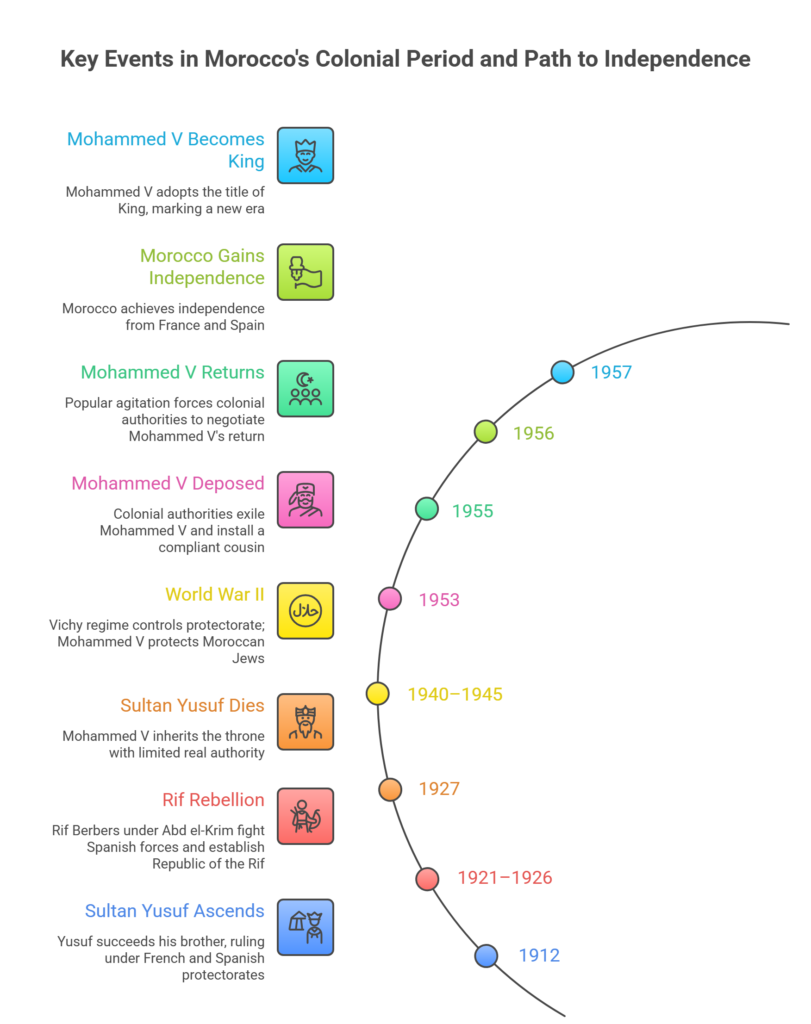
Yusuf moved the capital from Fez to Rabat, where it remains today. When he died in 1927, his son Mohammed V inherited a throne with limited real authority but significant symbolic importance.
World War II created unexpected opportunities. When France fell to Nazi Germany, the Vichy regime took control of the protectorate. Sultan Mohammed V managed to block efforts to deport Moroccan Jews to concentration camps, providing significant protection to the country’s substantial Jewish community throughout the war.
After the war, nationalist sentiment intensified. France ignored calls for independence. In 1953, colonial authorities deposed Mohammed V at gunpoint and exiled him, replacing him with a more compliant cousin. But popular agitation proved too strong. Mohammed V had become the symbol of Moroccan nationalism itself.
With France already fighting a war against nationalists in Algeria, colonial authorities couldn’t afford conflict in Morocco as well. They negotiated Mohammed V’s return in 1955, and Morocco achieved independence in 1956. The following year, Mohammed V adopted the title of King rather than Sultan, marking a new chapter in Alawite history.
The modern kingdom
King Hassan II, who ruled from 1961 to 1999, shaped the Morocco that contemporary travelers experience. His reign began with difficult questions about governance: would Morocco have an absolutist monarch or incorporate democratic elements?
The 1962 constitution established a monarchy alongside a multi-party parliamentary system, but Hassan II quickly initiated what became known as the “Years of Lead.” Thousands of dissidents were jailed or killed. Two assassination attempts in 1971 and 1972 nearly succeeded.
Hassan II focused on economic development and territorial expansion. The 16-year war to control Western Sahara, a territory that remains disputed today, dominated foreign policy. By the early 1990s, he had begun allowing democratic reforms and relaxing suppression of dissidents.
King Mohammed VI, who took the throne in 1999, has largely distanced himself from his father’s authoritarian approach. The 2011 Arab Spring protests prompted constitutional reforms that expanded parliamentary powers. While the king retains substantial authority and some critics allege corruption, Morocco has avoided the instability that devastated other Arab nations during that period.
Crown Prince Moulay Hassan, born in 2003, stands next in line for succession, followed by the king’s brother Moulay Rasheed. The dynasty that began in the Tafilalt oases over seven centuries ago continues into the third decade of the 21st century.
What this means for travelers
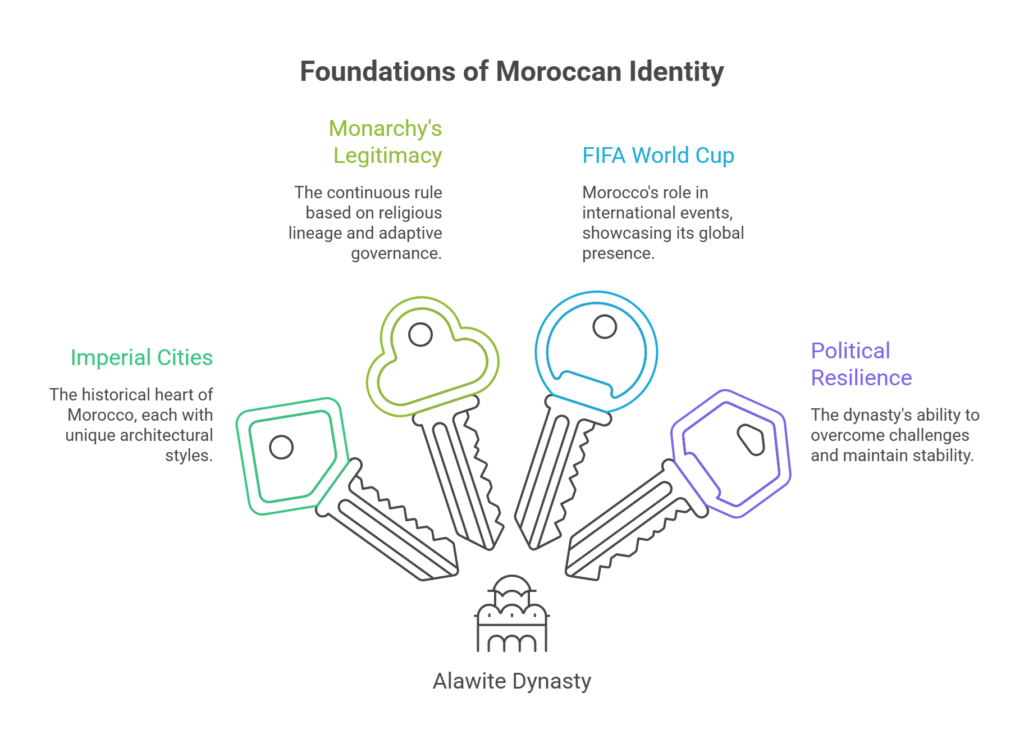
Understanding Alawite history transforms how you experience Morocco. The imperial cities of Fez, Meknes, Marrakech, and Rabat each bear the marks of different rulers’ priorities and personalities. Sultan Ismail’s massive construction projects in Meknes reflect his absolutist ambitions. Mohammed V’s role in independence explains his continued reverence in contemporary Morocco.
The stability that distinguishes Morocco from many neighboring countries traces directly to the monarchy’s continuous legitimacy, built on both religious lineage and adaptive governance across centuries. The 2030 FIFA World Cup, which Morocco will co-host with Spain and Portugal, represents the latest chapter in a long history of navigating relationships with European powers.
For travelers, the Alawite story provides context that enriches every palace tour, every medina exploration, every conversation about contemporary Moroccan society. The dynasty’s 350-year survival through golden ages and near-collapse, colonial domination and independence, offers lessons about political resilience that resonate well beyond North Africa.
How does understanding a country’s royal history change the way you experience its present-day culture and monuments?