
Menara Garden Marrakech: a guide to the city’s most serene escape
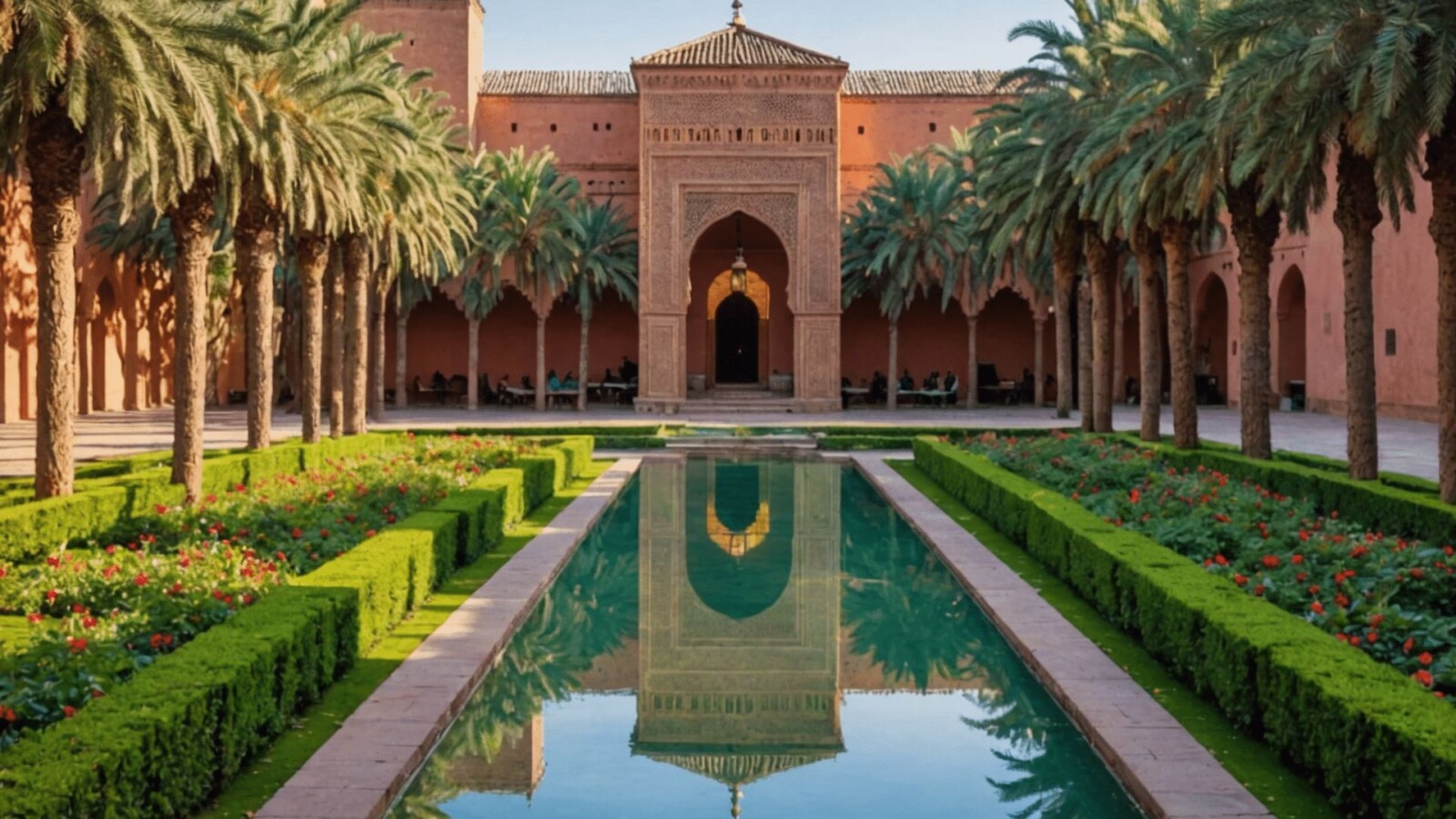
Marrakech moves fast. The Medina pulls you through its corridors with noise, color, and the constant press of crowds. Menara Garden exists for the opposite reason. A vast olive grove, a centuries-old basin, and an unobstructed view toward the Atlas Mountains create one of the most genuinely restful stops in the entire city.
This guide covers everything you need to visit Menara Garden well, from the best time to arrive to how to pair it with the rest of your Marrakech itinerary.
What makes Menara Garden worth your time
Menara is not a formal garden in the European sense. There are no manicured flowerbeds or sculpted hedges. What you find instead is space, water, and old trees.
The central feature is a large rectangular basin that reflects the sky and, on clear days, the snow-capped peaks of the Atlas range sitting on the horizon beyond the city. A green-roofed pavilion stands at the water’s edge, modest and elegant, its clean lines doubling in the still surface when the wind drops.
Around the basin, a grove of olive trees spreads across several hectares. The trunks are ancient and twisted, the canopy low and filtering. Walking into the grove shifts the temperature by several degrees and replaces the sound of the city with birdsong and the rustle of leaves.
Locals use this space the way a neighborhood park is used anywhere in the world. Families spread out on the grass. Couples walk the edge of the basin. Older visitors sit in the shade and watch the light move. That everyday quality is part of what makes Menara feel real rather than staged.
Quick reference: Menara Garden at a glance
| Detail | Information |
|---|---|
| Location | 2 km southwest of Koutoubia Mosque |
| Entrance fee | Free (pavilion interior may charge a small fee) |
| Best time to visit | Early morning or late afternoon |
| Avoid | Midday in summer (June–August) |
| Getting there | Taxi, calèche, or 25-min walk from Medina |
| Accessibility | Basin edge accessible; grove requires care |
| What to bring | Water, hat, sunscreen, comfortable shoes |
| Time needed | 1 to 2 hours |
When to visit for the best experience
Timing matters at Menara more than at most Marrakech attractions.
Morning visits, arriving before 9am, give you cool air, soft light, and a mostly empty basin. The reflection is at its clearest when the air is still and the sun is low. Photographers and early risers will find this the most rewarding window.
Late afternoon, from around 4pm onward, brings a different quality of light. The sun moves behind the pavilion, turning the water gold and deepening the shadows between the olive trunks. This is the most atmospheric time to visit and the most popular with locals finishing their day.
Midday in summer should be avoided if possible. The open ground around the basin offers little shade, and temperatures between June and August regularly exceed 38 degrees Celsius. For a broader look at how to plan around Marrakech’s climate, the guide to Morocco climate and weather breaks down the best travel windows across all regions.
How to get to Menara Garden
The garden sits roughly two kilometers southwest of the Koutoubia Mosque, outside the Medina walls. Most visitors arrive by taxi, which takes under ten minutes from the main square and costs a small flat fare. Agree on the price before you get in.
Calèches, the horse-drawn carriages that line up near Jemaa el-Fna, also make the trip and add a slower, more atmospheric approach if you have time to spare.
Walking from the Medina takes around 25 minutes along a straightforward route. It passes through a quieter residential neighborhood and gives you a useful sense of the city’s scale beyond the tourist center.
There is no entrance fee for the garden itself. The pavilion interior sometimes charges a small admission, but the grounds, the basin, and the olive grove are all free to access.
Walking the olive grove
Most visitors spend their time along the basin edge and never step into the grove. That is a missed opportunity.
The olive trees at Menara are thought to date back several centuries. Their trunks split and lean at odd angles, shaped by decades of pruning and weather. The canopy they form is irregular but consistently cool, blocking the direct sun and creating a green half-light that feels completely different from the open brightness of the basin.
Paths through the grove are informal. There are no signs or marked routes. The best approach is simply to walk in and let the rows carry you. A slow figure-eight between two lines of trees, pausing occasionally to look up through the branches, takes around 20 minutes and covers the character of the grove well.
Birds move low through the trunks. The ground is firm with exposed roots and occasional flat stones. Families sometimes spread blankets in the shade for a simple picnic. If you carry water and something to read, this is one of the more genuinely peaceful spots available in a busy city.
Photographing the pavilion and basin
The pavilion photograph is the image most associated with Menara, and earning a clean version of it requires a small amount of patience.
The reflection strengthens as the wind drops. On a still morning or a calm late afternoon, the pavilion doubles almost perfectly in the surface of the basin. Crouching low places the horizon higher in the frame and gives the water more visual weight. Stepping to one side or the other removes other visitors from the composition, or includes them deliberately to show the scale of the space.
The most honest photograph of Menara usually includes people. The pavilion alone reads as a postcard. The pavilion with locals walking the edge and children at the far corner reads as a real place.
Inside the olive grove, look for the contrast between dark trunks and bright patches of sky visible through the canopy. A single well-lit trunk with the basin visible in soft focus behind it captures the layered quality of the garden without requiring any special equipment.
Pairing Menara with the rest of your Marrakech day
Menara works best as a counterbalance to the denser parts of the city.
A productive Marrakech morning might include the souks, a palace or two, and lunch in the Medina. By early afternoon, sensory overload sets in for most visitors. Menara is the logical antidote. The open horizon empties the head in a way that no amount of coffee or air conditioning manages.
“Marrakech is a city that rewards those who know when to stop. Menara is where you go to remember that stillness is also part of travel.”
If you are building a green-focused day, Menara pairs naturally with the Majorelle Garden, though the two could not be more different in character. Majorelle is theatrical, curated, and deliberately beautiful. Menara is plain, old, and quietly restorative. Visiting both on the same day makes the contrast instructive rather than repetitive.
For a tighter, more intimate experience of water and tile after the open horizon of Menara, the guide to gardens of the Medina: Marrakech’s hidden courtyards shows you where to find the city’s more secluded green spaces tucked behind Medina walls.
For a complete picture of every green space worth including in your stay, the complete guide to Marrakech gardens covers the full range from the grandest public parks to the smallest courtyard gardens.
A brief history of the site
Menara’s basin is not purely decorative. It was built as part of a hydraulic system that once fed the surrounding orchards and agricultural land. Water was channeled from the Atlas Mountains through underground channels called khettaras, a technique still documented by UNESCO as part of Morocco’s intangible cultural heritage.
The pavilion visible today dates to the 19th century in its current form, though earlier structures occupied the same position. The name Menara comes from the Arabic word for lighthouse or minaret, a reference to the pavilion’s role as a visible landmark on the plain west of the Medina.
The olive trees are believed to have been planted in the 12th century during the Almohad dynasty, which used the site as a royal garden and retreat. Whether every tree standing today dates to that era is impossible to confirm, but the grove’s age and continuity are well-established parts of Marrakech’s agricultural and cultural record. The official Moroccan tourism portal provides additional historical context on the site if you want to read further before your visit.
Understanding that history changes the walk. The basin is not a decorative feature. It is infrastructure. The trees are not landscaping. They are a working orchard. That practical character underneath the beauty is what gives Menara its particular gravity among the city’s green spaces.
Practical information before you go
Menara Garden is open daily and accessible from early morning until evening. There is no closing time posted at the entrance, though the grounds naturally empty as darkness falls.
Wear comfortable shoes with a flat sole. The stone edges around the basin can be smooth and slightly uneven. The grove floor is firm but crossed with roots and low bumps that require attention underfoot.
Bring water. The garden has no vendors operating inside the grounds, and the walk in heat is draining. A hat is useful for the open sections near the water. Sunscreen is worth applying before you arrive rather than after.
The site is reasonably accessible for visitors using wheelchairs or pushing strollers. The basin edge path is wide and level. The grove floor is passable with care along the clearer lines between trees.
Keep the space as you found it. The garden’s calm depends on everyone treating it like a shared room rather than a thoroughfare.
What unexpected detail about Menara Garden surprised you most when you visited, and did it change how you thought about the rest of Marrakech?


